AQA GCSE Biology: Rate of Photosynthesis
A clear GCSE Biology revision guide to the rate of photosynthesis: limiting factors including temperature, light, carbon dioxide and chlorophyll, the inverse square law, and using limiting factors in farming.
The rate of photosynthesis depends on the conditions, and at any moment one factor is usually holding it back. This guide explains the idea of a limiting factor, works through the factors that affect the rate, and covers the Higher-tier ideas of the inverse square law and how farmers use limiting factors. Understanding limiting factors is the key to the whole topic.
Limiting factors
A limiting factor is a factor that, when it is in short supply, restricts the rate of photosynthesis and stops it increasing, even if the other conditions are favourable.
The factors that affect the rate
- Temperature. As temperature rises, the rate increases, because the enzymes that control photosynthesis gain kinetic energy and collide with their substrates more often. Above an optimum temperature, the rate falls sharply, because the enzymes denature: their active sites change shape so substrates can no longer bind.
- Light intensity. As light intensity increases, the rate increases, because light provides the energy for the reaction. Above a certain intensity the rate levels off, because another factor, such as temperature or carbon dioxide, has become limiting.
- Carbon dioxide concentration. As carbon dioxide increases, the rate increases, because carbon dioxide is a raw material. Above a certain concentration the rate levels off, because another factor has become limiting.
- Chlorophyll. The amount of chlorophyll affects how much light energy can be absorbed. Plants with less chlorophyll, for example variegated leaves or plants infected with tobacco mosaic virus, absorb less light and photosynthesise more slowly.
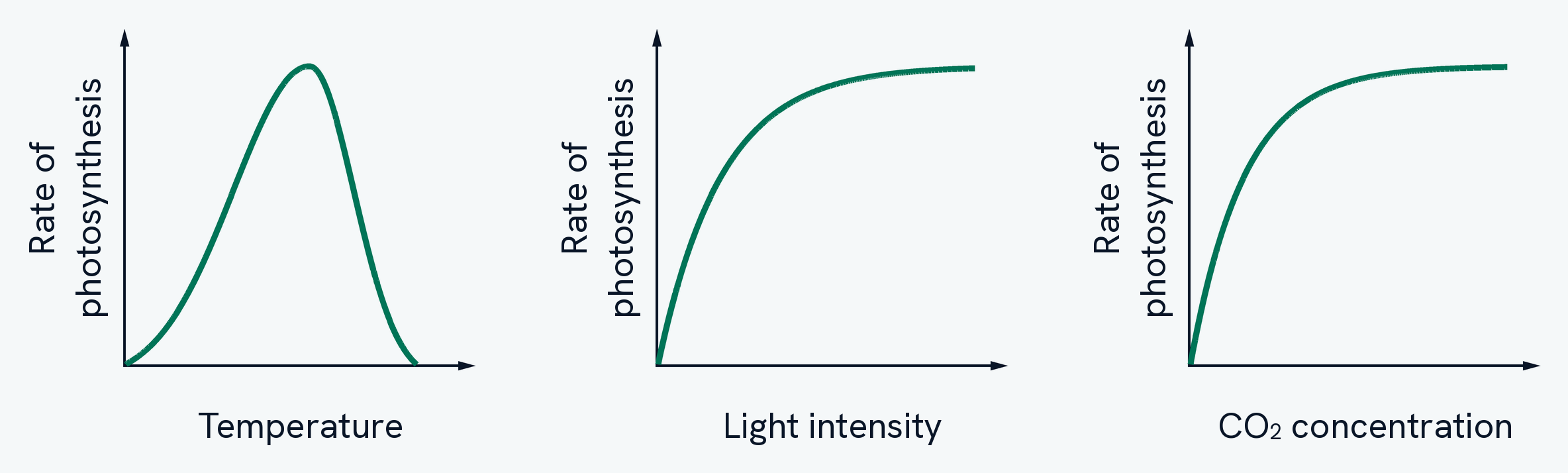
The two graphs on the right have the same shape for the same reason. While the line is rising, that factor is the one holding the rate back, so more of it gives a faster rate. Once the line is level, adding more makes no difference, because another factor has become limiting.
Temperature starts out looking the same and then does something different. The fall after the optimum is not another factor becoming limiting. It is the enzymes denaturing, so the plant photosynthesises more slowly however much light and carbon dioxide it is given. The curve comes all the way back down to the axis because once every enzyme is denatured the rate is zero, and cooling the plant down again will not undo it. That is the one place in this topic where more of a factor makes things worse, and saying "another factor is limiting" about the falling part of this graph loses the mark.
None of the three graphs carries a scale, which is deliberate. A question on a graph like this wants the shape and the reason, so name which factor is limiting in each part of the curve rather than trying to read values off it.
The inverse square law
(Higher tier only.) Light intensity depends on the square of the distance from the light source: light intensity is inversely proportional to distance squared.
light intensity ∝ 1 / distance²
So doubling the distance from a lamp reduces the light intensity to one quarter, and tripling the distance reduces it to one ninth.
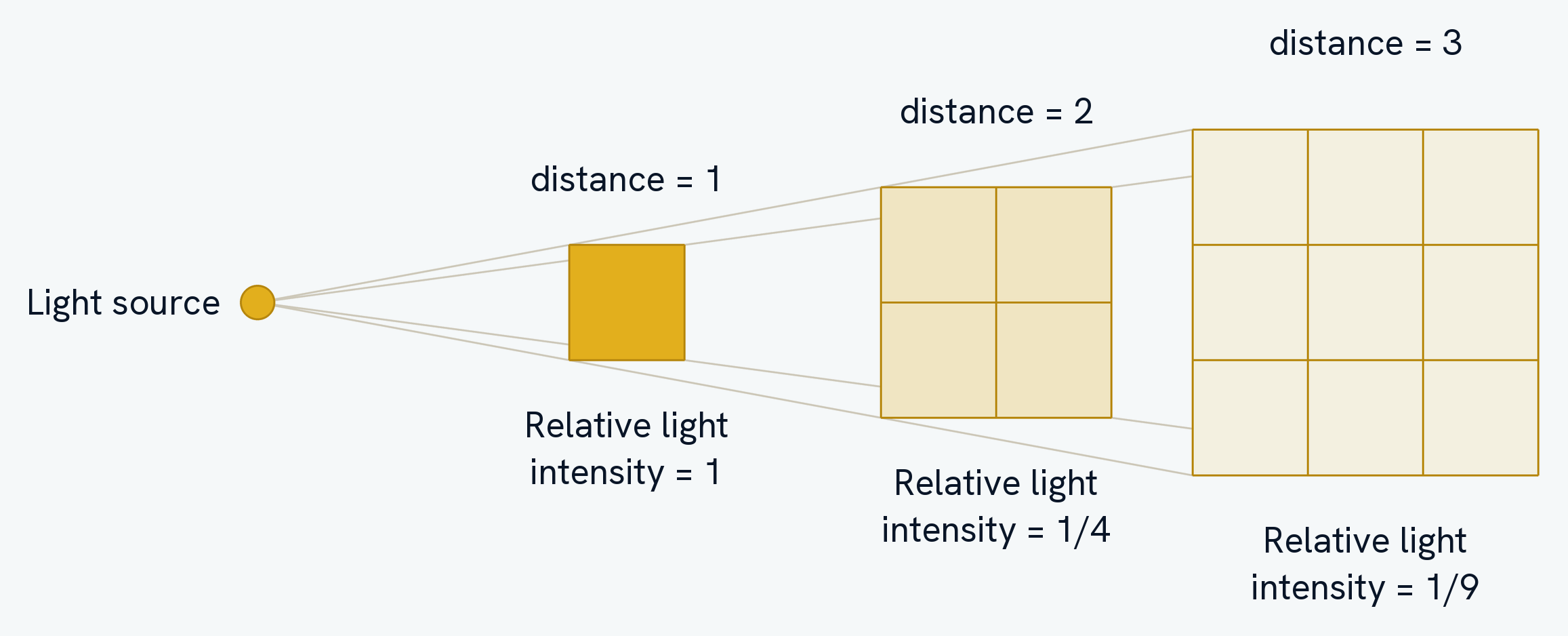
Count the cells rather than reading the fractions off. Every cell in that figure is the same size as the whole first square, so the light that lit one square at distance 1 has to light four of them at distance 2 and nine at distance 3. Each cell therefore gets a quarter, and then a ninth, of what the first one got. That is where the square in the law comes from: the light spreads out in two directions at once, not one.
The shading does the same arithmetic. The second block is drawn a quarter as strong as the first and the third a ninth, which is why the third is so pale it is nearly white. A lamp three times further away is doing very little for the plant.
This usually arrives in an exam attached to the required practical. If a lamp is moved from 10 cm to 20 cm, the light intensity falls to a quarter, not a half, so the count of bubbles from the pondweed falls by much more than most people expect.
Using limiting factors in farming
(Higher tier only.) Farmers can increase crop yields by removing limiting factors inside greenhouses, for example by adding extra lighting, heating, or enriching the air with carbon dioxide. However, providing these conditions costs money, so it is only worthwhile if the profit from the extra yield is greater than the cost of maintaining the conditions.
How this fits together
Photosynthesis stores energy in glucose. The opposite process, releasing that energy again, is respiration, which is the subject of the respiration guide.