AQA A-Level Biology: Gene Mutations
A clear revision guide to gene mutations for AQA A-Level Biology: substitution and deletion mutations, frameshifts, how they change proteins, and mutagenic agents.
A gene mutation is a change in the base sequence of DNA. Most arise spontaneously when DNA is copied, and while many have no effect at all, some change a protein enough to stop it working. This guide covers the two types you need, how they alter a protein, and what speeds them up.
What a gene mutation is
A gene mutation is a change in the sequence of bases in the DNA of a chromosome. Mutations happen spontaneously, most often as errors during DNA replication in interphase. The two types to know are substitution and deletion.
Their rate can be increased by a mutagenic agent (a mutagen), such as ultraviolet light or ionising radiation like alpha particles.
How a mutation can change a protein
The reason a change in DNA can matter is a chain of consequences. A change in the base triplets of a gene changes the codons on the mRNA, which changes the sequence of amino acids in the polypeptide (its primary structure). Because the amino acid sequence determines where the hydrogen, ionic and disulfide bonds form, the folding changes, and so the tertiary structure, the three-dimensional shape of the protein, changes too.
For an enzyme this is critical. If the shape of the active site changes, the substrate may no longer fit, no enzyme-substrate complex can form, and the enzyme cannot catalyse its reaction. The protein has become non-functional.
Substitution mutations
In a substitution, one base is swapped for a different one. Because the reading frame is not disturbed, only the single triplet containing that base is affected, so at most one codon, and therefore one amino acid, changes.
A substitution often has a small effect, or none at all, for three reasons:
- The code is degenerate, so the new triplet may still code for the same amino acid, leaving the protein unchanged.
- If one amino acid does change, it may sit somewhere that does not affect the folding, so the tertiary structure and function are unharmed.
- If the substitution falls within an intron, it is removed during splicing and never reaches the protein.
Deletion mutations
A deletion removes a base entirely, and this is usually far more damaging. Losing a base shifts every triplet from that point onwards along by one, a frameshift. Because all the codons after the mutation are now read differently, the amino acid sequence changes from that point on, not just at one position.
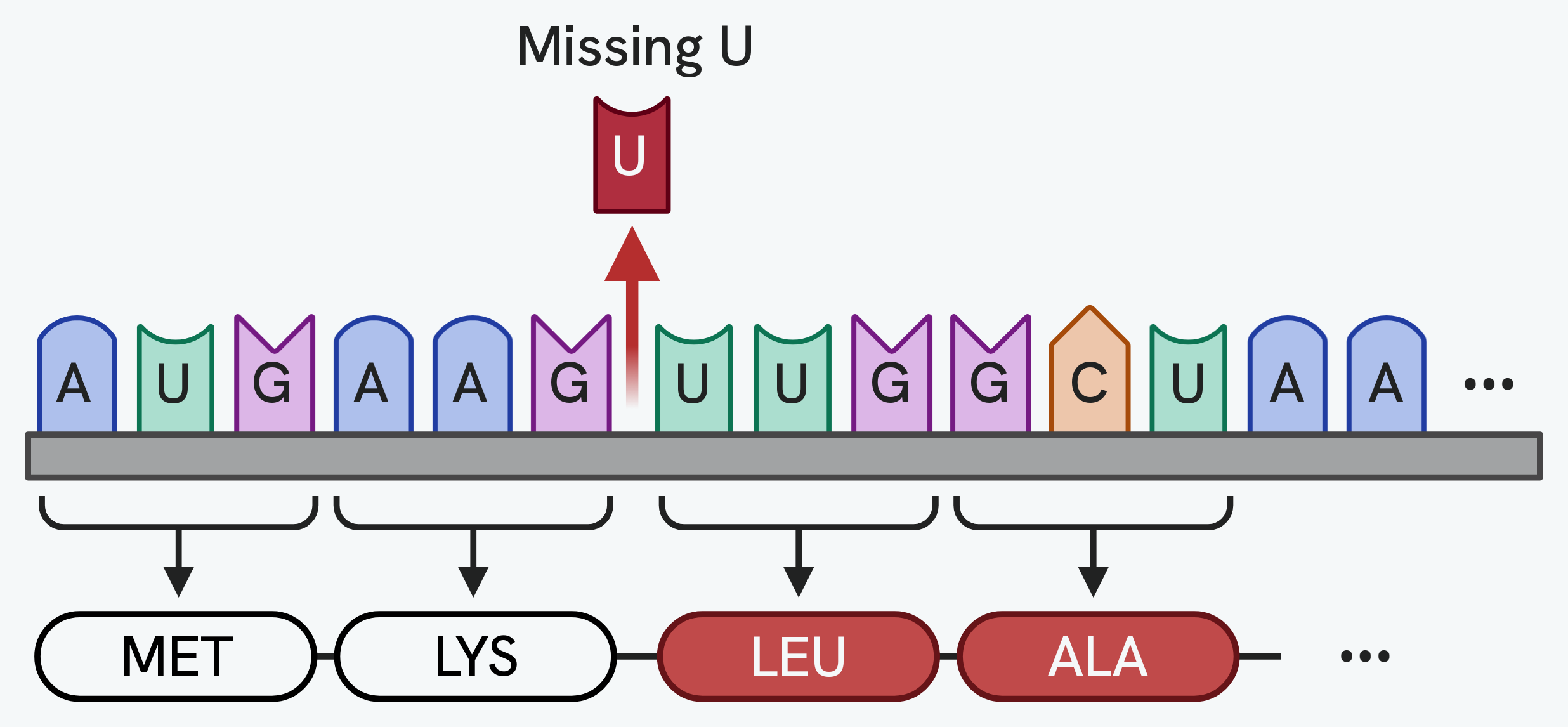
This usually changes the primary structure drastically, which changes the positions of the bonds that hold the protein together, changing its tertiary structure and almost always destroying its function.
The full set of mutation types
Substitution and deletion are the two named in the earlier part of the course, and they are the two that come up most. The A-level specification lists six types in total, and you should be able to recognise all of them.
| Type | What happens | Frameshift? |
|---|---|---|
| Substitution | One base is replaced by a different one | No |
| Deletion | A base is removed | Yes |
| Addition | An extra base is inserted | Yes |
| Duplication | A base or sequence is repeated | Yes |
| Inversion | A sequence is reversed in place | No |
| Translocation | A sequence moves to a different place, often another chromosome | No |
The column that matters is the last one. Deletion, addition and duplication change the number of bases, so every triplet after the mutation is read in the wrong place and the effect is severe. Substitution and inversion keep the number of bases the same, so the reading frame survives and the damage is limited to the region actually altered.
An analogy makes the frameshift idea concrete. DNA is read in blocks of three with no gaps, like the sentence THE BIG DOG ATE THE CAT. Change one letter and you get THE BIG COG ATE THE CAT, which is still mostly readable. Delete one letter instead and everything after it reshuffles: THE BIG OGA TET HEC AT. Nothing past the mutation means anything any more, and that is exactly what a frameshift does to a polypeptide.
Inversion is worth a second look because it keeps the base count but still does real damage. The sequence within the inverted region is reversed, so those triplets now code for a different set of amino acids, even though everything before and after reads normally.
Why mutations do not always matter
Pulling the three escape routes together, a mutation can occur and change nothing at all because:
- the genetic code is degenerate, so more than one triplet codes for the same amino acid and the substituted triplet may code for the same one;
- the mutation may fall in an intron, which is spliced out of the pre-mRNA and never translated;
- the amino acid that changes may lie away from the active site or from any bond that determines folding, so the tertiary structure is unaffected.
This is why most mutations are neutral. It is also why a question asking you to explain how a mutation could occur without altering the phenotype is really asking which of these three applies.
Mutagenic agents
The rate of mutation is increased by mutagenic agents, which act either by altering a base chemically or by interfering with replication. Examples worth quoting are ultraviolet light, ionising radiation such as alpha and beta particles and X-rays, and chemicals such as those in tobacco smoke.
Note the precise wording: a mutagen increases the rate at which mutations occur. It does not create a particular mutation to order, and mutations happen spontaneously whether or not a mutagen is present.
Mutations are not only a source of disease, though. By creating new alleles, they are the ultimate origin of all genetic variation, the raw material on which natural selection acts. That story continues in the meiosis and natural selection guides.