AQA A-Level Biology: Genes and the Genetic Code
A clear revision guide to genes and the genetic code for AQA A-Level Biology: the triplet code, its features, coding and non-coding DNA, and the genome, proteome and alleles.
DNA carries information as a code, and this guide explains how that code is organised. It covers what a gene is, how bases specify amino acids, why much of our DNA does not code for proteins at all, and the key terms genome, proteome and allele.
What a gene is
A gene is a sequence of DNA bases that codes for either the amino acid sequence of a polypeptide or a functional RNA (such as tRNA or ribosomal RNA). The fixed position a gene occupies on a DNA molecule is called its locus.
The triplet code
The order of bases in a gene determines the order of amino acids in a polypeptide, and it does so in groups of three. A sequence of three DNA bases, called a triplet, codes for one specific amino acid. In the mRNA copy, the equivalent group of three bases is called a codon.
The genetic code has four important features:
- It is a triplet code: three bases code for one amino acid.
- It is universal: the same triplet codes for the same amino acid in almost all organisms, which is powerful evidence that all life shares a common ancestor.
- It is non-overlapping: each base is part of only one triplet, so the code is read as a series of discrete units.
- It is degenerate: most amino acids can be coded for by more than one triplet, because there are 64 possible triplets but only 20 amino acids.
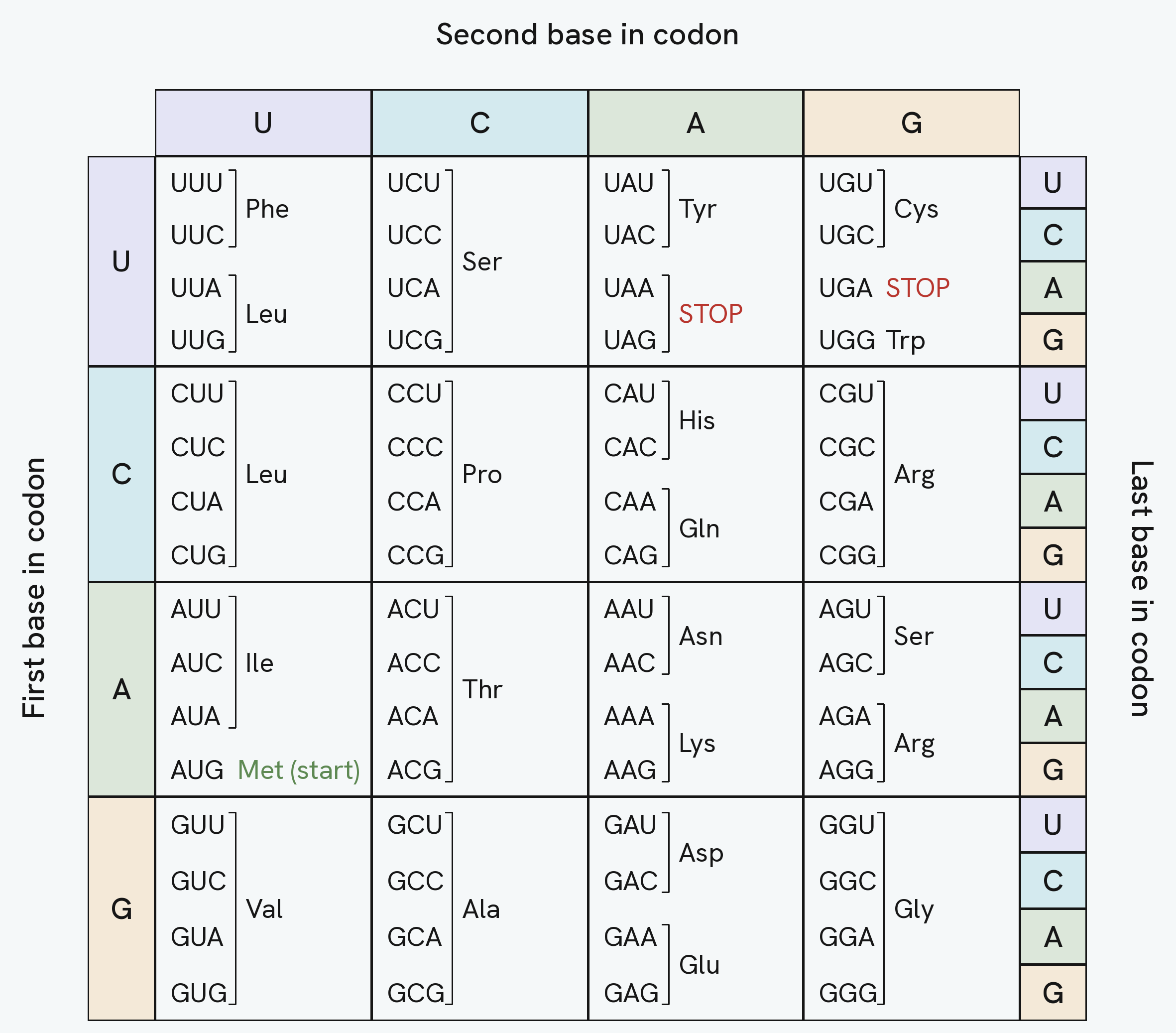
A genetic code table sets out all 64 codons. Read the first base of the codon down the left-hand side, the second base along the top, and the last base up the right-hand side, and the cell where they meet gives the amino acid. Notice how the degeneracy shows up: the four codons that share a first and second base very often code for the same amino acid, so it is usually the third base that can vary without changing the protein.
Coding and non-coding DNA
Not all of a gene, and not all of the DNA between genes, actually codes for amino acids. In eukaryotes, much of the nuclear DNA is non-coding.
Within a gene, the coding sections are called exons and the non-coding sections are called introns. Introns are found in eukaryotic genes but not prokaryotic ones. Between genes there are also long stretches of non-coding DNA, including multiple repeats, short base sequences repeated many times over. So the two main types of non-coding DNA in eukaryotes are introns, found within genes, and multiple repeats, found between them.
Genome, proteome and alleles
Three terms describe the bigger picture of a cell's genetic information.
The genome is the complete set of genes in a cell, including the genes in the mitochondria and chloroplasts.
The proteome is the full range of proteins that a cell can produce, coded for by its genome.
An allele is a different version of the same gene. Alleles sit at the same locus but have a slightly different base sequence, and they arise by mutation. Because the order of bases differs slightly between alleles, each allele codes for a slightly different version of the same polypeptide, which is the ultimate source of variation between individuals.
How the code in a gene is actually turned into a protein is the subject of the protein synthesis guide.