AQA A-Level Biology: Nutrient Cycles
A clear revision guide to nutrient cycles for AQA A-Level Biology: saprobionts, mycorrhizae, the nitrogen cycle, the phosphorus cycle, fertilisers and eutrophication.
Unlike energy, which flows through an ecosystem once and is lost, nutrients such as nitrogen and phosphorus are used again and again. This guide explains how decomposers return elements to the soil, how bacteria drive the nitrogen cycle, how phosphorus moves through an ecosystem, and why fertilisers are used and what can go wrong when they are. The theme throughout is recycling: the same atoms passing between the living and non-living parts of an ecosystem.
Saprobionts and decomposition
Saprobionts are decomposers, mainly fungi and bacteria, that recycle the elements locked up in dead organisms and waste.
- They decompose organic compounds such as proteins, urea and DNA in dead matter and waste.
- They do this by extracellular digestion: they secrete enzymes onto the material, which break it down outside their bodies. This way of feeding is called saprobiotic nutrition.
- They then absorb the soluble products they need, and release mineral ions, such as phosphate ions, back into the soil.
Without saprobionts, nutrients would stay trapped in dead material and could not be reused.
Mycorrhizae
Mycorrhizae are a symbiotic association between fungi and the roots of plants, and they help plants take up nutrients.
The fungal threads, or hyphae, act as an extension of the plant's root system, greatly increasing its surface area. This raises the rate at which the plant can absorb water and inorganic ions from the soil. In return, the fungi receive organic compounds, such as carbohydrates, from the plant. Both partners benefit, which is what makes the relationship symbiotic.
The nitrogen cycle
Nitrogen is needed for many important molecules, including amino acids and proteins, enzymes, DNA and RNA, ATP and ADP, NAD and NADP, and chlorophyll. Although the air is mostly nitrogen gas, plants cannot use it in that form, so a series of bacteria convert it between forms in the nitrogen cycle.
- Nitrogen fixation. Nitrogen-fixing bacteria convert nitrogen gas (N₂) into ammonia, which forms ammonium ions in the soil. Some of these bacteria live freely in the soil, and others live in the root nodules of plants such as legumes.
- Ammonification. Saprobionts break down nitrogen-containing compounds, such as proteins and urea, from dead organisms and waste, converting them into ammonium ions in the soil.
- Nitrification. In well-aerated soil, nitrifying bacteria oxidise ammonium ions into nitrites, and then nitrites into nitrates, in a two-step reaction. Nitrate is the form plants absorb most easily, taken up by the roots by active transport. Because these bacteria need oxygen, nitrification only happens well in aerobic conditions.
- Denitrification. In waterlogged, oxygen-poor soil, denitrifying bacteria convert nitrates back into nitrogen gas, which returns to the atmosphere. This reduces the nitrate available to plants.
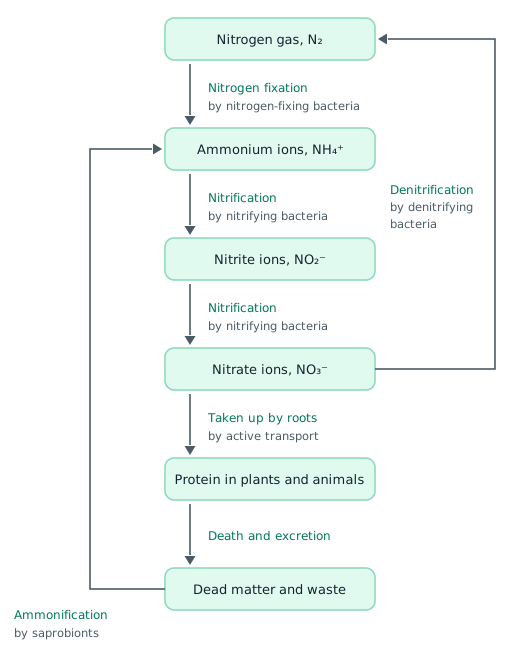
The names on the arrows are what this topic is examined on. Every arrow but two is a named group of bacteria, and a question will almost always be asking which group does which step, or what the soil has to be like for it to happen.
Two different arrows arrive at the ammonium ions, and that is worth noticing. One comes down from the air, by nitrogen fixation. The other comes round from dead matter, by ammonification. So the ammonium in a soil has two origins, and a question about where it came from needs you to say which route it took.
Follow the nitrification arrows and note there are two of them, not one: ammonium to nitrite, then nitrite to nitrate. Both are done by nitrifying bacteria, and both need oxygen, so they only go properly in well-aerated soil.
Denitrification is the only arrow pointing backwards. It takes nitrate, the form plants can actually use, and returns it to the air as nitrogen gas. It is carried out by denitrifying bacteria, which work in waterlogged, anaerobic soil. That single arrow is the reason farmers drain and plough their fields: it keeps the soil aerobic, which both favours nitrification and starves denitrification.
This explains why ploughing soil improves its fertility. Turning the soil lets in air, which favours the aerobic nitrifying bacteria, so more ammonium is turned into nitrate, and discourages the anaerobic denitrifying bacteria, so less nitrate is lost as nitrogen gas.
The phosphorus cycle
Phosphorus is found in phospholipids, DNA and RNA, ATP and ADP, NADP, and the intermediates of photosynthesis such as TP, GP and RuBP. Unlike nitrogen, it does not have a gaseous stage; it moves mainly through rocks, soil and living things.
- Phosphate ions in rocks are released into the soil and oceans by weathering and erosion.
- Producers, such as plants and algae, take up phosphate ions from the soil and build them into their biomass. Their rate of uptake is increased by mycorrhizae.
- Phosphate ions are then passed along the food chain as animals eat the producers.
- Some phosphate is lost from animals in their waste products through excretion.
- Saprobionts decompose the organic compounds in dead matter and waste, releasing phosphate ions back into the soil to be used again.
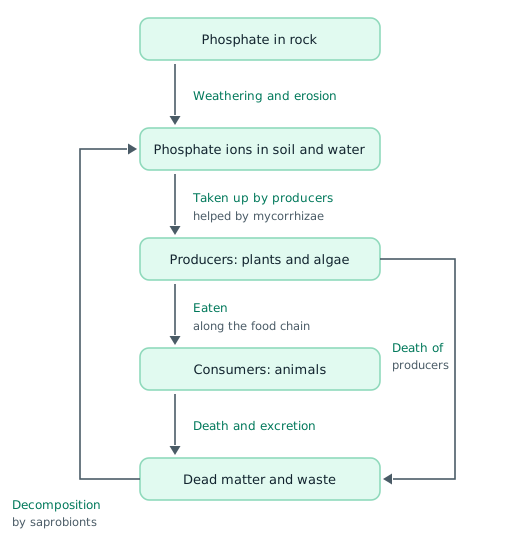
Put this figure beside the nitrogen one and the difference is the first thing you see: nothing leaves to the air. There is no gaseous stage and so no equivalent of denitrification. Phosphorus stays in rock, soil, water and living things, which is exactly the comparison a question will ask for.
The second difference is what happens along the arrows. In the nitrogen cycle, bacteria change nitrogen from one form into another at nearly every step. Here the phosphate ion is the same ion throughout; what changes is only whose body it is in. The only chemical work is saprobionts releasing it from the organic compounds in dead matter.
That leaves one arrow doing all the supply: weathering. It is slow, and nothing replaces it, which is why phosphate is so often the limiting nutrient in an ecosystem and why mycorrhizae matter so much. They do not make more phosphate; they increase the surface area for absorbing what little there is.
Fertilisers
When crops are harvested and livestock are removed, the nitrogen and phosphorus in them leave the field with them. Because that material is no longer there to be decomposed by saprobionts, those nutrients are not returned to the soil, and the soil gradually becomes less fertile. Fertilisers are used to replace them, so that a shortage of nutrients does not limit growth, improving the efficiency of energy transfer and raising the yield.
There are two kinds of fertiliser.
- Natural (organic) fertilisers, such as manure, compost and sewage, are made of organic matter. Their nutrients are released slowly as saprobionts decompose them.
- Artificial (inorganic) fertilisers contain inorganic compounds of nitrogen, phosphorus and potassium, in a form plants can take up directly.
Natural fertilisers have an advantage: because they are less soluble, less is washed away, and because their nutrients have to be broken down by saprobionts first, they are released slowly. Both of these make the problem of eutrophication less likely.
Eutrophication
The main environmental problem with fertilisers, especially soluble artificial ones, is leaching. When nitrates or phosphates dissolve in water, they can be washed out of the soil and into lakes, rivers and oceans, where they cause eutrophication:
- The extra nutrients cause a rapid growth of algae at the surface, an algal bloom, which blocks light from reaching the water below.
- Deprived of light, the submerged plants cannot photosynthesise and die.
- Saprobionts decompose the dead plant matter, and as their numbers grow they use up the oxygen in the water through aerobic respiration.
- With little oxygen left, fish and other aerobic organisms cannot respire and die.
How this fits together
Nutrient cycles are what keep an ecosystem running long term. The energy captured in photosynthesis and released in respiration flows through once and is gone, but the atoms it is carried on are recycled endlessly by decomposers and bacteria. Understanding how those nutrients move, and how farming and fertilisers disturb the cycles, ties this topic back to the energy and ecosystems guide.