AQA A-Level Biology: Photosynthesis
A clear revision guide to photosynthesis for AQA A-Level Biology: the structure of a chloroplast, the light-dependent reaction, photolysis, the Calvin cycle, and the factors that limit the rate.
Photosynthesis is how plants capture light energy and store it as chemical energy in glucose. This guide explains where the two stages happen inside a chloroplast, how light is used to make ATP and reduced NADP, and how those products are used to build organic molecules in the Calvin cycle. Once you can follow the flow of energy through the two stages, the limiting factors make sense on their own.
An overview of photosynthesis
Photosynthesis happens in two linked stages, and each takes place in a different part of the chloroplast.
- The light-dependent reaction happens on the thylakoid membranes. It uses light energy to make ATP and reduced NADP, and it splits water.
- The light-independent reaction, also called the Calvin cycle, happens in the stroma. It uses the ATP and reduced NADP from the first stage to fix carbon dioxide into organic molecules such as glucose.
The key link between them is that the light-independent reaction cannot run without the products of the light-dependent reaction, so anything that slows the first stage slows the second.
The structure of a chloroplast
A chloroplast's structure suits it perfectly to the two stages of photosynthesis.
- It is surrounded by a double membrane, the chloroplast envelope.
- Inside is the stroma, a fluid that contains the enzymes for the light-independent reaction, along with small (70S) ribosomes, circular DNA, and starch grains or lipid droplets that store the products.
- The stroma contains a system of flattened sacs called thylakoids. Stacks of thylakoids are called grana, and single thylakoids called lamellae connect one granum to the next.
- The thylakoid membranes hold the chlorophyll and the electron carriers for the light-dependent reaction, and their stacked arrangement gives a very large surface area for capturing light.
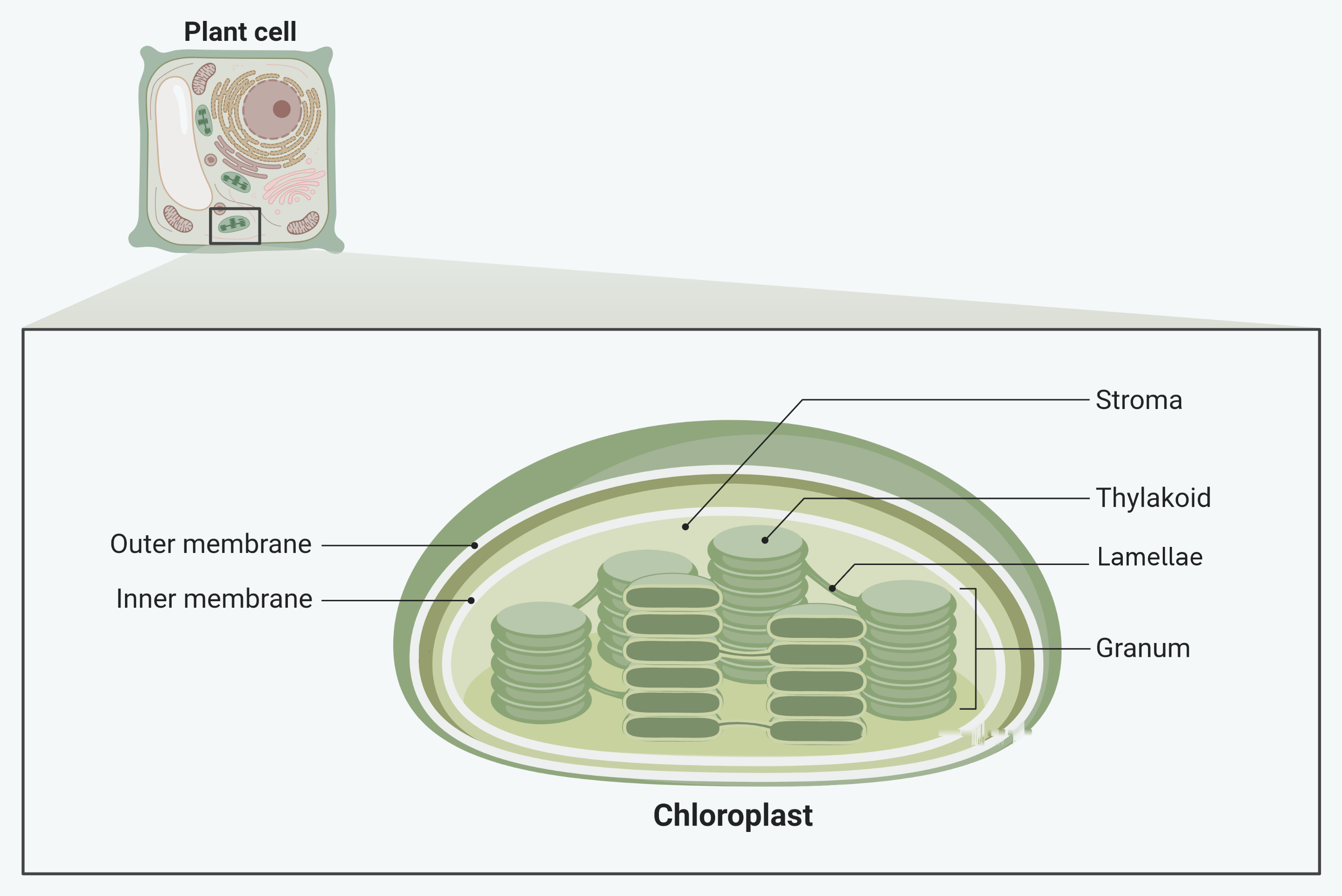
Count the membranes at the edge, because that is a mark on its own. There are two, an outer and an inner, and together they are the chloroplast envelope.
Then look at how the thylakoids are arranged. Stacking them into grana is what gives the chloroplast its enormous surface area for the light-dependent reaction, and the lamellae running between the stacks are what connect one granum to the next. Everything around them is stroma, which is where the Calvin cycle happens.
The light-dependent reaction
This stage traps light energy and converts it into the chemical energy of ATP and reduced NADP. It takes place on the thylakoid membranes.
Photoionisation of chlorophyll
When chlorophyll absorbs light energy, that energy excites its electrons to a higher energy level, so much so that the electrons are released from the chlorophyll altogether. This is photoionisation, and it leaves the chlorophyll positively charged.
Making ATP and reduced NADP
The excited electrons released from chlorophyll pass along a chain of electron carriers in the thylakoid membrane, the electron transfer chain. As they move from carrier to carrier they release energy, and this energy is used to build ATP by a mechanism called chemiosmosis.
- The energy released is used to actively pump protons (H⁺) from the stroma into the thylakoid space, building up a high concentration of protons inside the thylakoid.
- The protons then move back into the stroma down their electrochemical gradient by facilitated diffusion, through a channel enzyme called ATP synthase.
- As the protons pass through, the energy released is used to join ADP and inorganic phosphate into ATP. Because light drives the whole process, this is called photophosphorylation.
At the end of the chain, NADP accepts a proton and an electron to become reduced NADP, which carries them to the Calvin cycle.
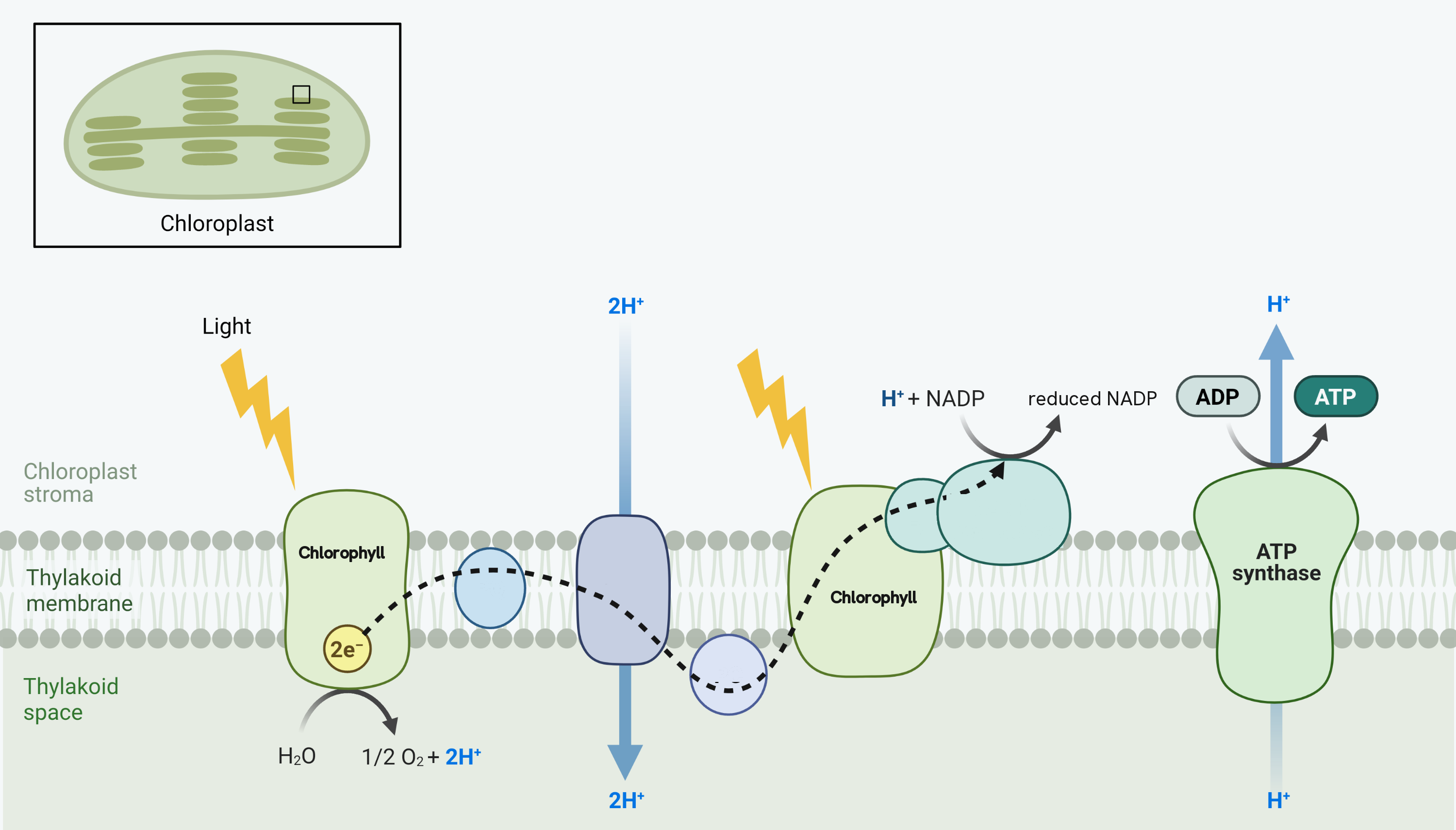
Follow the two things that move, because they move in opposite directions and questions turn on that. The electrons travel left to right along the chain of carriers. The protons are pushed down into the thylakoid space, build up there, and then flow back up through ATP synthase.
That build-up is the point of the whole picture. Protons collect on one side of the membrane and not the other, which is the proton gradient, and the only way back is through ATP synthase. That is chemiosmosis, and because light is what drives it, the ATP made this way is said to be made by photophosphorylation.
Photolysis of water
Chlorophyll cannot keep losing electrons forever, so they have to be replaced. This is done by splitting water, a reaction called photolysis:
- Water is split into protons, electrons and oxygen.
- The electrons replace those lost from chlorophyll during photoionisation.
- The protons are picked up by NADP, and the oxygen is released as a waste product or used in respiration.
The light-independent reaction (the Calvin cycle)
The Calvin cycle takes place in the stroma and uses the ATP and reduced NADP made in the light-dependent reaction to fix carbon dioxide into useful organic molecules.
- Carbon dioxide combines with a five-carbon molecule, ribulose bisphosphate (RuBP), in a reaction catalysed by the enzyme rubisco.
- This produces two molecules of a three-carbon compound, glycerate 3-phosphate (GP).
- GP is then reduced to triose phosphate (TP), using energy from ATP and hydrogen from reduced NADP, both supplied by the light-dependent reaction.
- Some of the TP is converted into useful organic substances such as glucose, and from there into other molecules the plant needs.
- The rest of the TP is used to regenerate RuBP, using more energy from ATP, so the cycle can continue.
Because the cycle constantly rebuilds its own starting molecule, only a small pool of RuBP is needed to fix a large amount of carbon over time.
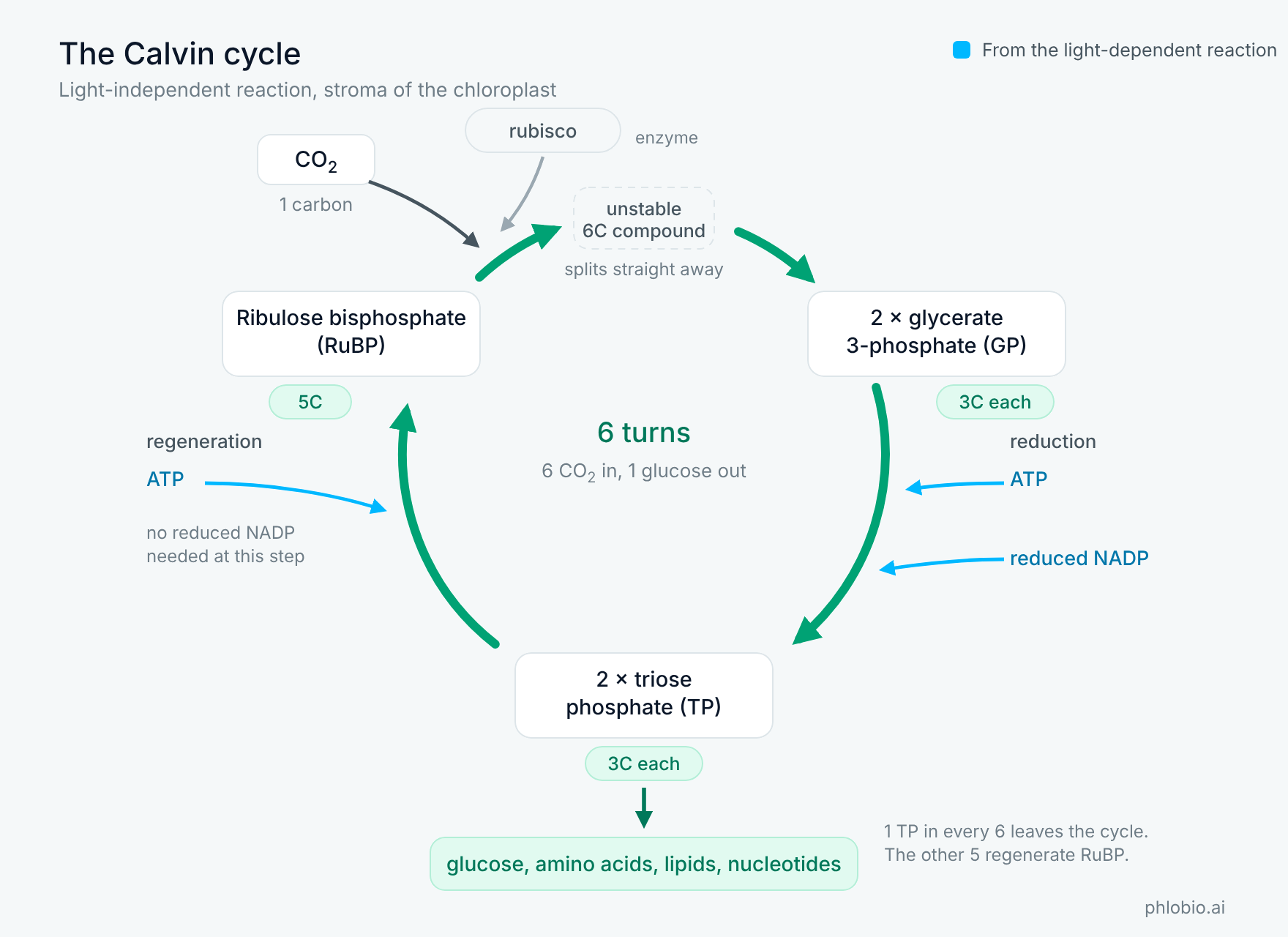
Read the two blue inputs on the right against the one on the left, because the difference is examined. Reduction of GP to TP needs both ATP and reduced NADP. Regeneration of RuBP needs ATP only. That is why a plant moved into darkness runs out of GP conversion first: the reduced NADP stops arriving, GP builds up, and TP and RuBP both fall.
The figure also answers the question students most often get wrong about yield. Six turns fix six carbon dioxide and make twelve triose phosphate, but only two of those leave to build one glucose. The other ten are spent rebuilding the RuBP, which is the one in six the note refers to. The cycle spends most of what it makes on staying able to run.
Factors that limit the rate of photosynthesis
The rate of photosynthesis depends on the conditions. At any moment one factor is usually holding the rate back, and that is the limiting factor: increasing it speeds photosynthesis up, while changing the others has no effect until they in turn become limiting.
| Factor | Effect as it increases | Why the rate eventually stops rising |
|---|---|---|
| Temperature | The rate rises as enzymes such as rubisco gain kinetic energy, so more enzyme-substrate complexes form | Above an optimum, enzymes denature as hydrogen bonds in their tertiary structure break, so the rate falls |
| Light intensity | The light-dependent reaction speeds up, making more ATP and reduced NADP, so the Calvin cycle can run faster | Above a certain intensity another factor, such as temperature or carbon dioxide, becomes limiting |
| Carbon dioxide concentration | More carbon dioxide combines with RuBP to form GP, so more TP is made and more RuBP regenerated | Above a certain concentration another factor becomes limiting |
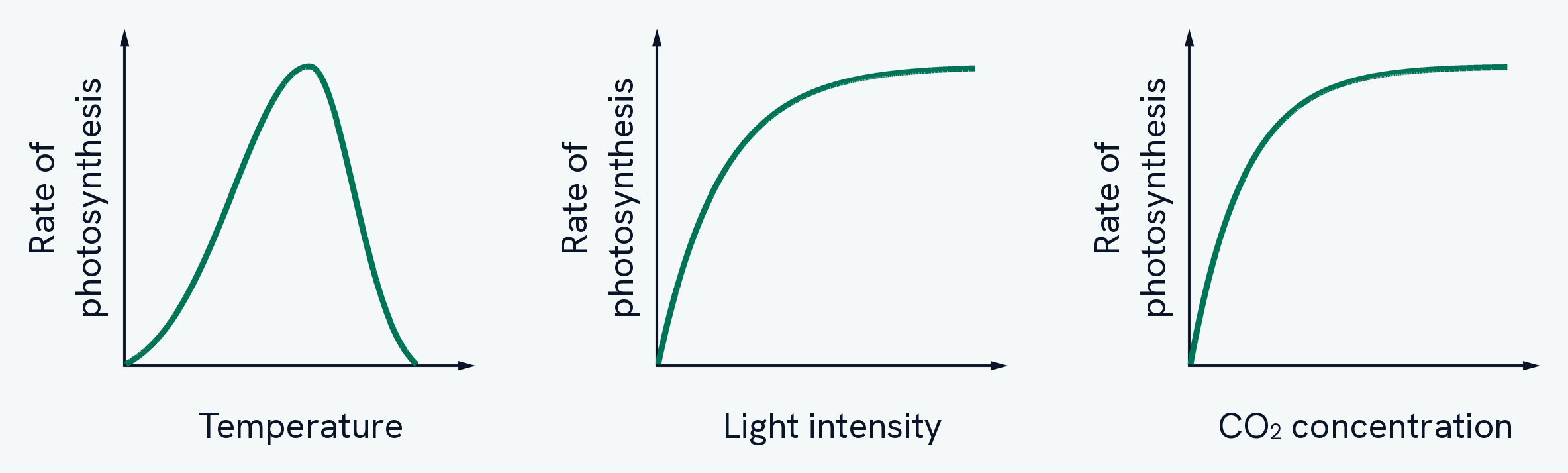
All three curves rise for the same reason and stop rising for the same reason, and only one of them comes back down.
While a line is rising, the plotted factor is the limiting one, so supplying more of it speeds the rate up. Once a line is level, something else has become limiting and adding more of the plotted factor changes nothing. On the light intensity graph the plateau is usually set by temperature or carbon dioxide; on the carbon dioxide graph, by light or temperature.
Temperature is the exception, and the difference is worth being precise about. The fall after the optimum is not another factor becoming limiting. It is rubisco and the other enzymes denaturing as hydrogen bonds in their tertiary structure break, so the active site changes shape and fewer enzyme-substrate complexes form. That is why the curve returns to the axis instead of levelling off, and why cooling the plant again does not restore the rate. Writing "another factor is limiting" about the falling part of this graph loses the mark.
At A-Level you are also expected to say which stage a factor acts on. Light intensity limits the light-dependent reaction, so less ATP and reduced NADP reach the stroma and the Calvin cycle slows for want of them. Carbon dioxide limits the Calvin cycle directly, because less carbon dioxide combines with RuBP and less GP is formed. Temperature acts on the enzymes of both. Naming the stage, not just the factor, is usually where the second mark is.
Understanding limiting factors also explains agricultural decisions. A grower can raise the rate of photosynthesis, and so the yield of a crop, by increasing whichever factor is limiting, for example adding carbon dioxide or lighting a glasshouse. The judgement is an economic one: the extra income from the greater yield has to be worth more than the cost, in money and in environmental impact, of providing the extra conditions.
Investigating photosynthesis
Two features of the light-dependent reaction are useful to understand because they explain how photosynthesis can be studied.
The pigments in a leaf are not a single substance but a mixture, and they can be separated by chromatography because each pigment travels a different distance through a solvent. Each pigment can then be identified from its Rf value, the distance it has moved divided by the distance the solvent has moved.
The light-dependent reaction can also be followed using a redox indicator dye such as DCPIP. The enzyme dehydrogenase in the chloroplast catalyses the reduction of NADP, and DCPIP acts as an artificial electron acceptor in its place. As electrons from the light-dependent reaction reduce the dye, it changes from blue to colourless, so the speed of the colour change reflects how fast the light-dependent reaction is running.
How this fits together
Photosynthesis is a story of energy being captured, stored and moved. Light energy becomes the chemical energy of ATP and reduced NADP on the thylakoid, and that energy is then spent in the stroma to lock carbon dioxide into organic molecules. The glucose made here is the starting point for almost every other molecule in the plant, and the fuel for respiration.