AQA A-Level Biology: Respiration
A clear revision guide to respiration for AQA A-Level Biology: the structure of a mitochondrion, glycolysis, the link reaction, the Krebs cycle, oxidative phosphorylation, and anaerobic respiration.
Respiration is how cells release the energy stored in glucose and other substrates and transfer it to ATP, the molecule cells use to power their work. This guide follows glucose through the four stages of aerobic respiration, explains where each stage happens and what it produces, and shows what changes when oxygen is not available. Keeping track of where ATP and the reduced coenzymes are made is the key to the whole topic.
Why cells respire
Respiration matters because it produces ATP. Cells cannot use the energy in glucose directly, so they transfer it in small, manageable amounts to ATP, which then releases energy exactly where and when it is needed, for processes such as active transport, protein synthesis, muscle contraction and cell division.
The structure of a mitochondrion
Most of respiration happens inside the mitochondrion, whose structure suits its role.
- It has an outer membrane that separates it from the cytoplasm.
- The inner membrane is folded into cristae, which give a large surface area for the electron transfer chain of oxidative phosphorylation.
- The matrix, the fluid inside, contains the enzymes for the link reaction and the Krebs cycle, along with small (70S) ribosomes and circular DNA.
An overview of respiration
Aerobic respiration has four stages, and it helps to know where each one happens before looking at the detail.
| Stage | Where it happens |
|---|---|
| Glycolysis | Cytoplasm |
| Link reaction | Mitochondrial matrix |
| Krebs cycle | Mitochondrial matrix |
| Oxidative phosphorylation | Inner mitochondrial membrane |
Glycolysis does not need oxygen and happens in every stage of respiration. When oxygen is available, the pathway continues into the mitochondrion through the link reaction, the Krebs cycle and oxidative phosphorylation. When oxygen is absent, only glycolysis runs, followed by a reaction in the cytoplasm that regenerates NAD.
Glycolysis
Glycolysis splits one molecule of glucose into two molecules of pyruvate, in the cytoplasm.
- Glucose is first phosphorylated to glucose phosphate, using inorganic phosphate from two molecules of ATP. This investment makes the glucose reactive enough to break down.
- The glucose phosphate is then hydrolysed into two molecules of triose phosphate.
- Each triose phosphate is oxidised to pyruvate. In doing so, two molecules of NAD are reduced, and four molecules of ATP are regenerated.
Because two ATP were used at the start and four were made, glycolysis gives a net gain of two ATP, plus two reduced NAD, per molecule of glucose.
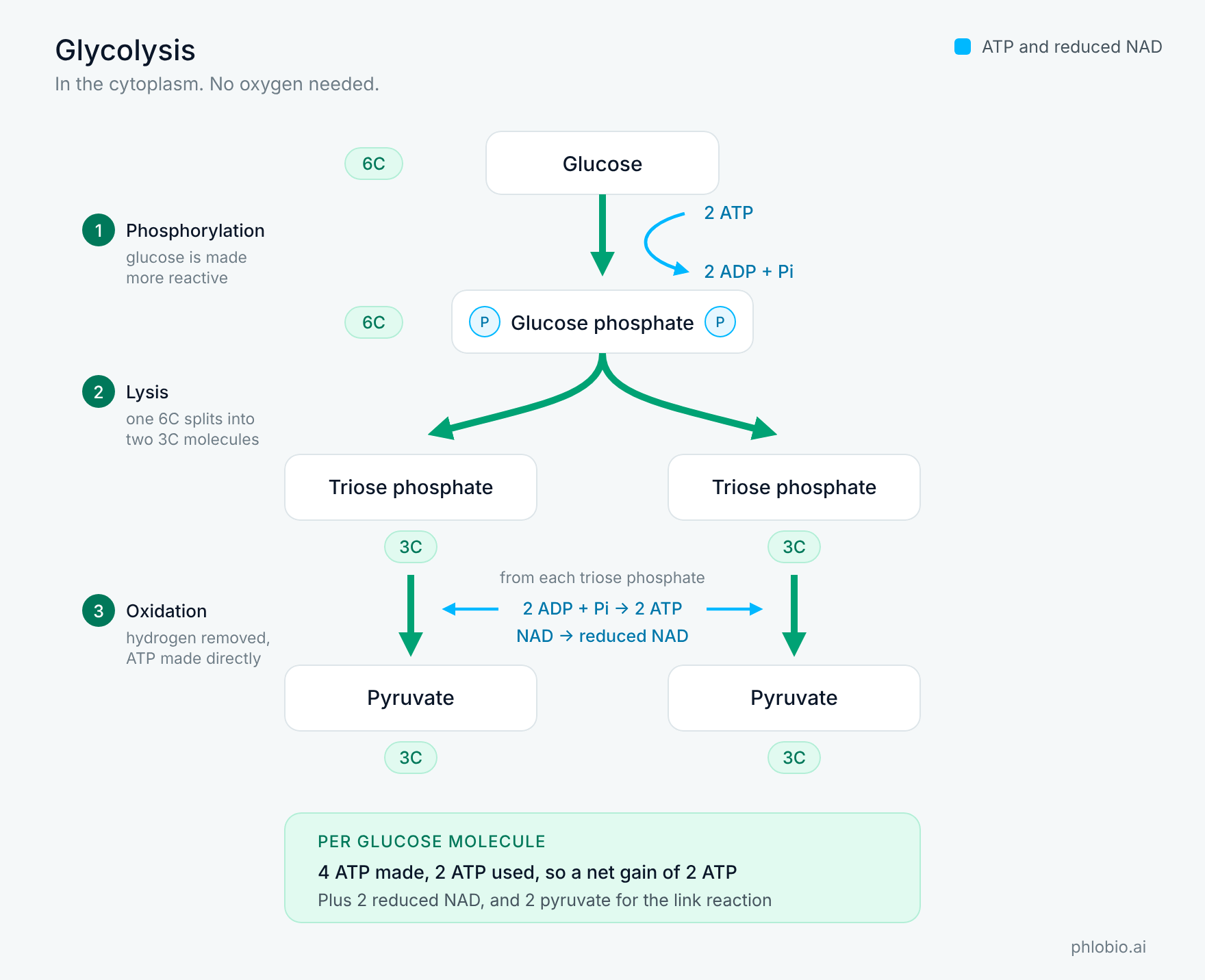
Count the ATP on the figure in both directions, because the net gain is the mark. Two ATP go in at the top, and the arrows that matter are the ones leaving each of the two triose phosphates lower down, which is why the four made are four rather than two. Lose track of the fact that everything below the split happens twice and the arithmetic stops working.
Notice also where the reduced NAD is made. It comes from the oxidation step, not from the phosphorylation, and this is the only stage of respiration that makes ATP without any oxygen anywhere in the cell.
The link reaction
If oxygen is present, pyruvate is actively transported into the mitochondrial matrix, where the link reaction prepares it for the Krebs cycle.
- Pyruvate is oxidised and decarboxylated to a two-carbon molecule called acetate. This releases a molecule of carbon dioxide and produces reduced NAD.
- The acetate combines with a molecule called coenzyme A to form acetyl coenzyme A, which carries it into the Krebs cycle.
Because glycolysis makes two pyruvate molecules per glucose, the link reaction runs twice. Per glucose it produces two acetyl coenzyme A, two carbon dioxide and two reduced NAD.
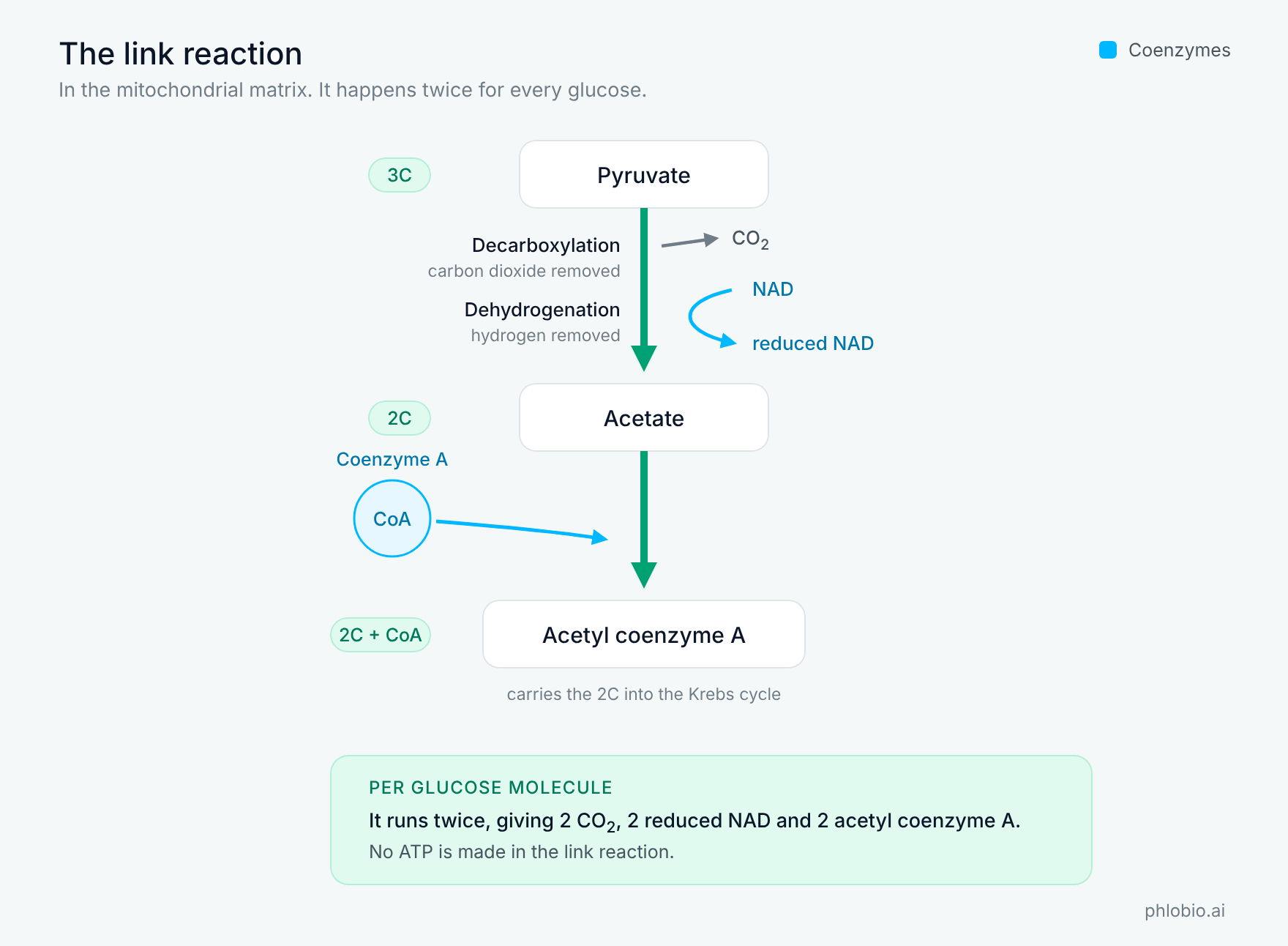
Two different things are being removed from the pyruvate, and the figure separates them because the mark scheme does. Decarboxylation takes away a carbon, which leaves as carbon dioxide and is why three carbons become two. Dehydrogenation takes away hydrogen, which goes to NAD. Answers that say pyruvate is "broken down" without naming either are describing the result rather than the reaction.
The other thing worth reading off it is the line at the bottom: no ATP is made here. The link reaction is a preparation step, and its value to the cell is the reduced NAD and the acetyl coenzyme A it hands on, not energy released at the time.
The Krebs cycle
The Krebs cycle is a series of oxidation and reduction reactions in the matrix that release the remaining energy from acetate and load it onto coenzymes.
- Acetyl coenzyme A (2 carbons) reacts with a four-carbon molecule, releasing coenzyme A and forming a six-carbon molecule.
- Through the cycle, this six-carbon molecule is gradually broken back down, regenerating the original four-carbon molecule so the cycle can continue. Along the way, carbon dioxide is released, the coenzymes NAD and FAD are reduced, and a small amount of ATP is made directly by substrate-level phosphorylation.
Per molecule of glucose, the two turns of the Krebs cycle produce six reduced NAD, two reduced FAD, two ATP and four carbon dioxide. The reduced coenzymes are the important products, because they carry hydrogen to the final stage.
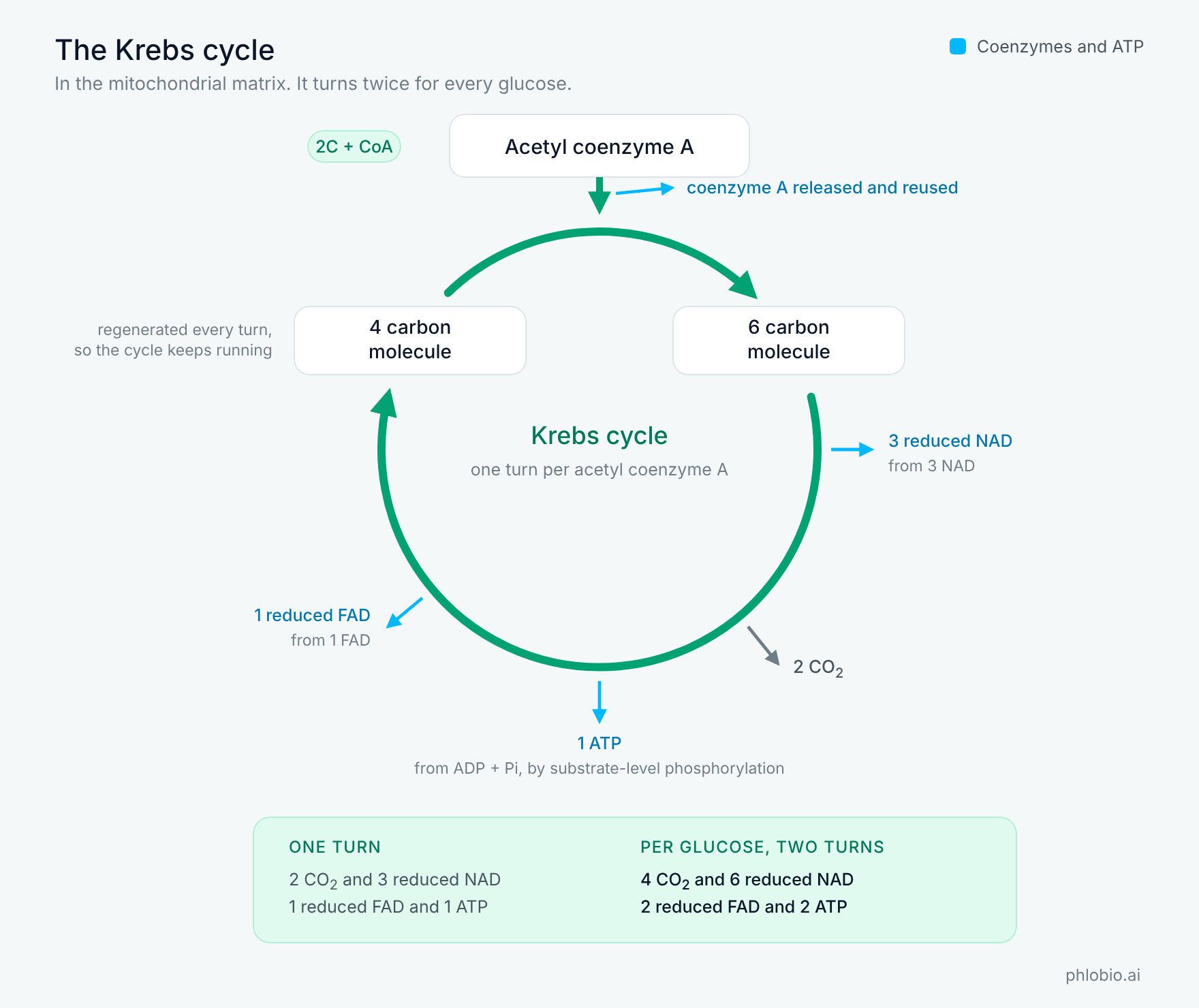
Everything on the circle is one turn, and the panel underneath doubles it. That is the distinction to keep hold of, because a question will specify which it wants and the two sets of numbers are both correct for different questions.
The four-carbon molecule being regenerated is what makes this a cycle rather than a pathway. It is not used up, so one molecule of it can accept acetyl group after acetyl group indefinitely, which is why a cell does not need to keep making more of it.
Two of the four products are worth more than the others, and the figure deliberately makes them look modest. Only one ATP per turn is made here directly. The reduced NAD and reduced FAD are where almost all the energy goes, and they are about to be cashed in at the next stage.
Oxidative phosphorylation
Oxidative phosphorylation, on the inner mitochondrial membrane, is where most of the ATP is made. It works by the same chemiosmotic mechanism as the light-dependent reaction of photosynthesis.
- The reduced NAD and reduced FAD made in the earlier stages are oxidised, releasing the hydrogen atoms they carried, which split into protons and electrons.
- The electrons are passed along the electron transfer chain, a series of carriers at decreasing energy levels, releasing energy at each step.
- This energy is used to actively pump protons from the matrix into the intermembrane space, building up an electrochemical gradient.
- The protons flow back into the matrix through ATP synthase, and the energy released is used to join ADP and inorganic phosphate into ATP.
- At the end of the chain, oxygen acts as the final electron acceptor. It combines with the protons and electrons to form water. Without oxygen to accept the electrons, the whole chain would back up and stop.
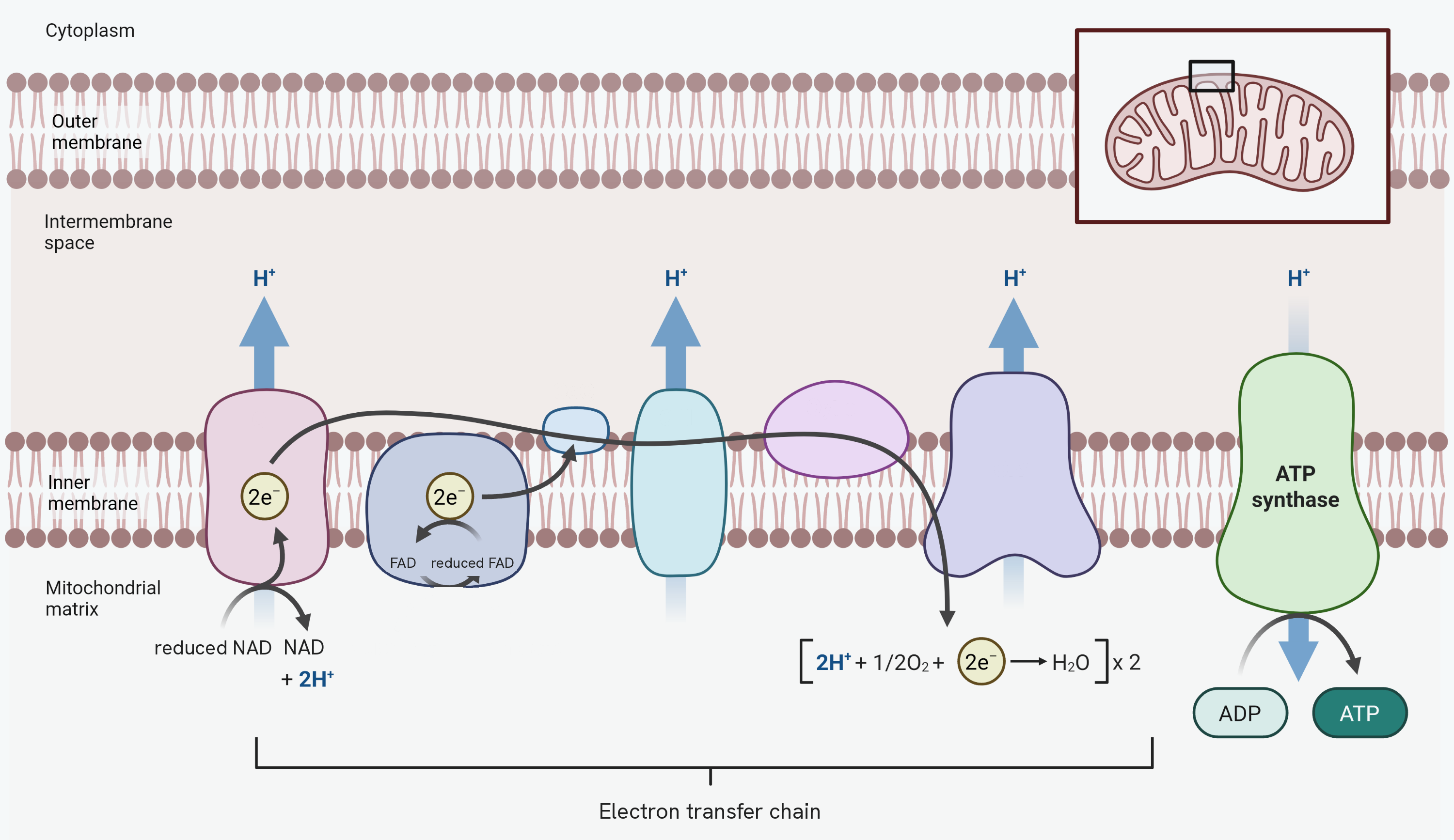
Two things move, in opposite directions, and keeping them apart is most of this topic. The electrons travel left to right along the chain. The protons are pumped up into the intermembrane space, collect there, and come back down through ATP synthase.
Look at where the protons go up, and notice it happens at three points along the chain. Nothing there makes ATP directly. The carriers only build the gradient, and the ATP is made in one place, at ATP synthase, by the protons coming back.
The last step on the right of the chain is the one students leave out. Oxygen takes the electrons and the protons and becomes water. If it is not there to accept them, nothing further along can pass its electrons on, the chain backs up, and the pumping stops.
Anaerobic respiration
When there is no oxygen, the electron transfer chain cannot run, so the link reaction, Krebs cycle and oxidative phosphorylation all stop. Only glycolysis can continue, but glycolysis needs a supply of NAD, and without the later stages there is nothing to reoxidise the reduced NAD.
The cell solves this with an extra reaction in the cytoplasm. Pyruvate is converted into lactate (in animals and some bacteria) or into ethanol (in plants and yeast). This reaction oxidises reduced NAD back to NAD, so glycolysis can keep running and keep making its small amount of ATP.
This is why anaerobic respiration yields far less ATP than aerobic respiration. Only glycolysis is involved, giving a net gain of just two ATP per glucose, whereas oxidative phosphorylation, which is lost without oxygen, normally provides the great majority of a cell's ATP.
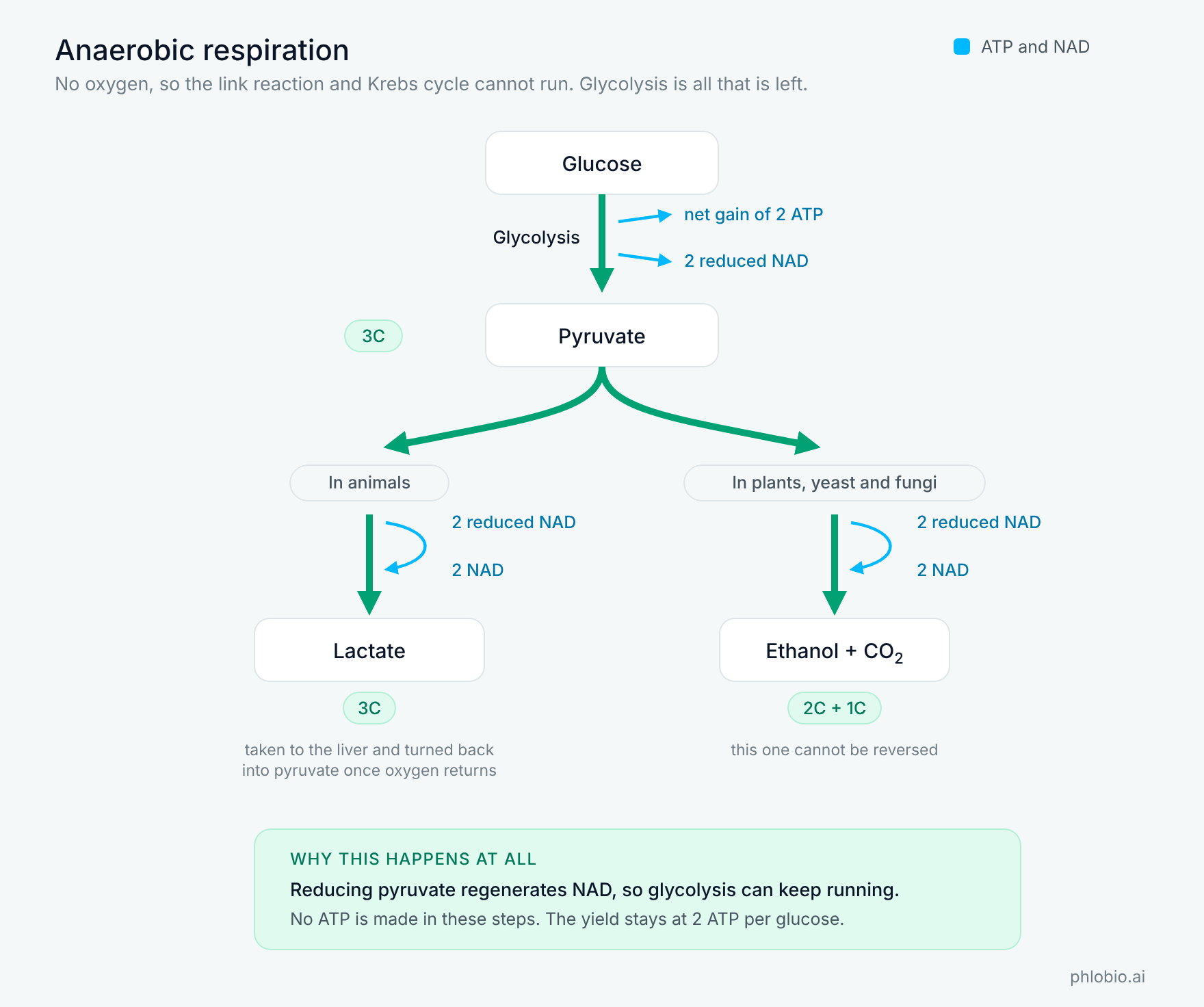
Follow the NAD arrows rather than the molecules, because they are the reason either branch exists. Both sides do the same job: reduced NAD is oxidised back to NAD, and that returned NAD goes straight back into glycolysis. Without it, glycolysis would stop within seconds and the cell would make no ATP at all.
So the lactate and the ethanol are not useful products. They are what the cell is willing to throw away in order to get its NAD back, which is why the panel states that no ATP is made in either branch. The yield is the two ATP from glycolysis and nothing more.
The one asymmetry worth noting is at the bottom of each branch. Lactate can be converted back to pyruvate in the liver when oxygen returns, so none of its energy is lost permanently. Ethanol cannot, so a plant or yeast cell that respires anaerobically has written off everything still held in that molecule.
Other respiratory substrates
Glucose is not the only fuel. When it runs short, other molecules can be broken down and fed into respiration.
- Fatty acids from the hydrolysis of lipids are converted into acetyl coenzyme A and enter at the Krebs cycle.
- Amino acids from the hydrolysis of proteins are converted into intermediates that also enter the Krebs cycle.
Because lipids carry a large amount of energy for their mass, they release a great deal of ATP when respired.
Measuring respiration
The rate of respiration can be followed by measuring gas exchange. A respirometer measures the volume of oxygen taken up during aerobic respiration, or the carbon dioxide released, and the change in gas volume over time gives the rate.
Respiration can also be studied using a redox indicator such as methylene blue, which changes colour when it is reduced. The dye takes up hydrogen and is reduced in place of NAD or FAD, so the time taken for it to lose its colour reflects how fast respiration is happening.
How this fits together
Respiration is the mirror image of photosynthesis: where photosynthesis stores energy in glucose, respiration releases it again into ATP. The same ideas keep returning, an electron transfer chain, chemiosmosis and ATP synthase, so once you understand oxidative phosphorylation you already understand the equivalent stage in photosynthesis. The energy transferred here is what powers every living process, and its flow through whole ecosystems is the subject of the energy and ecosystems guide.