AQA A-Level Biology: Populations in Ecosystems
A clear revision guide to populations in ecosystems for AQA A-Level Biology: communities, niches, carrying capacity, interspecific and intraspecific competition, predator-prey cycles, and estimating population size.
An ecosystem is a web of populations interacting with each other and with their non-living surroundings. This guide sets out the key terms, explains what limits the size a population can reach, and shows how competition and predation make populations rise and fall. It ends with how ecologists actually measure population size in the field. The central idea is that population size is a balance between the resources available and the pressures acting against growth.
The key terms
Ecology has a nested set of terms, each building on the last.
- A population is all the individuals of one species in a habitat at one time.
- A community is all the populations of different species living in the same place at the same time.
- An ecosystem is a community together with the abiotic (non-living) components of its environment. Ecosystems range from tiny to vast and are dynamic, with populations rising and falling over time.
- A niche is the specific role of a species in its habitat: what it eats, and where and when it feeds. It is governed by the species' adaptations to both abiotic and biotic conditions.
Two species cannot occupy exactly the same niche in the same habitat. If they tried, one would always be slightly better adapted and would outcompete the other. Occupying different niches reduces competition and lets more species coexist.
Carrying capacity
The carrying capacity is the maximum stable population size of a species that an ecosystem can support. It is set by several factors:
- Abiotic factors, such as light intensity, temperature, soil pH, mineral content and humidity.
- Competition, both between different species (interspecific) and within a species (intraspecific).
- Predation.
When abiotic conditions are favourable, more organisms survive and reproduce, so the carrying capacity is higher. For example, more light raises the rate of photosynthesis, and more nitrate and phosphate support more protein and phospholipid production, so more plants can grow. A greater variety of plants creates more habitats, niches and food sources, which in turn raises the carrying capacity for animals.
Competition
Competition happens whenever a resource is in short supply, and it comes in two forms.
Interspecific competition is between different species for the same resource. It reduces the amount of that resource available to both, limiting the survival and reproduction of each, so both populations are smaller than they would be alone. If one species is better adapted, it outcompetes the other, whose population then declines and may even become locally extinct.
Intraspecific competition is between members of the same species, and it tends to keep a population around its carrying capacity through a self-correcting cycle.
- As the population grows, there is less resource per individual, so competition rises, fewer survive and reproduce, and the population falls.
- As the population falls, there is more resource per individual, so competition eases, more survive and reproduce, and the population rises again.
Predator-prey cycles
The numbers of a predator and its prey rise and fall in linked cycles, with the predator population peaking after the prey because it takes time for predator numbers to respond.
- The prey population increases, so predators have more food.
- More predators survive and reproduce, so the predator population increases.
- More predators kill more prey, so the prey population decreases.
- With less food, fewer predators survive, so the predator population decreases.
- With fewer predators, more prey survive, so the prey population increases again, and the cycle repeats.
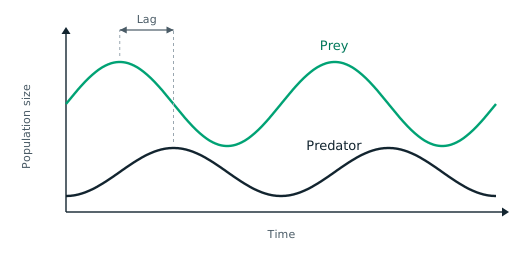
The lag marked at the top of the graph is the detail questions are built on. Each predator peak comes after the prey peak before it, because the predators have to eat and reproduce before their numbers can rise, and that takes time. Reading a peak off the predator curve and saying which prey peak caused it is a common exam task.
Notice too that the predator curve sits below the prey curve throughout. There are always fewer predators than prey, because energy is lost at each transfer along the food chain, so a given mass of prey can only support a smaller mass of predators.
In reality these cycles are also affected by other factors, such as disease and the availability of food for the prey, so the pattern is rarely as clean as the basic model.
Estimating population size
Ecologists estimate population sizes rather than counting every individual, using a method suited to whether the organism moves.
For slow-moving or non-motile organisms, such as plants, a quadrat is used: a frame of known area is placed in the habitat and the organisms inside it are counted. Placing quadrats at random positions, generated by random coordinates, avoids bias, and taking a large number of samples makes the estimate more representative. The population is then scaled up from the mean number per quadrat to the whole area. Where individuals are too small or numerous to count, percentage cover is estimated instead of frequency. Where there is an environmental gradient, quadrats are placed at regular intervals along a transect line to see how the community changes along it.
For motile organisms, the mark-release-recapture method is used. A sample is captured, marked in a way that does not harm them or affect their survival, and released. After time for the marked individuals to mix back into the population, a second sample is taken, and the proportion of it that is marked is used to estimate the total population size. The method assumes that marked individuals mix evenly, that the mark does not come off or affect survival, and that the population does not change much through births, deaths or migration between the two samples. Over very large areas the method is unreliable, because the organisms are unlikely to mix evenly and the chance of recapturing marked individuals is low.
How this fits together
Population size is always a balance: resources and favourable abiotic conditions push it up, while competition and predation pull it back towards the carrying capacity. Communities are not fixed, though. Over longer timescales they change in a directional way, as one community replaces another, which is the subject of the succession and conservation guide.