AQA A-Level Biology: Succession and Conservation
A clear revision guide to succession for AQA A-Level Biology: primary succession, pioneer species, the climax community, plagioclimax, and the conflict between conservation and human needs.
Over time, the community living in a place changes in a predictable, directional way, until it reaches a stable end point. This guide explains how that process, succession, works, from the first pioneer species to the final climax community, and then how conservation often means deliberately halting succession to preserve a habitat. The key idea is that each community changes its own environment, making way for the one that follows.
What succession is
Succession is the change in a community over time, caused by changes in the abiotic factors and the species present. Primary succession begins on newly exposed land with no soil, such as bare rock, and proceeds in stages.
- The first species to arrive are the pioneer species, which are adapted to harsh, bare conditions.
- Pioneer species, and the species at each later stage, change the abiotic conditions. When they die and decompose, they form a layer of humus (organic matter), which begins to build soil that can retain water and nutrients.
- This makes the environment less hostile and suitable for new species with different adaptations. At the same time it becomes less suitable for the previous species, which are then outcompeted by the better-adapted newcomers.
- With each stage, more species can live there, so biodiversity increases.
- Eventually a climax community is reached: a final, stable community that does not undergo further succession.
Each stage, then, makes conditions worse for itself and better for the next, which is what drives the community forward.
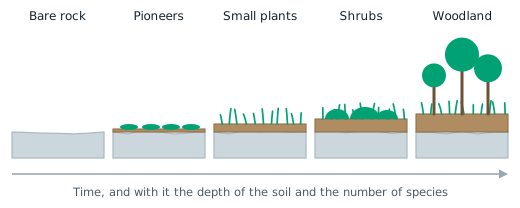
The band of soil is the thing to watch, because it is what drives everything else. It is absent on bare rock and thickest under the woodland, and each stage thickens it a little further, by dying and decomposing to add humus. Nothing in the figure happens to the rock; the change is entirely in what has accumulated on top of it.
That is why the plants get taller from left to right. Lichens can live on bare rock because they need almost no soil. Trees cannot, because they need enough depth to anchor roots and hold water. So each stage makes the conditions suitable for the one after it, and a question asking why trees appear last is really asking about soil depth.
The same band explains the stage each community then loses. As the soil deepens, conditions stop suiting the species that built it, and they are outcompeted by the larger plants that arrive. A pioneer species is not killed off by the weather but by the shade and the competition that its own remains made possible.
Finally, count the kinds of plant across the figure: one, then a few, then many. Biodiversity increases at each stage, and stops rising at the climax community, which is where succession ends because no further change in the abiotic conditions is being driven.
The climax community
A climax community is the stable end point of succession. It is recognised by three features:
- the same species are present, and the community stays stable, over a long time;
- the abiotic factors stay fairly constant;
- the populations are fairly stable, staying around their carrying capacity.
Managing succession in conservation
Succession does not always run to its natural climax, because conservation sometimes means deliberately stopping it at an earlier stage to preserve a particular habitat.
If succession were allowed to continue, later species would eventually take over and the earlier habitat, with its own species and niches, would be lost. To prevent this, the growth of later-stage species is held back, for example by grazing animals or by mowing, so that the early species are not outcompeted. A community held at an earlier stage in this way is called a plagioclimax. Managing succession like this preserves the habitat and the biodiversity that depends on it.
Conservation and human needs
Conservation frequently comes into conflict with human demands.
Human demand for natural resources, such as timber, leads to habitat destruction and loss of biodiversity. Conservation is needed to protect habitats, niches, species and biodiversity, but it has to be balanced against people's needs. Managing this conflict is about achieving sustainability: meeting the needs of the present without compromising the ability of future generations to meet their own needs. Doing this well means weighing evidence carefully, including conflicting evidence, about the effects of different management choices.
How this fits together
Succession shows that even a stable-looking community is the current stage of a longer process, and conservation often means managing that process rather than letting it run its course. This completes Topic 7, which has followed genetics from a single allele in an individual, through the changing gene pools of whole populations, to the communities and ecosystems those populations build.