AQA GCSE Biology: The Carbon and Water Cycles
A clear GCSE Biology revision guide to the carbon and water cycles: how carbon and water move through ecosystems, and the role of microorganisms in recycling materials.
Materials such as carbon and water are used again and again as they cycle through ecosystems. This guide explains the carbon cycle, the water cycle, and the key role of microorganisms in recycling materials. The theme is that the same atoms are reused by generation after generation of organisms.
The carbon cycle
The carbon cycle returns carbon from organisms to the atmosphere as carbon dioxide, so it can be used again by plants in photosynthesis. Carbon matters because organisms need it to build complex molecules such as carbohydrates, fats and proteins.
- Photosynthesis: plants absorb carbon dioxide and use it to make glucose, which becomes starch, cellulose and other molecules.
- Feeding: carbon compounds pass to other organisms when they eat.
- Respiration: all organisms break down carbon compounds and release carbon dioxide.
- Decay: microorganisms decompose dead organisms and waste, respiring the carbon compounds and releasing carbon dioxide.
- Fossilisation: some dead organisms form fossil fuels such as coal.
- Combustion: burning fossil fuels releases carbon dioxide.
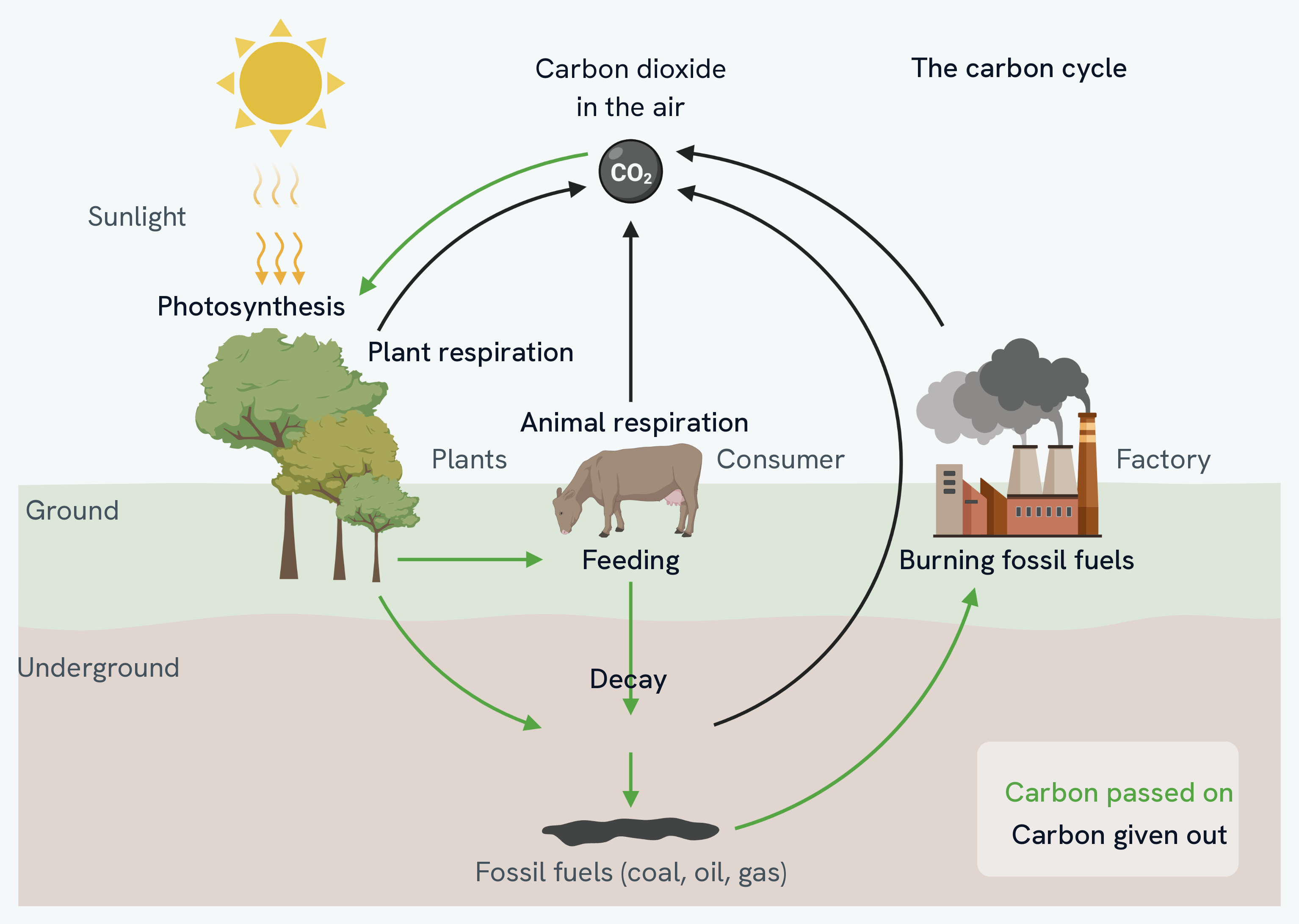
Follow the colours. Green arrows pass carbon from one place to the next without putting any into the air. Black arrows put carbon dioxide back into the air.
Now count them. There is one green arrow taking carbon out of the air, photosynthesis, and four black arrows putting it back. In a balanced ecosystem those cancel out, which is what makes it a cycle at all.
The bottom of the drawing is where that balance breaks. Carbon that went into fossil fuels took millions of years to get there, through decay and then through being buried and compressed. Burning it returns it to the air in moments. That mismatch of timescales, and not the chemistry, is why burning fossil fuels raises the carbon dioxide in the atmosphere, which the land use, deforestation and global warming guide picks up.
The water cycle
The water cycle continuously evaporates and returns water, providing fresh water for organisms on land before it drains to the sea. Water is vital for respiration, for photosynthesis and support in plants, and for transport.
- Evaporation: the Sun's energy turns water from seas and rivers into water vapour.
- Condensation: the vapour cools into droplets, forming clouds.
- Precipitation: water falls as rain, snow or hail.
- Water then returns to rivers and seas by surface run-off and moves through the ground by percolation. It is also released by transpiration from plants and by respiration in all organisms.
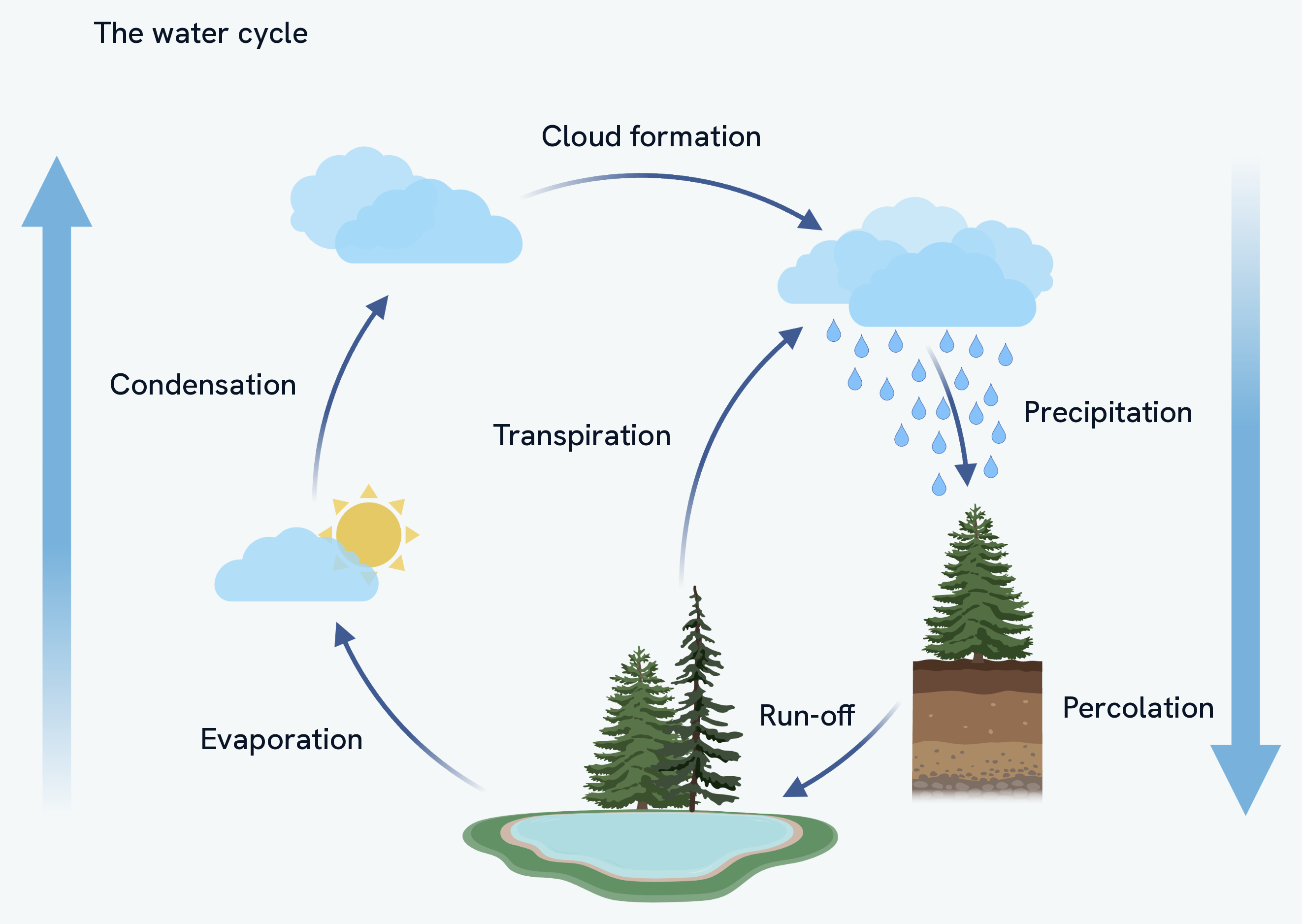
Two arrows go up and one comes down. Evaporation lifts water from the lake and transpiration lifts it out of the trees, and both are driven by energy from the Sun. Condensation and precipitation bring it back.
Transpiration is the one students leave out. Plants lose a large volume of water through their leaves, so on land they are a major route from the ground back into the air, not a side effect.
The label on the drawing reads run-off, and the full term is surface run-off: water flowing over the ground into rivers and back to the sea. Water that soaks in instead moves down through the soil, which is percolation, labelled on the block of soil at the right.
The role of microorganisms
Microorganisms are essential to recycling materials.
- They decompose dead organisms and waste by releasing enzymes that break large molecules into small ones.
- They return carbon to the atmosphere as carbon dioxide through respiration.
- They release mineral ions, such as nitrate, into the soil, where plant roots can absorb them by active transport.
In this way, all the materials in the living world are recycled to provide the building blocks for future organisms.
How this fits together
Decomposition by microorganisms is central to these cycles, and in Triple award biology you study the factors that affect its rate, in the decomposition guide.