AQA GCSE Biology: Decomposition
A Triple award GCSE Biology revision guide to decomposition: what decay is, the factors that affect its rate, compost and biogas, and environmental change.
This whole guide is Triple award only. Decomposition breaks down dead material and returns its nutrients to the environment. This guide explains what decay is, the factors that control its rate, and how it is put to use in compost and biogas. The key idea is that decomposers are living things, so their rate depends on conditions that suit their enzymes and respiration.
What decomposition is
Decomposition (decay) is the breaking down of organic matter from dead organisms or waste products by microorganisms, which are bacteria or fungi.
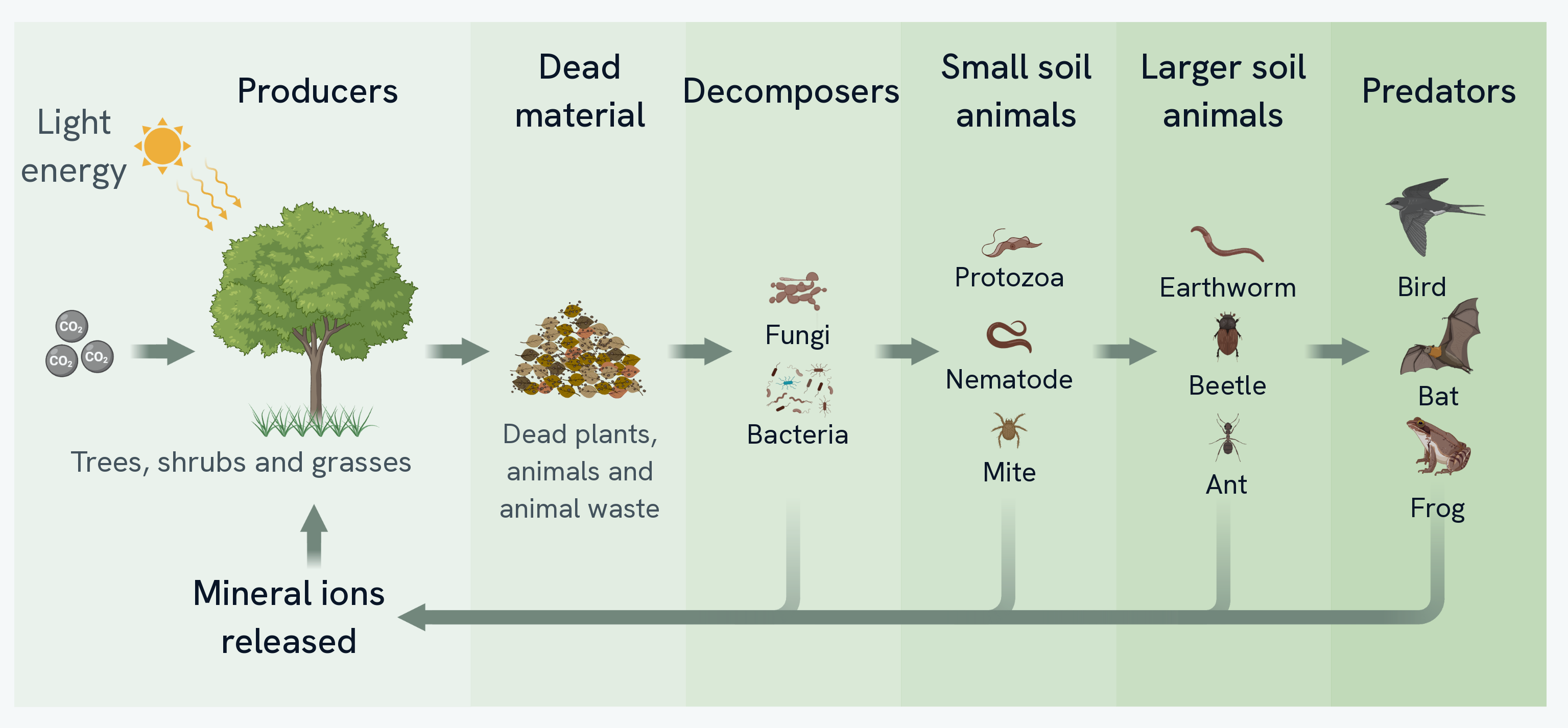
Read the bottom arrow first, because it is the whole point. Everything that goes into the ecosystem at the left comes back to the producers at the end, and the thing that comes back is mineral ions, released into the soil where roots can take them up.
The decomposers are the band that matters. Fungi and bacteria feed on dead material, and in doing so they break large molecules into small ones and release the mineral ions locked up in them. Nothing else in the drawing can do that.
The three bands to the right of the decomposers are a soil food chain, and they are not something you will be asked to name. They are there to show that the return arrow comes from every level, not only from the decomposers: whatever eats what, the minerals end up back in the soil.
Factors that affect the rate of decay
Because decomposers are living, their activity depends on the conditions.
- Temperature: as temperature rises, the rate increases, because enzyme activity speeds up. Above a certain temperature, the rate falls, because the enzymes denature and the decomposers die.
- Water: as water increases, the rate increases, because decomposers need water for their chemical reactions. But if it becomes waterlogged, oxygen levels fall, so decomposers cannot aerobically respire and the rate falls.
- Oxygen: more oxygen increases the rate, because many decomposers can aerobically respire faster and release more energy.
The rate of decay can be worked out as the change in value ÷ change in time, where the value is something measurable linked to decay.
Compost and biogas
Decay is put to practical use.
- Compost: gardeners and farmers provide the optimum conditions (plenty of oxygen, warm and moist) for the rapid decay of waste material by microorganisms. The compost is used as a natural fertiliser, rich in mineral ions.
- Biogas: the anaerobic decay of waste material by microorganisms produces methane gas. It can be made in a biogas generator and burned as a fuel to release energy, for example for heating.
Environmental change
(This section is Triple award and Higher tier only.) Changes in temperature, the availability of water, and the composition of atmospheric gases can affect the distribution of species in an ecosystem. These factors change because of seasonal changes, geographical changes, and human interaction.
How this fits together
Recycling by decomposers keeps ecosystems healthy, but human activity is disturbing many ecosystems. The variety of life at risk, and why it matters, is the subject of the biodiversity guide.