AQA GCSE Biology: Human Defence Systems
A clear GCSE Biology revision guide to human defence systems: the non-specific barriers that keep pathogens out, and how white blood cells destroy pathogens that get in.
The body has two lines of defence against pathogens: barriers that try to keep them out, and an immune system that destroys any that get in. This guide covers both, and the memory cells that give long-term protection. The key idea is that the first defences are non-specific, while the immune response is targeted at a particular pathogen.
Keeping pathogens out
The body's non-specific defences try to stop pathogens entering in the first place.
- Skin: a tough, dry outer layer acts as a barrier, scabs seal cuts, and it makes antimicrobial secretions and oily sebum that kill or repel pathogens.
- Nose: hairs and mucus trap pathogens in the air breathed in.
- Trachea and bronchi: they produce mucus to trap pathogens, and cilia (tiny hair-like structures) waft the mucus up to the throat to be swallowed.
- Stomach: hydrochloric acid kills most pathogens in food or in swallowed mucus.
The immune system
If a pathogen gets past the barriers, the immune system, made of white blood cells, tries to destroy it in three ways.
- Phagocytosis: white blood cells engulf and digest pathogens.
- Antibodies: white blood cells produce specific antibodies in response to the antigens on a pathogen's surface. The antibodies bind to those antigens (their shapes are complementary), which makes the pathogens clump together so more can be engulfed at once.
- Antitoxins: white blood cells produce antitoxins that neutralise the toxins released by bacteria, so fewer cells are damaged and the person feels less ill.
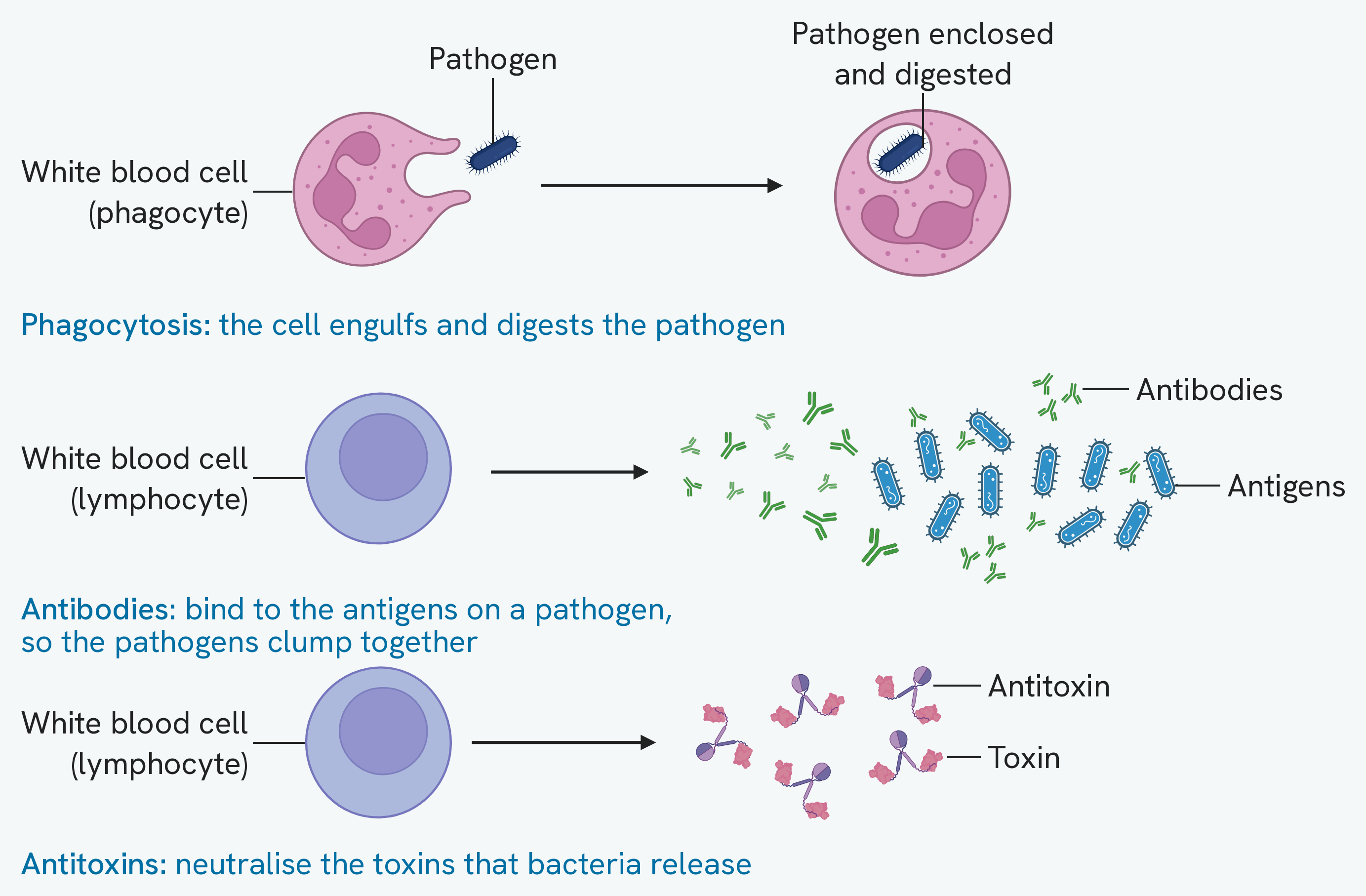
Every row starts with a white blood cell, which is the answer AQA wants in all three cases. The brackets name the two kinds only because the cell that engulfs pathogens really is a different type from the one that makes antibodies, so the drawings look different for a reason.
The middle row is drawn covered in antibodies, but each one fits the antigens on a single kind of pathogen and nothing else. That is what specific means, and it is why a different antibody is needed for every disease.
Only the top row destroys a pathogen. Antibodies do not kill anything: they make pathogens clump together, which is what lets phagocytosis deal with several at once. Antitoxins do not kill anything either: they cancel out the toxin, which is what was making the person feel ill. Writing that antibodies kill bacteria throws away the mechanism, and the mechanism is where the mark is.
Memory cells
After an infection, a type of white blood cell called a memory cell stays in the body. If the same pathogen returns, the memory cells recognise its antigen and produce the correct antibodies faster and in larger amounts, usually destroying the pathogen before it can cause illness. This is the basis of long-term immunity.
Questions on this almost always come as a graph of antibody concentration against time, with two exposures to the same pathogen. Describing it correctly needs three comparisons between the second response and the first: antibodies are produced faster, in greater quantity, and the level stays high for longer. Giving only one of the three is the usual reason for dropping marks.
The reason the first response is slow is that the body has to find the few white blood cells that happen to make the right antibody and multiply them up, which takes days. That is why you feel ill the first time: the pathogen has a head start. After the infection, memory cells for that pathogen are already present in large numbers, so the second response begins immediately and you usually notice nothing at all.
Two words are easy to confuse here. An antigen is the marker on the surface of the pathogen. An antibody is the protein made by a white blood cell that fits it. Note also that an antibody is a protein, not a cell, so writing that antibodies engulf pathogens or divide is wrong.
How this fits together
Memory cells are also what makes vaccination work: a vaccine produces them without you having to catch the disease first. That is the subject of the vaccination guide.