AQA GCSE Biology: Monoclonal Antibodies
A Higher tier GCSE Biology revision guide to monoclonal antibodies: what they are, how they are made using hybridoma cells, and their uses in diagnosis, research and treatment.
This whole guide is Higher tier only. Monoclonal antibodies are identical antibodies made to bind to one specific target, which makes them very useful in medicine. This guide explains what they are, how they are produced from hybridoma cells, and how they are used. The key idea is specificity: each monoclonal antibody binds to just one antigen.
Antibodies, antigens and monoclonal antibodies
An antibody is a protein made by a type of white blood cell called a lymphocyte. Each antibody binds to a specific antigen, for example on a pathogen, a cancer cell, or a particular chemical.
Monoclonal antibodies are antibodies produced from a single clone of cells, so they are all identical. Because they are specific to one binding site on one antigen, they will only bind to that antigen, which lets them target a specific chemical (such as a hormone) or specific cells (such as cancer cells).
How monoclonal antibodies are made
They are produced in the lab using hybridoma cells.
- A mouse is injected with the specific antigen.
- The mouse's lymphocytes are stimulated to make the antibody specific to that antigen.
- These lymphocytes are combined with a kind of tumour cell to make a hybridoma cell, which can both divide rapidly (like the tumour cell) and produce the antibody (like the lymphocyte).
- A single hybridoma cell is cloned to make many identical cells, all producing the same antibody.
- Large amounts of the antibody are then collected and purified.
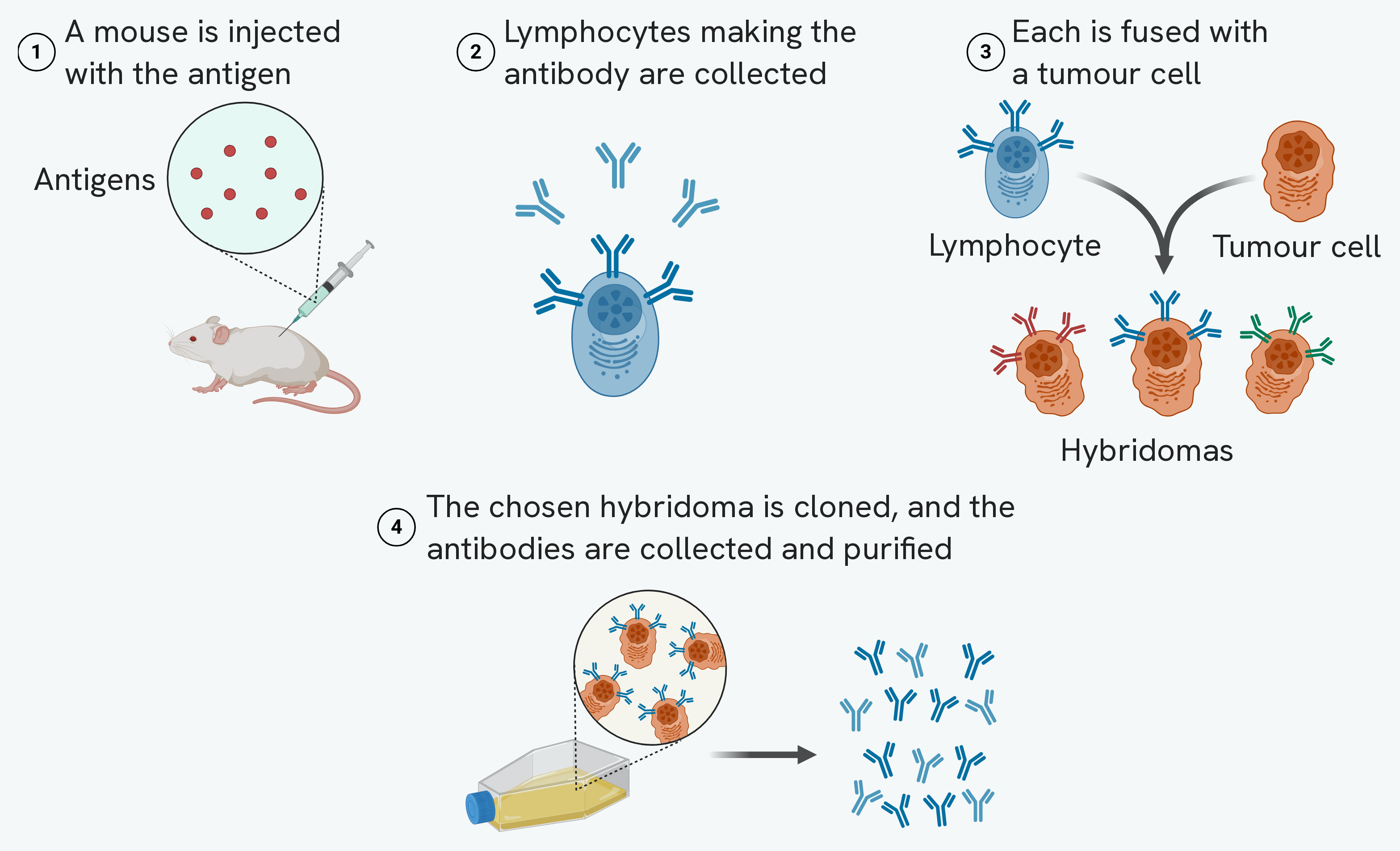
The name says what step three does: a hybridoma is a hybrid of the two cells above it, and it inherits one useful property from each.
Step three is worth a second look. The three hybridomas carry three different antibodies, because each came from a different lymphocyte. Only one of them makes the antibody that binds the antigen you started with, which is why step four begins by choosing a hybridoma rather than growing them all.
Cloning a single hybridoma cell matters because it ensures every cell is genetically identical and makes exactly the same antibody, so the antibodies are all specific to the same antigen. (Note that the hybridoma cell is the cell that makes the antibody; the monoclonal antibodies themselves are the protein molecules collected from it.)
Uses of monoclonal antibodies
Monoclonal antibodies have several uses.
- Diagnosis, such as in pregnancy tests.
- In laboratories, to measure the level of a hormone or other chemical in the blood, or to detect a pathogen such as HIV.
- In research, to locate a specific molecule in a cell or tissue by binding to it with a fluorescent dye.
- In treatment, for example of cancer: monoclonal antibodies are made to bind only to antigens found on cancer cells, and are attached to a radioactive substance, toxic drug or chemical. This stops the cancer cells growing and dividing, without harming healthy cells.
Monoclonal antibodies are not yet used as widely as first hoped, because they created more side effects than expected, since they were originally made using mouse lymphocytes.
How this fits together
Monoclonal antibodies complete the human side of Topic 3. The topic also covers disease and defences in plants, which is the subject of the plant disease and defences guide.