AQA GCSE Biology: Plant Disease and Defences
A Triple award GCSE Biology revision guide to plant disease and defences: causes of plant disease, mineral deficiencies, detecting and identifying disease, and physical, chemical and mechanical defences.
This whole guide is Triple award only. Plants get diseases too, and they have their own defences against pathogens and herbivores. This guide covers what causes plant disease, the mineral deficiencies that harm plants, how disease is detected and identified, and the three kinds of plant defence. The recurring theme is that damage to a plant usually comes back to reduced photosynthesis.
Causes of plant disease
Plant disease can be caused by pathogens, viruses such as TMV, bacteria, or fungi such as rose black spot, and by insects such as aphids.
Aphids harm plants in two ways: they feed on phloem sap, removing sugars so the plant has less glucose for respiration and for making proteins, which stunts growth; and they act as vectors, transferring pathogens between plants.
Mineral deficiencies
Plants need certain mineral ions, and a shortage causes clear symptoms.
- Nitrate ions are needed to make proteins for growth. A deficiency causes stunted growth.
- Magnesium ions are needed to make chlorophyll, which absorbs light for photosynthesis. A deficiency causes chlorosis (yellow leaves) because less chlorophyll is made, which reduces photosynthesis and can also stunt growth.
Detecting and identifying disease
(Detection and identification are Higher tier.) Plant disease can be detected from signs such as malformed stems or leaves, areas of decay, stunted growth, unusual growths, spots on leaves, discolouration, or the presence of pests.
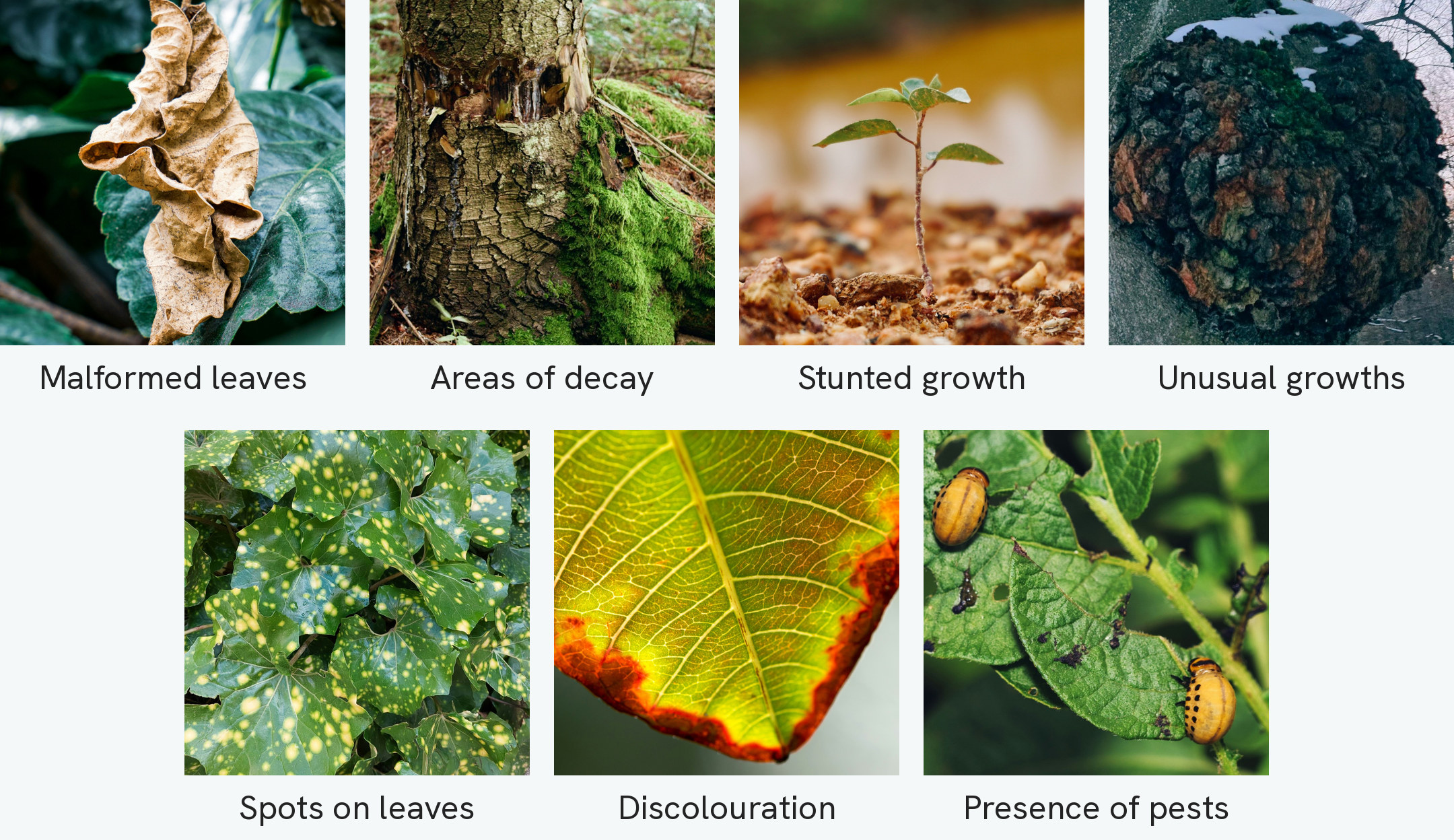
All seven signs are in the photographs, in the order the list above gives them. The discolouration is the same chlorosis as a magnesium deficiency causes, which is worth noticing here: the sign looks identical whatever produced it.
Spotting a sign is not the same as knowing what caused it, which is exactly why detection and identification are two separate steps. A yellow, stunted plant could have rose black spot, a magnesium deficiency or simply too little light, and it looks much the same in each case. Narrowing that down is what the identification methods below are for.
The disease can then be identified by comparing it with descriptions in a gardening manual or website, by sending an infected plant to a laboratory for DNA analysis, or by using testing kits that contain monoclonal antibodies which bind to antigens on a particular pathogen.
Plant defences
Plants defend themselves in three ways.
- Physical defences: the cellulose cell wall and the waxy cuticle are tough for pathogens to get through, and layers of dead cells such as bark fall off, taking pathogens with them.
- Chemical defences: antibacterial chemicals kill bacterial pathogens, and poisons (for example in some berries) deter herbivores from eating the plant.
- Mechanical adaptations: thorns and hairs deter herbivores; leaves that droop or curl when touched dislodge insects; and mimicry, such as looking like something inedible or like another species' eggs, tricks animals into leaving the plant alone.
How this fits together
Plant disease and defences complete Topic 3, which has covered how pathogens cause disease and how both humans and plants defend against them. Keeping plants healthy links forward to how they grow and photosynthesise in later topics.