AQA A-Level Biology: Eukaryotic Cell Structure
A clear revision guide to eukaryotic cell structure for AQA A-Level Biology: the organelles, what each one does, and how their structure fits their function.
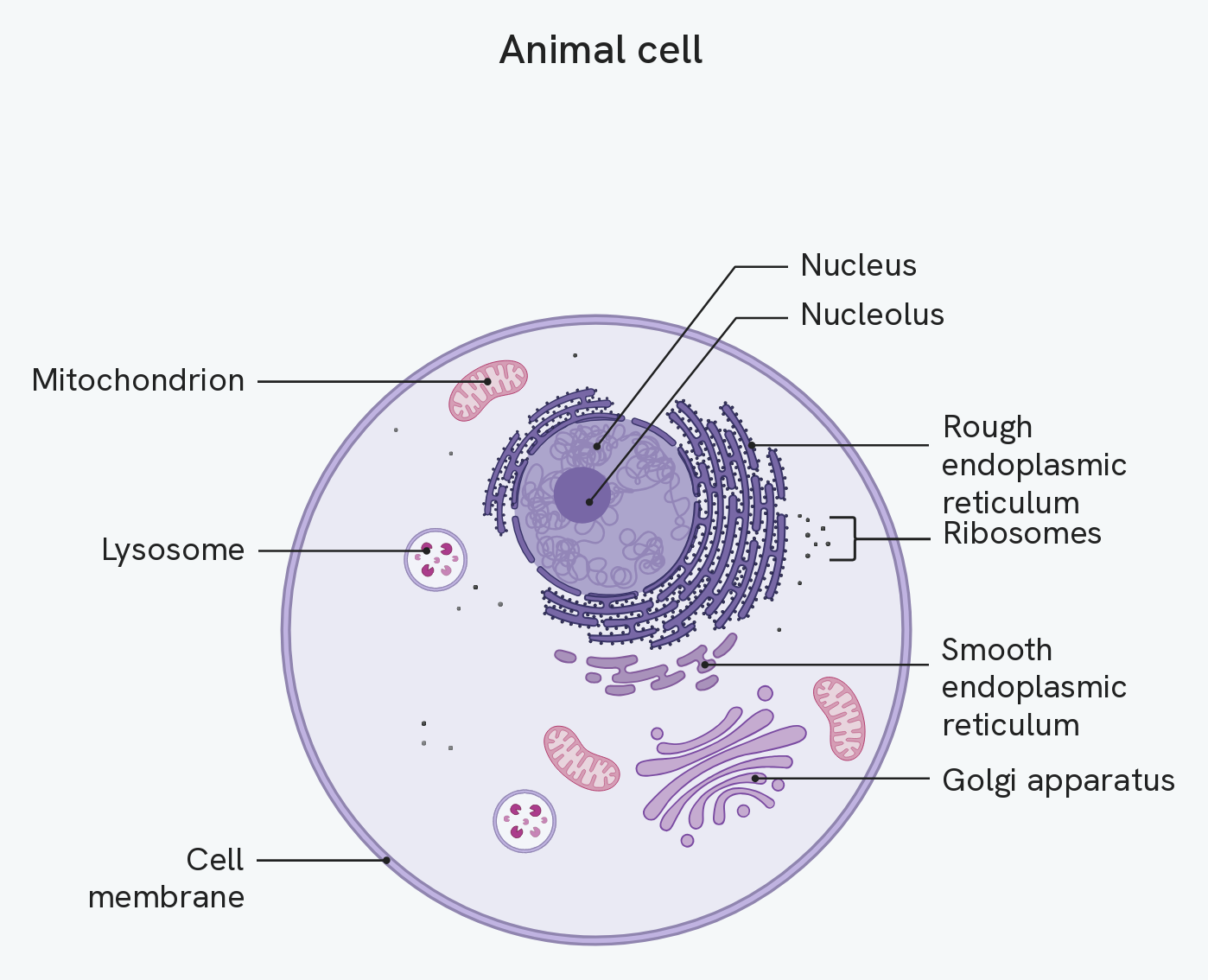
A eukaryotic cell is defined by one thing above all: it keeps its DNA inside a nucleus, and it packages many of its processes into membrane-bound compartments called organelles. Animal cells, plant cells, fungi and protoctista are all eukaryotic. This guide works through the organelles and, for each one, links its structure to what it does.
The cell-surface membrane
Every cell is surrounded by a cell-surface membrane made of a phospholipid bilayer with proteins embedded in it. The phosphate heads are hydrophilic and face the watery surroundings inside and outside the cell, while the fatty acid tails are hydrophobic and point inwards, away from water.
This arrangement makes the membrane selectively permeable: small, non-polar molecules pass straight through the bilayer, while larger or water-soluble molecules can only cross through transport proteins. The membrane also carries receptors and other molecules on its surface that let the cell be recognised and take part in signalling.
The nucleus
The nucleus stores the cell's genetic information. It is surrounded by a nuclear envelope, a double membrane containing nuclear pores that let larger molecules such as mRNA pass between the nucleus and the cytoplasm. Inside is the nucleoplasm, and within that a dense region called the nucleolus.
The DNA in a eukaryotic nucleus is linear and wound around histone proteins. When it is loosely coiled it is called chromatin; when it condenses fully during cell division it forms chromosomes.
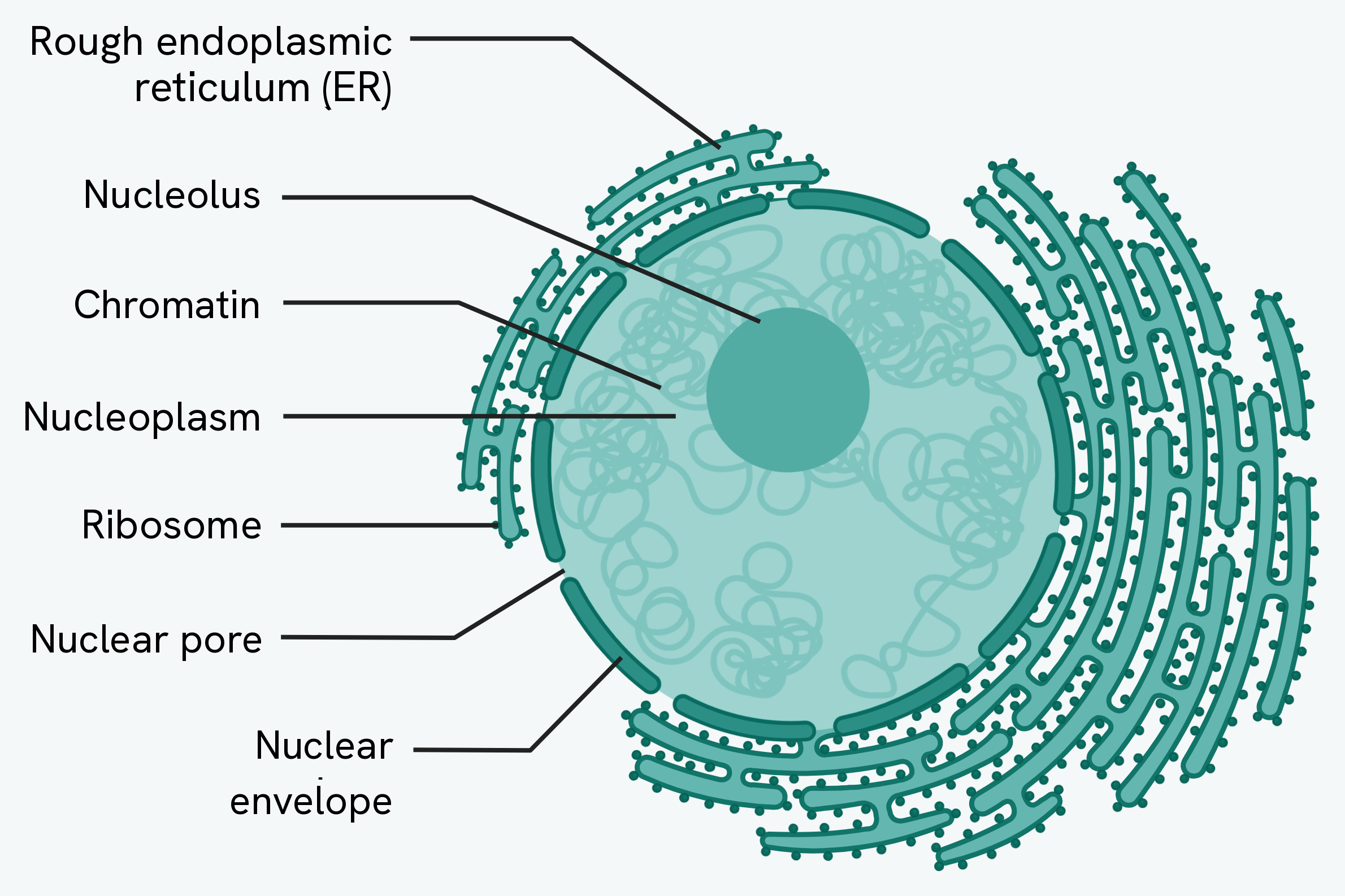
The nucleus is where DNA is stored and copied (replication) and where the DNA code is transcribed into mRNA (transcription, the first stage of making a protein). The nucleolus makes ribosomes and ribosomal RNA.
Ribosomes, and the endoplasmic reticulum
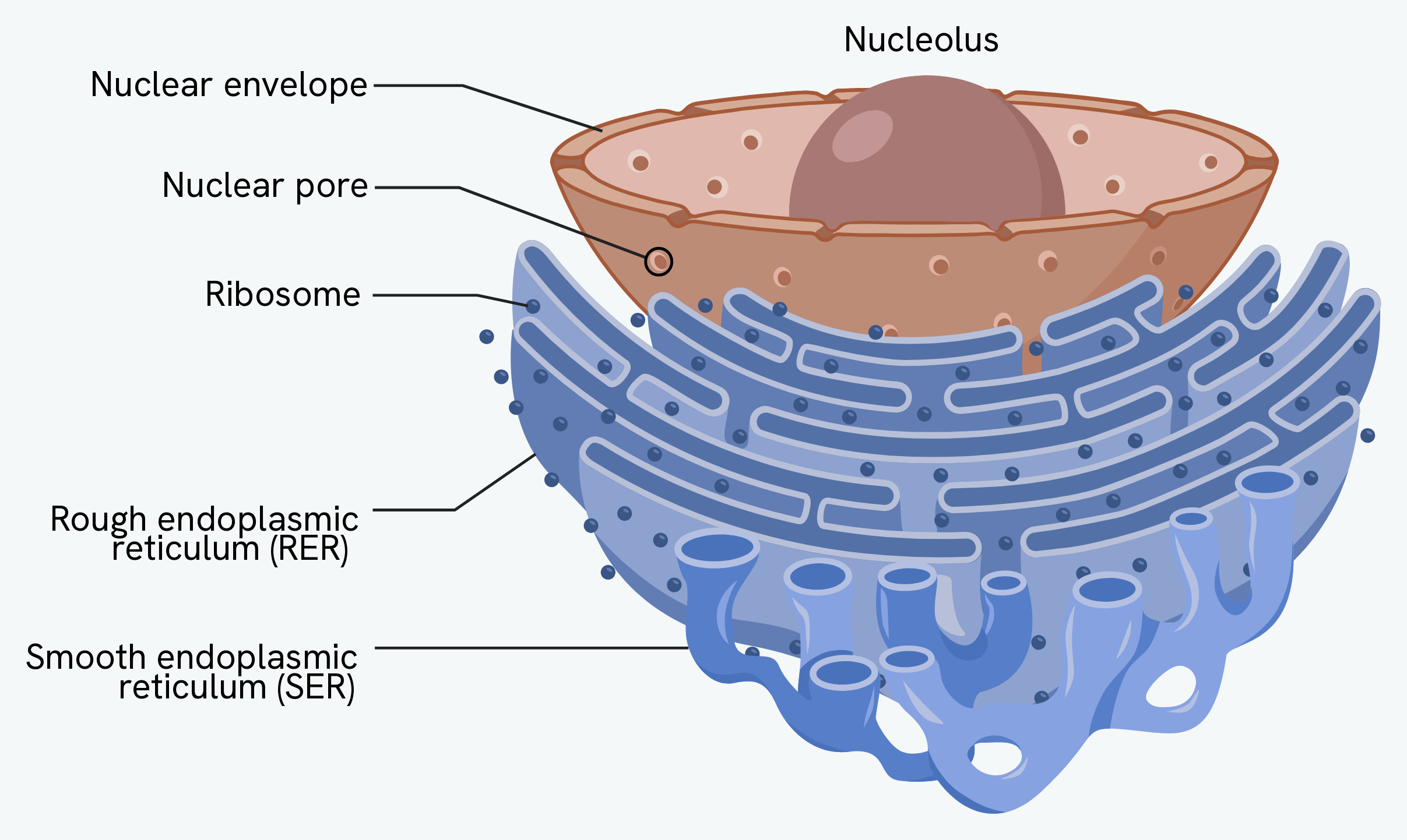
Ribosomes are the sites of protein synthesis (translation). Each is built from ribosomal RNA and protein in two subunits, and unusually for the cell's machinery it is not membrane-bound. Ribosomes either float free in the cytoplasm or sit on the rough endoplasmic reticulum. Eukaryotic ribosomes are the larger 80S type.
The rough endoplasmic reticulum (RER) is a system of flattened membrane sacs, called cisternae, studded with ribosomes. Proteins made by those ribosomes are folded and processed inside the RER, then packaged into vesicles to be carried on, often to the Golgi apparatus.
The smooth endoplasmic reticulum (SER) has the same sac-like structure but no ribosomes. Instead of proteins it synthesises, processes and transports lipids and carbohydrates, such as cholesterol and steroid hormones.
The Golgi apparatus and lysosomes
The Golgi apparatus is a stack of flattened membrane sacs that acts as the cell's finishing and dispatch centre. It modifies proteins and lipids, for example by adding carbohydrates to make glycoproteins and glycolipids, and then packages them into Golgi vesicles. These vesicles carry their contents to where they are needed, often fusing with the cell-surface membrane to release them.
The Golgi also produces lysosomes, a type of vesicle containing hydrolytic enzymes. Lysosomes release these enzymes to break down worn-out organelles or to digest material the cell has engulfed, such as pathogens.
Mitochondria
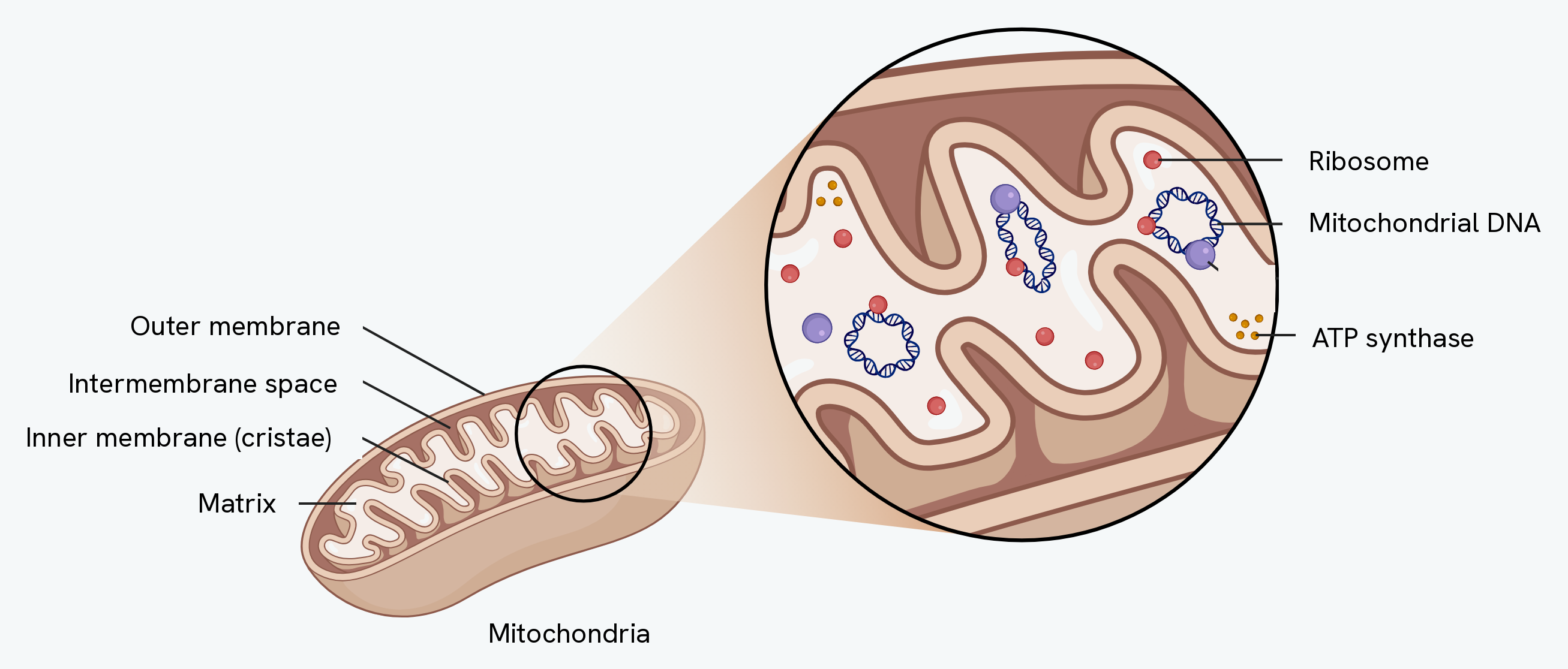
Mitochondria are the site of aerobic respiration, which releases energy to make ATP. A mitochondrion has two membranes: a smooth outer membrane and an inner membrane folded into cristae, which increase the surface area for the reactions of respiration. Inside is the matrix, which contains small 70S ribosomes and a loop of circular DNA. Cells with a high energy demand, such as muscle cells, contain large numbers of mitochondria.
Chloroplasts
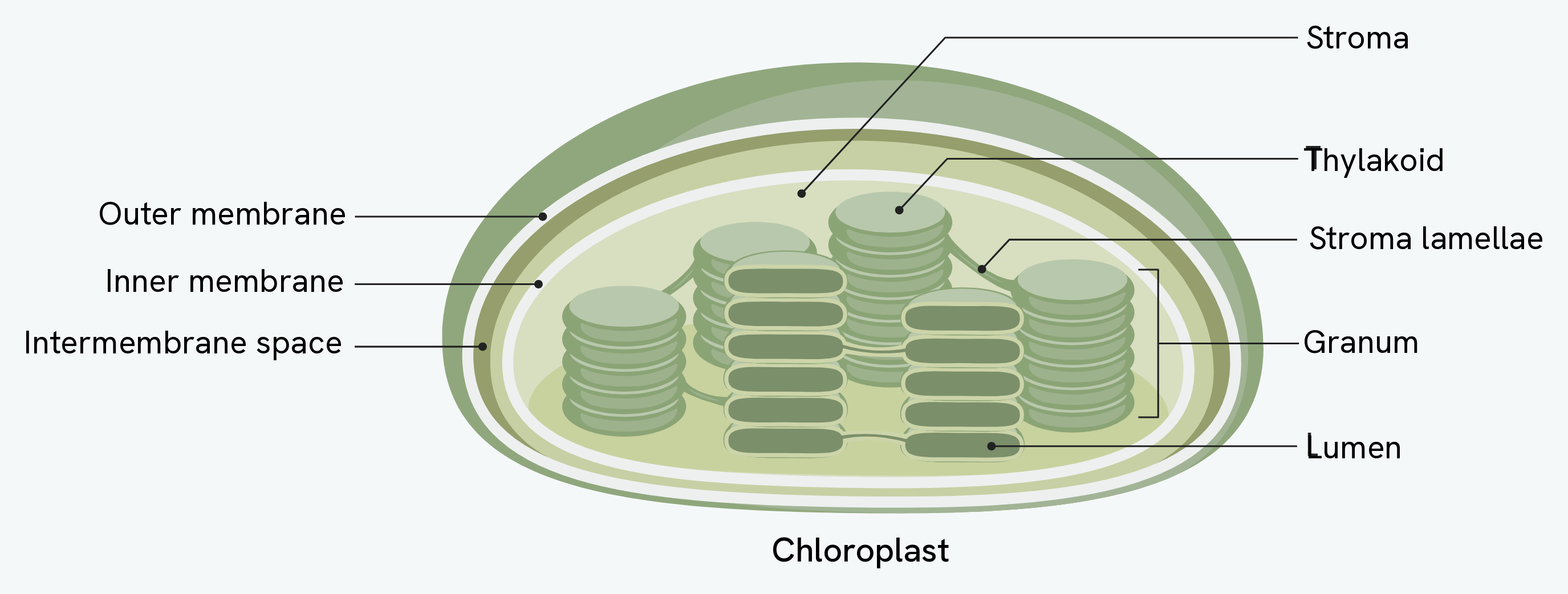
Chloroplasts are found in plants and algae and are the site of photosynthesis. They are surrounded by a double membrane, and inside is the stroma, a fluid containing 70S ribosomes, circular DNA and starch grains. Running through the stroma is a system of thylakoid membranes, stacked into piles called grana and joined by lamellae. The pigment chlorophyll, held in the thylakoid membranes, absorbs light energy, which is used to build organic substances such as carbohydrates.
Structures found in plant, algal and fungal cells
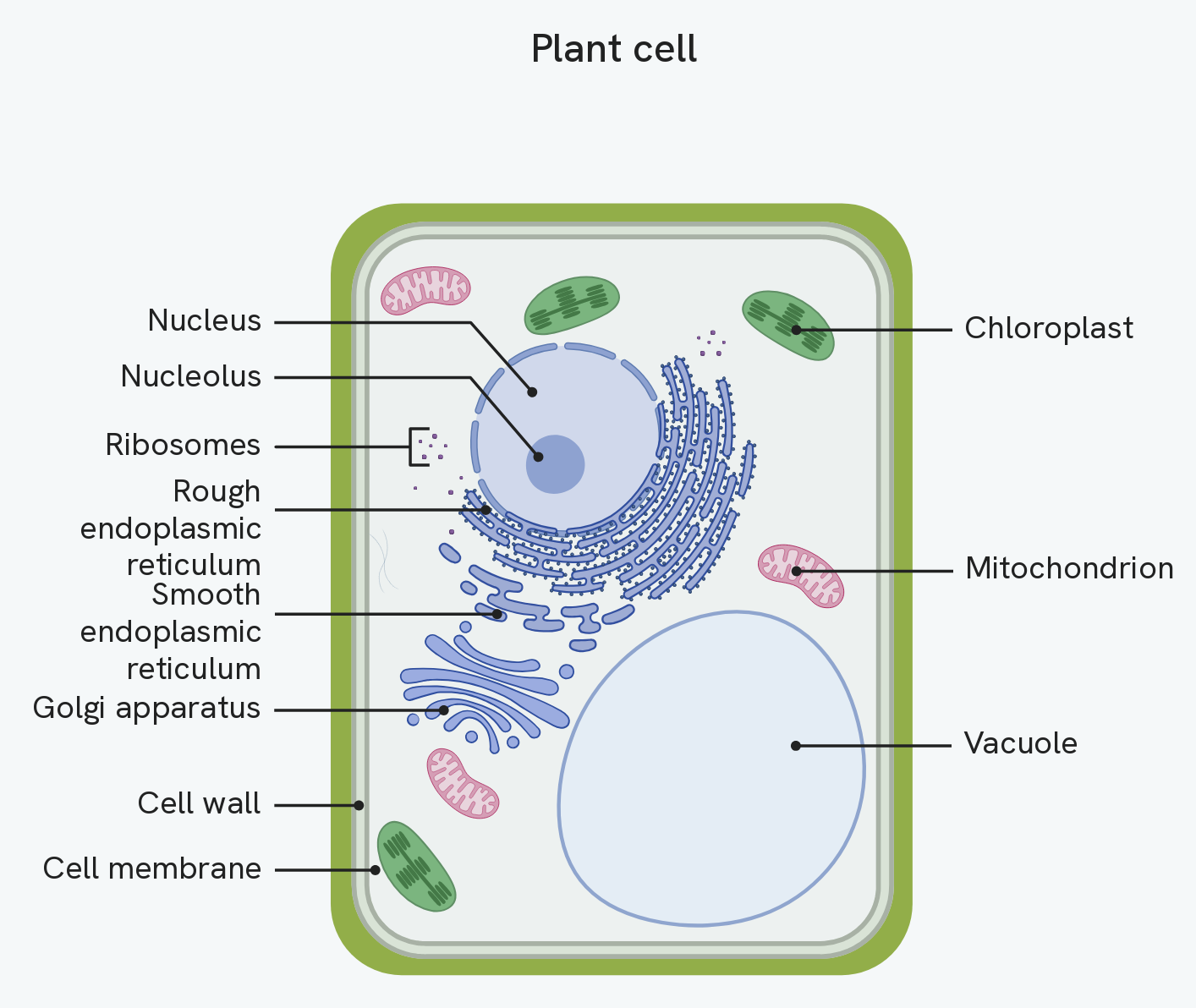
Plant, algal and fungal cells are surrounded by a cell wall outside the membrane. In plants and algae it is made mainly of cellulose, and in fungi of chitin, a nitrogen-containing polysaccharide. The wall gives the cell mechanical strength, which stops it changing shape or bursting when water enters by osmosis.
Mature plant cells also contain a large permanent vacuole, surrounded by a membrane called the tonoplast and filled with cell sap. By taking up water the vacuole keeps the cell firm, maintaining the turgor pressure that supports the plant, and it stores sugars, amino acids, pigments and waste.
A summary of the organelles
| Organelle | Key structure | Main function |
|---|---|---|
| Nucleus | Double envelope with pores, contains linear DNA | Stores genetic information, site of replication and transcription |
| Ribosome | rRNA and protein, two subunits, not membrane-bound | Protein synthesis (translation) |
| Rough ER | Membrane sacs with ribosomes | Folds and transports proteins |
| Smooth ER | Membrane sacs, no ribosomes | Makes lipids and carbohydrates |
| Golgi apparatus | Stack of flattened sacs | Modifies and packages proteins and lipids, makes lysosomes |
| Lysosome | Sac of hydrolytic enzymes | Digests pathogens and worn-out organelles |
| Mitochondrion | Double membrane, cristae, matrix | Aerobic respiration to make ATP |
| Chloroplast | Double membrane, grana, stroma | Photosynthesis |
| Cell wall | Cellulose (plants) or chitin (fungi) | Support, prevents bursting |
| Vacuole | Tonoplast, cell sap | Maintains turgor, stores substances |
Why membranes matter inside the cell
Membranes do not only surround the whole cell. By wrapping around organelles they compartmentalise the cell, which lets very different reactions happen at the same time without interfering. They control what enters and leaves each organelle, keep damaging enzymes isolated, provide internal transport routes such as RER to Golgi, and offer surfaces on which reactions can take place.
From cells to organisms
In a complex multicellular organism, cells become specialised for particular jobs, and a cell's structure reflects its role: a cell that makes and exports a lot of protein, for example, will have many ribosomes, plenty of RER and many mitochondria to supply energy. Specialised cells are then organised into levels: a tissue is a group of similar cells working together, an organ is made of several tissues performing a function, and an organ system is a group of organs working together.
Prokaryotic cells are built very differently, with no nucleus and no membrane-bound organelles. The prokaryotic cells and viruses guide sets out the contrast.