AQA A-Level Biology: Mitosis and the Cell Cycle
A clear revision guide to the cell cycle and mitosis for AQA A-Level Biology: interphase, the stages of mitosis, why cancer forms, and how prokaryotes and viruses replicate.
New cells come from existing cells. In eukaryotes this happens through the cell cycle, at the heart of which is mitosis, the division that produces two genetically identical cells. This guide covers the cell cycle, the stages of mitosis, what goes wrong in cancer, and how prokaryotes and viruses make more of themselves.
The cell cycle
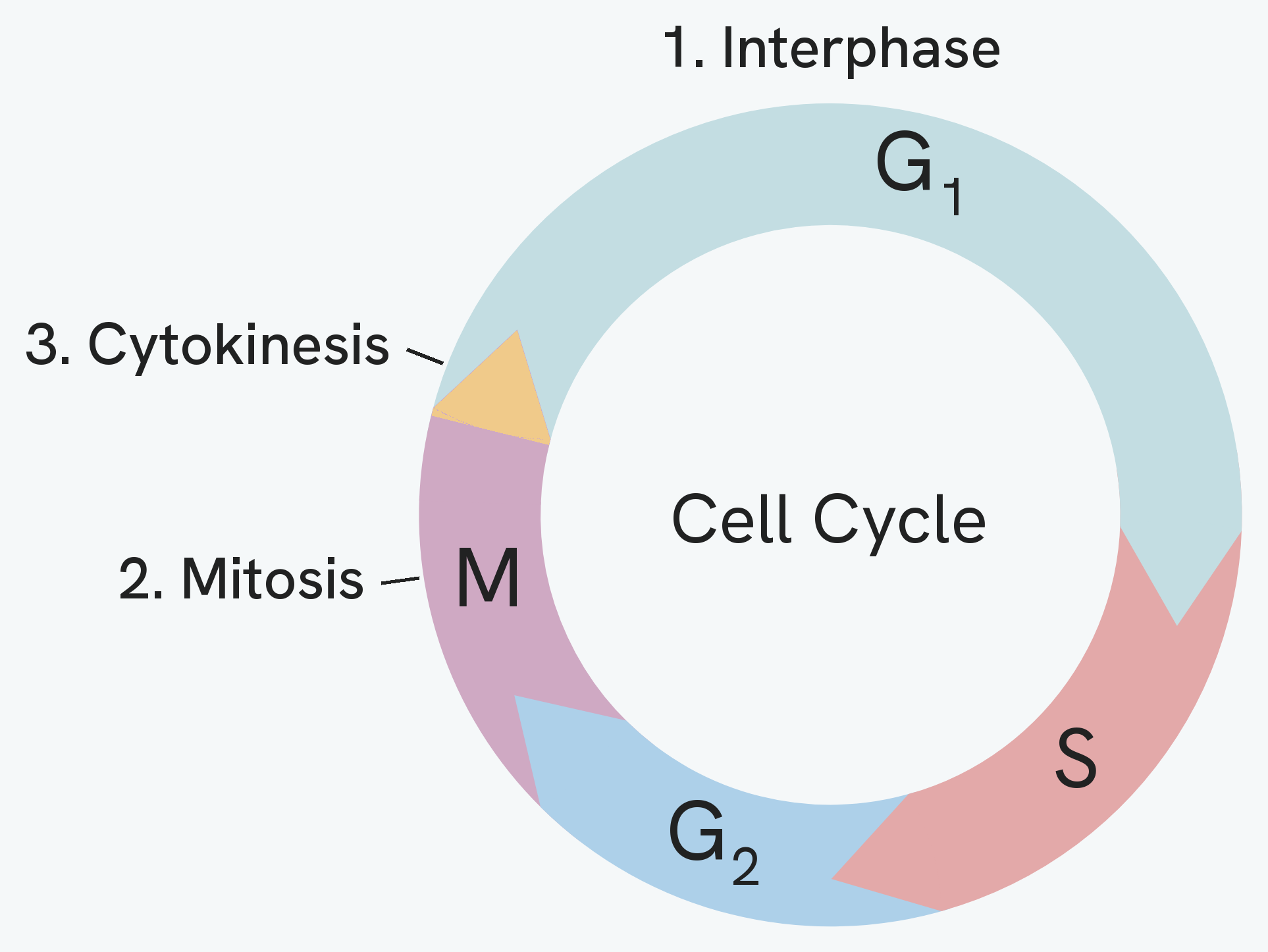
The cell cycle has three parts.
The longest is interphase, the period between divisions. During interphase the DNA is copied by semi-conservative replication, so that each chromosome becomes two identical chromatids joined at a centromere. The cell also grows, makes proteins and increases its number of organelles, so that there is enough of everything for two cells.
The second part is mitosis, in which the nucleus divides to produce two nuclei with identical copies of the DNA.
The third is cytokinesis, in which the cytoplasm and cell-surface membrane divide to give two separate, genetically identical daughter cells.
The stages of mitosis
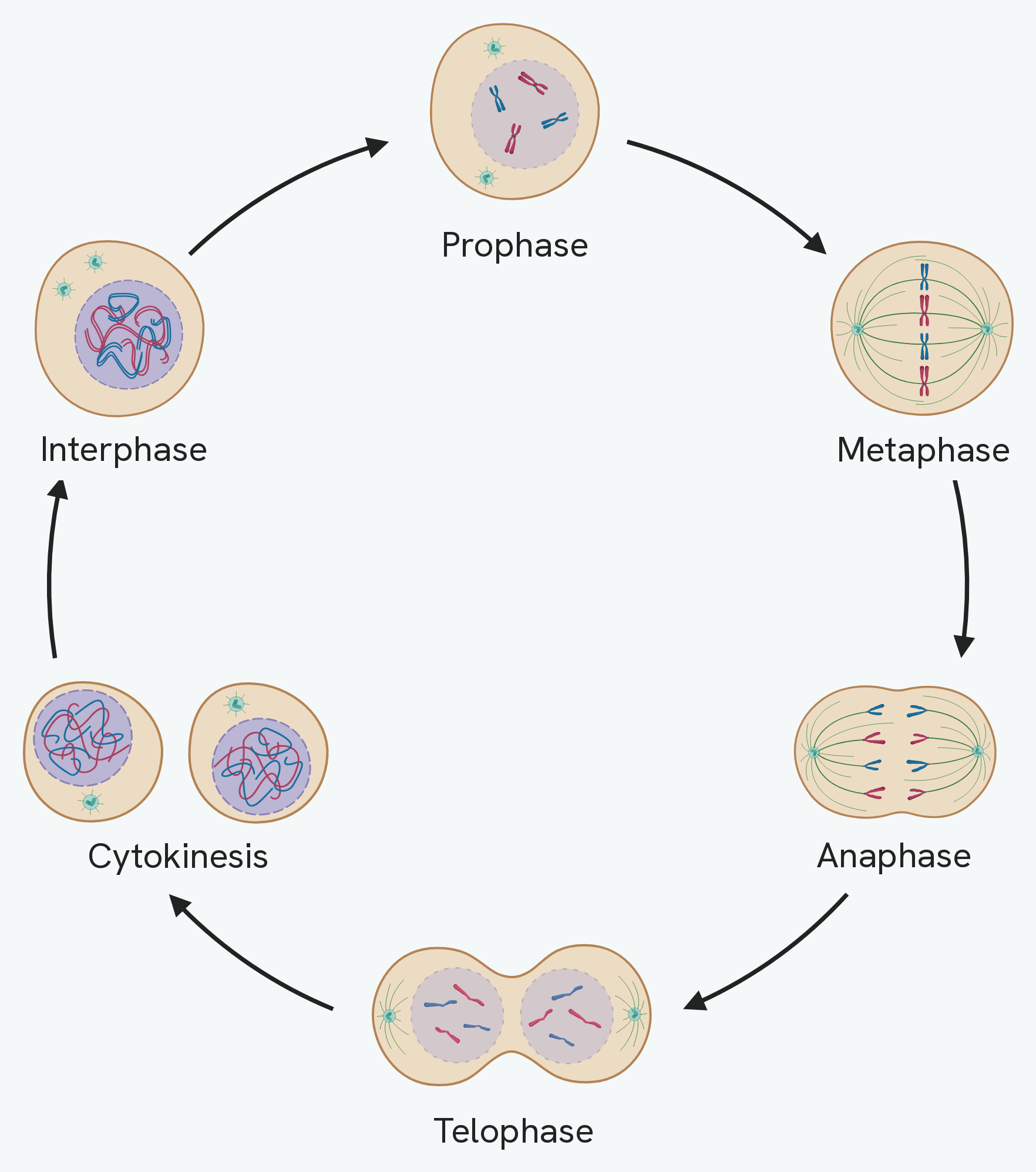
Mitosis is a continuous process, but it is described in four stages.
In prophase, the chromosomes condense, becoming shorter and thicker so that they are now visible, each as two sister chromatids joined at the centromere. The nuclear envelope breaks down, and structures called spindle fibres begin to form and reach towards the chromosomes.
In metaphase, the spindle fibres attach to the chromosomes at their centromeres and line the chromosomes up along the equator (the middle) of the cell.
In anaphase, the spindle fibres shorten, the centromeres divide, and the two chromatids of each chromosome are pulled apart to opposite poles of the cell. Because they are dragged by the centromere, the separating chromatids often look V-shaped.
In telophase, the chromosomes reach the poles and uncoil, becoming long and thin again. A nuclear envelope reforms around each group, giving two nuclei, and the spindle breaks down. Cytokinesis then splits the cell in two.
The mitotic index
The proportion of cells that are in mitosis at a given moment is called the mitotic index:
- mitotic index = number of cells undergoing mitosis divided by the total number of cells
Because it is a proportion it has no units, though a question may ask for it as a percentage. A high mitotic index means a large fraction of cells are actively dividing.
Why some cells do not divide
Not every cell keeps the ability to divide. In a multicellular organism some cells, such as neurones, become so specialised that they no longer go through the cell cycle at all. Only cells that retain the ability to divide continue to cycle.
Why mitosis matters
Because mitosis produces two genetically identical daughter cells, it is the basis of:
- growth, by increasing the number of cells in a multicellular organism
- repair, by replacing cells in damaged or worn-out tissues
- asexual reproduction, producing offspring identical to the parent
Cancer: mitosis out of control
Mitosis is normally a tightly controlled process. If a mutation occurs in a gene that controls cell division, a cell may begin to divide uncontrollably. This can produce a mass of abnormal cells called a tumour. A benign tumour stays in one place and is not cancerous, while a malignant tumour is cancerous and can spread to other parts of the body, a process called metastasis.
Many cancer treatments work by interfering with the cell cycle. Some disrupt the spindle fibres, so chromosomes cannot be pulled to the poles and mitosis cannot complete. Others block DNA replication during interphase, so a cell cannot make the second copy of its chromosomes and therefore cannot divide. These treatments hit rapidly dividing cancer cells hardest, but because they target the cell cycle itself they also affect healthy cells that divide quickly, which is why they cause side effects.
How prokaryotes replicate: binary fission
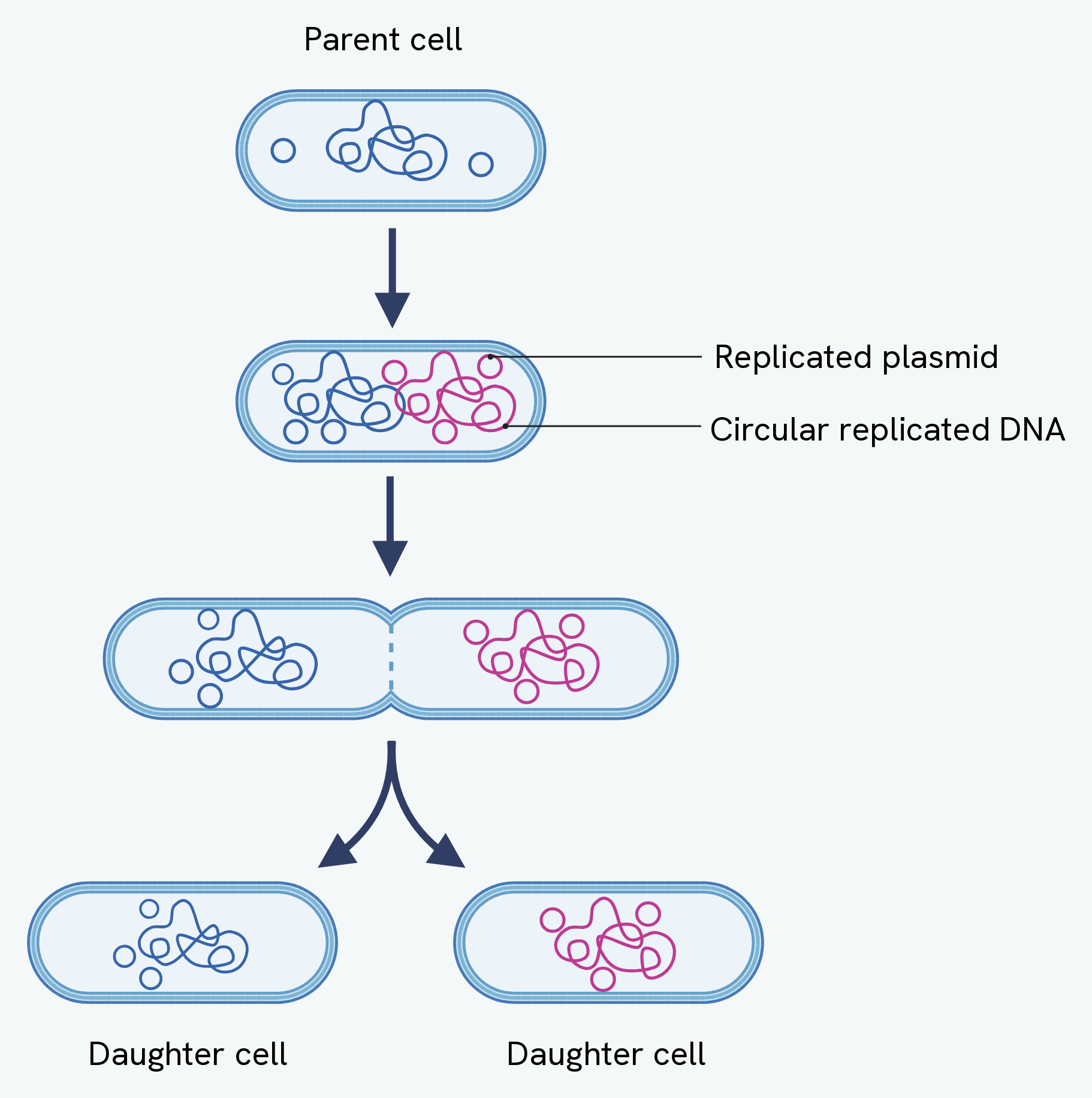
Prokaryotic cells do not use mitosis. They divide by binary fission. The single loop of circular DNA is replicated, and any plasmids are replicated too. The cytoplasm then divides to produce two daughter cells, each with one copy of the circular DNA and a variable number of plasmid copies.
How viruses replicate
Viruses are non-living and have no cell machinery, so they cannot divide at all. Instead they hijack a host cell. The virus's attachment proteins bind to complementary receptors on the host, and the viral nucleic acid is injected into the cell. The host cell is then made to replicate the viral nucleic acid and to produce viral proteins, including new capsids. New virus particles are assembled from these parts and released to infect further cells.
For the specific and unusual way HIV replicates inside helper T cells, see the immune system guide.