AQA A-Level Biology: Transport Across Cell Membranes
A clear revision guide to membrane transport for AQA A-Level Biology: the fluid mosaic model, diffusion, facilitated diffusion, osmosis, active transport and co-transport.
Every cell has to control what crosses its surface. This guide covers the structure of the cell membrane and the different ways substances move across it, from passive diffusion to energy-requiring active transport.
The fluid mosaic model
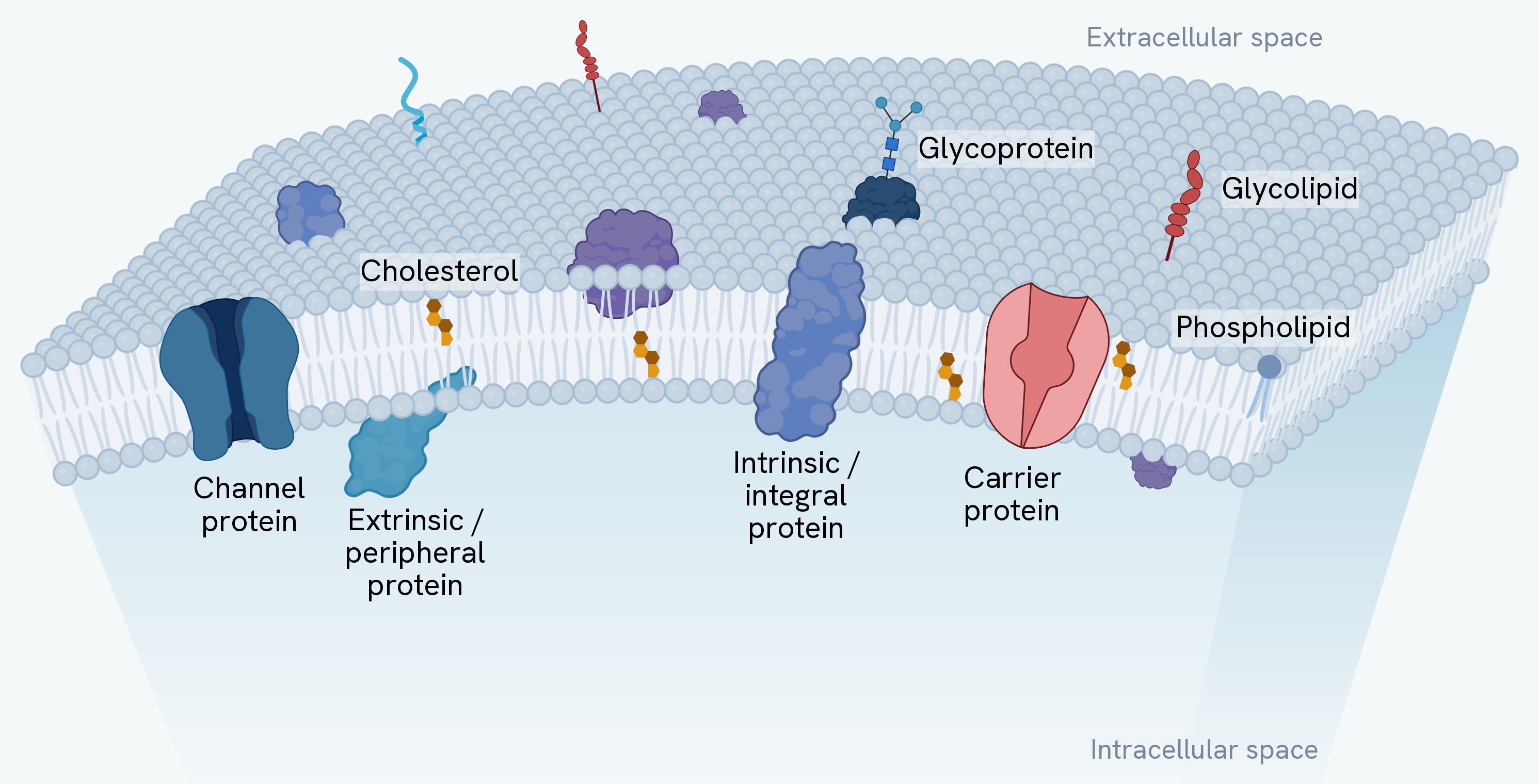
The cell membrane is described by the fluid mosaic model. It is fluid because the phospholipids are free to move sideways within the layer, and a mosaic because it is dotted with many different components: phospholipids, proteins, glycoproteins and glycolipids. The same basic structure is found in the cell-surface membrane and in the membranes around organelles.
The phospholipids form a bilayer. Their hydrophilic phosphate heads are attracted to the water on either side of the membrane and face outwards, while their hydrophobic fatty acid tails are repelled by water and point inwards. This is what makes the interior of the membrane a barrier to water-soluble substances.
Embedded in the bilayer are proteins. Intrinsic (integral) proteins span the whole bilayer and include the channel and carrier proteins used for transport, while extrinsic (peripheral) proteins sit on the surface. Glycolipids and glycoproteins, which carry short carbohydrate chains, sit on the outer surface and act as receptors and markers for cell recognition and signalling.
Cholesterol is sometimes present between the phospholipids. It binds to their hydrophobic tails and restricts their movement, which makes the membrane less fluid and more rigid, and reduces its permeability.
Simple diffusion
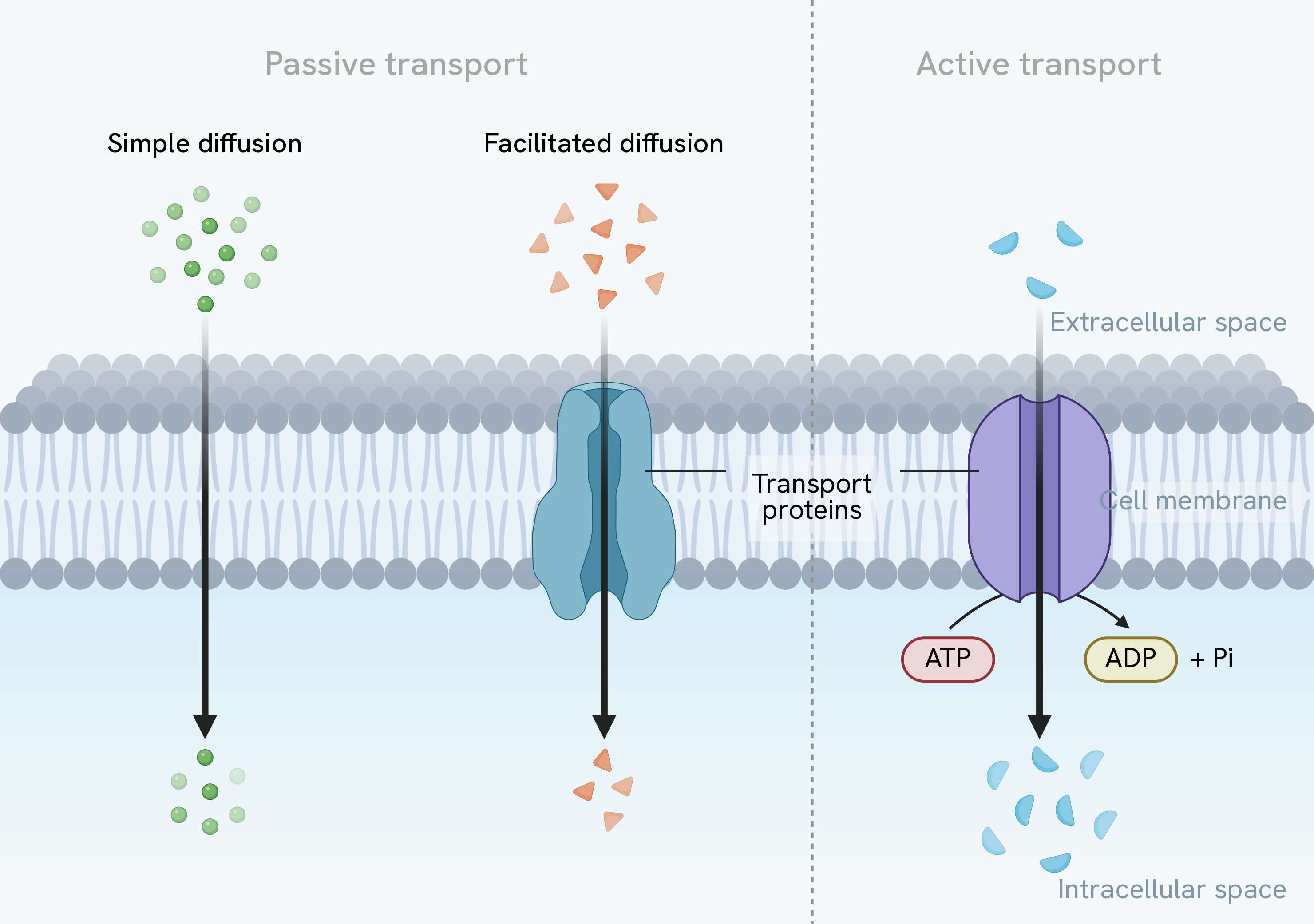
Diffusion is the net movement of particles from a region of higher concentration to a region of lower concentration, down a concentration gradient. It is passive: it needs no energy from ATP, only the kinetic energy the particles already have.
Only certain substances can cross the bilayer directly by simple diffusion: those that are lipid-soluble (non-polar) or very small, such as oxygen, carbon dioxide and steroid hormones. Water-soluble or larger substances, such as sodium ions or glucose, are held back by the hydrophobic core of the bilayer.
Facilitated diffusion
Substances that cannot cross the bilayer on their own can still diffuse down their concentration gradient with help, through transport proteins. This is facilitated diffusion, and it is still passive.
Channel proteins form a hydrophilic pore filled with water through which water-soluble ions can pass. Many are gated, meaning they can open and close. Carrier proteins work differently: the substance binds to a specific site on the protein, which then changes shape to move it across. In both cases the shape and charge of the protein determine which substance it will transport, so facilitated diffusion is specific.
Osmosis
Osmosis is a special case of diffusion for water. It is the movement of water from a region of higher water potential to a region of lower water potential, across a partially permeable membrane, and it too is passive.
Water potential (given the symbol psi) measures how likely water molecules are to move out of a solution. Pure water has the highest possible water potential, defined as zero. Adding solute lowers the water potential, making it negative, so a concentrated solution has a lower (more negative) water potential than a dilute one. Water therefore moves from dilute solutions towards more concentrated ones until the water potentials are equal.
Active transport
Sometimes a cell needs to move a substance against its concentration gradient, from a lower to a higher concentration. This cannot happen passively, so it requires energy. Active transport uses carrier proteins and energy released by the hydrolysis of ATP.
The substance binds to a specific carrier protein. ATP is then hydrolysed to ADP and a phosphate group, releasing energy that makes the carrier protein change shape and release the substance on the far side, where it is already more concentrated. The release of the phosphate lets the protein return to its original shape, ready to repeat the cycle.
Co-transport
Co-transport moves two substances at once through a single co-transporter protein. The trick is that the movement of one substance down its concentration gradient is used to drag a second substance against its gradient.
The classic example is the absorption of glucose and sodium ions in the small intestine (the ileum):
- Sodium ions are actively transported out of the epithelial cell into the blood, so that the concentration of sodium ions inside the cell falls below that in the gut.
- Sodium ions then diffuse from the gut into the epithelial cell down this gradient, through a co-transporter protein that carries glucose in at the same time, even though glucose is moving against its own gradient.
- The glucose that builds up in the cell then moves into the blood by facilitated diffusion.
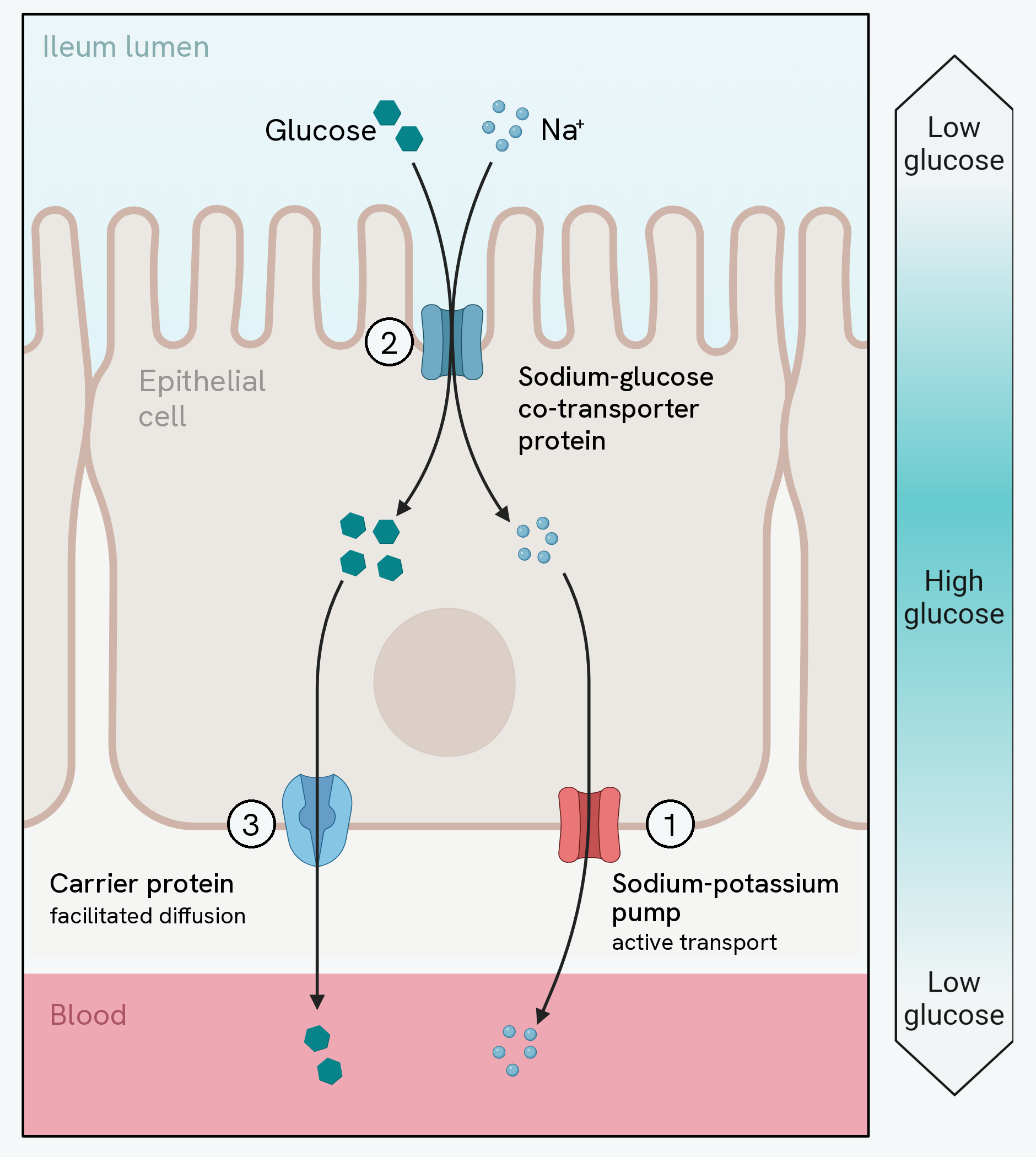
Notice that the numbers run bottom, top, bottom. Step 1 happens at the base of the cell, before anything has entered at the top, because the pump is what creates the sodium gradient that everything else runs on. The bar beside the cell is why the middle step is needed at all: glucose is low in the lumen and high inside the cell, so step 2 is moving it the wrong way for diffusion.
What affects the rate of transport
Several factors change how fast substances cross a membrane. A steeper concentration gradient speeds up simple and facilitated diffusion, and a steeper water potential gradient speeds up osmosis. A larger membrane surface area increases the rate of all forms of transport. For facilitated diffusion and active transport, the number of channel or carrier proteins matters too: once every protein is working at its maximum, adding more substrate makes no difference, because the proteins have become the limiting factor.
Adaptations for fast transport
Cells that move a lot of material are adapted for it. An epithelial cell in the ileum, for example, has its membrane folded into microvilli to increase the surface area, a large number of carrier and channel proteins in that membrane, and many mitochondria to supply the ATP that active transport and co-transport depend on.