AQA GCSE Biology: Coronary Heart Disease
A clear GCSE Biology revision guide to coronary heart disease: its cause, how it leads to a heart attack, stents and statins, faulty heart valves, and heart failure.
Coronary heart disease is one of the most important non-communicable diseases, caused by the heart's own blood supply becoming blocked. This guide explains what causes it, how it can lead to a heart attack, and the ways it and other heart problems are treated, along with the advantages and disadvantages of each. Weighing up treatments is a key skill here.
What causes coronary heart disease
The heart muscle is supplied with oxygenated blood by the coronary arteries. In coronary heart disease (CHD), layers of fatty material build up inside these arteries. This narrows them, reducing blood flow and so cutting the supply of oxygen and glucose to the heart muscle.
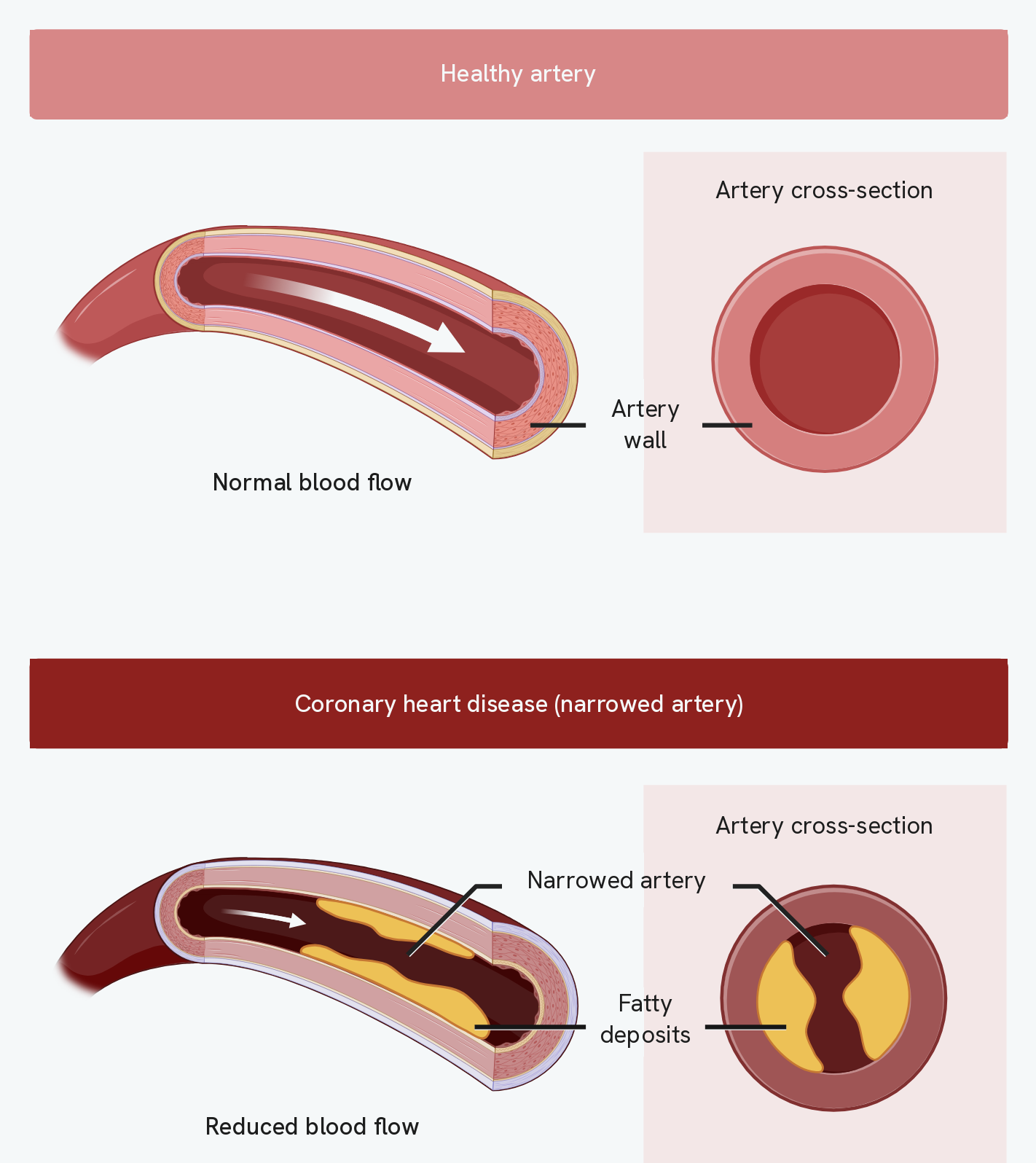
Both halves of that figure are the same artery. In the healthy one the lumen is wide and open. In the diseased one the fatty deposits, drawn in yellow, have built up inside the wall and pushed into the lumen, leaving only a narrow channel for the blood.
The cross-sections on the right are the ones worth remembering, because that is how an exam question usually draws it. Compare how much of each circle is open space. The wording that earns the marks is that the artery is narrowed by fatty material, and that this reduces blood flow, so less oxygen reaches the heart muscle. Saying the artery is "blocked" is not the same thing, and on its own it is worth nothing.
If blood flow through a coronary artery becomes severely restricted, the heart muscle beyond the blockage does not get enough oxygen for aerobic respiration. Without enough energy, those heart muscle cells die, which is a heart attack.
Treating coronary heart disease
Two common treatments tackle the problem in different ways.
- Stents are small metal mesh tubes inserted into a narrowed artery to hold it open, restoring blood flow straight away. The downside is that fitting one needs surgery, which carries risks such as infection, bleeding, and blood clots forming on the stent.
- Statins are drugs that reduce blood cholesterol, slowing the build-up of fatty deposits. They are non-invasive and taken as a daily tablet, but they take time to work, must be taken long-term, and can have side effects such as muscle pain.
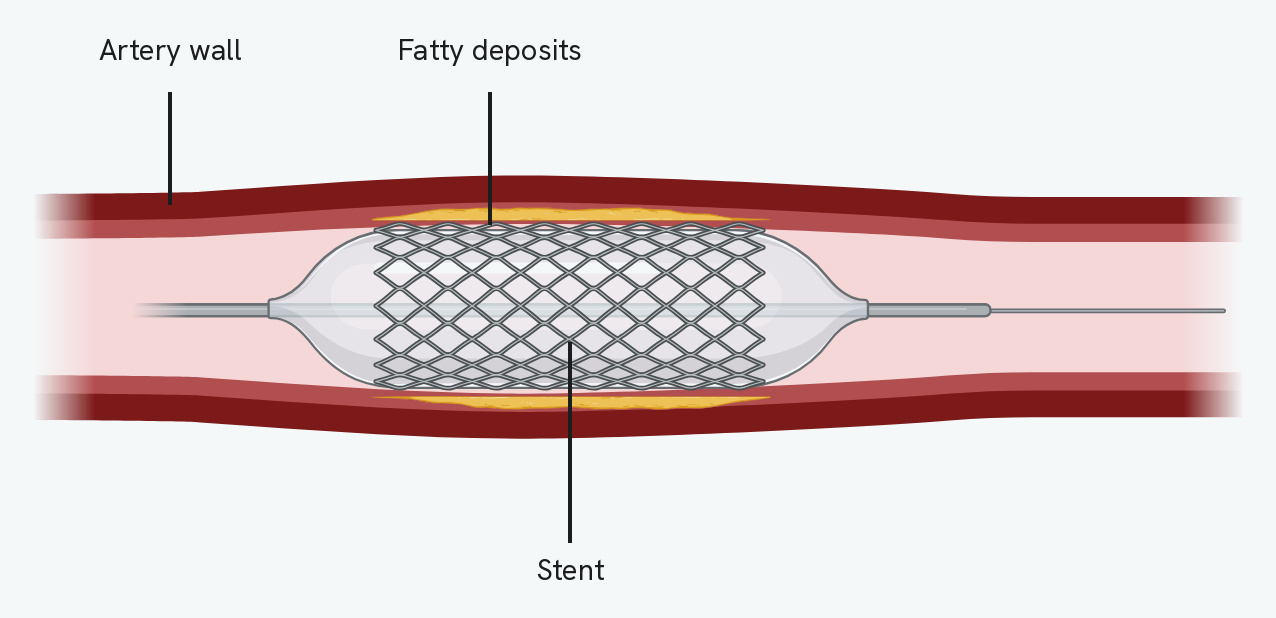
That is a stent in place. The mesh tube has been expanded inside the narrowed section, pressing the fatty deposits back against the artery wall and leaving a clear channel for blood. The transparent bulge around it is the balloon that opened it, carried in on a fine wire and taken out afterwards. You are not asked to name that, but it answers the obvious question of how something rigid gets inside a blood vessel.
Notice what a stent does and does not do. It widens the artery, so blood flow is restored at once. It does nothing to the fatty deposits themselves, and nothing to stop more forming elsewhere. That is why a patient is usually given statins as well: the stent deals with this blockage, the statins slow down the next one.
In general, statins suit prevention and long-term management, while a stent suits a case where a blockage has already formed and blood flow needs restoring quickly.
Faulty heart valves
Healthy valves stop blood flowing backwards inside the heart. A faulty valve causes problems: if it does not open fully, blood flow is restricted; if it leaks, blood flows backwards. Either way, less oxygenated blood is pumped around the body.
Faulty valves can be replaced with biological valves (from animal or human donors, which may wear out over time) or mechanical valves (artificial and longer-lasting, but they can cause blood clots, so patients need anti-clotting medication).
Heart failure
Heart failure is when the heart cannot pump enough blood to meet the body's needs. It may be treated with a heart transplant from a donor (with the risks of long waiting times and immune rejection, which needs immunosuppressant drugs), or a temporary artificial heart to keep the patient alive while waiting (which is expensive, has a limited lifespan and can cause blood clots).
How this fits together
Coronary heart disease is one example of a non-communicable disease driven by lifestyle. How lifestyle and other risk factors affect health more broadly is the subject of the health and non-communicable disease guide.