AQA GCSE Biology: Plant Transport
A clear GCSE Biology revision guide to transport in plants: transpiration and the transpiration stream, guard cells and stomata, the factors affecting transpiration, and translocation.
Plants move water up from the roots and sugars around from the leaves, using two transport tissues. This guide explains transpiration and the transpiration stream, and then the Triple-only detail on how stomata are controlled, what changes the rate of transpiration, and how sugars are moved in translocation. The big idea is that water is pulled up as it evaporates from the leaves.
The plant transport system
The roots, stem and leaves together form the organ system that transports substances around a plant.
Transpiration and the transpiration stream
Transpiration is the loss of water vapour from the leaves. It happens in two steps: water evaporates from the surfaces of cells inside the leaf, and the water vapour then diffuses out through the open stomata.
This water loss creates a continuous pull (tension) that draws water up through the xylem from the roots. Water enters the root hair cells from the soil by osmosis, and mineral ions enter by active transport. This continuous flow of water from roots to leaves is called the transpiration stream.
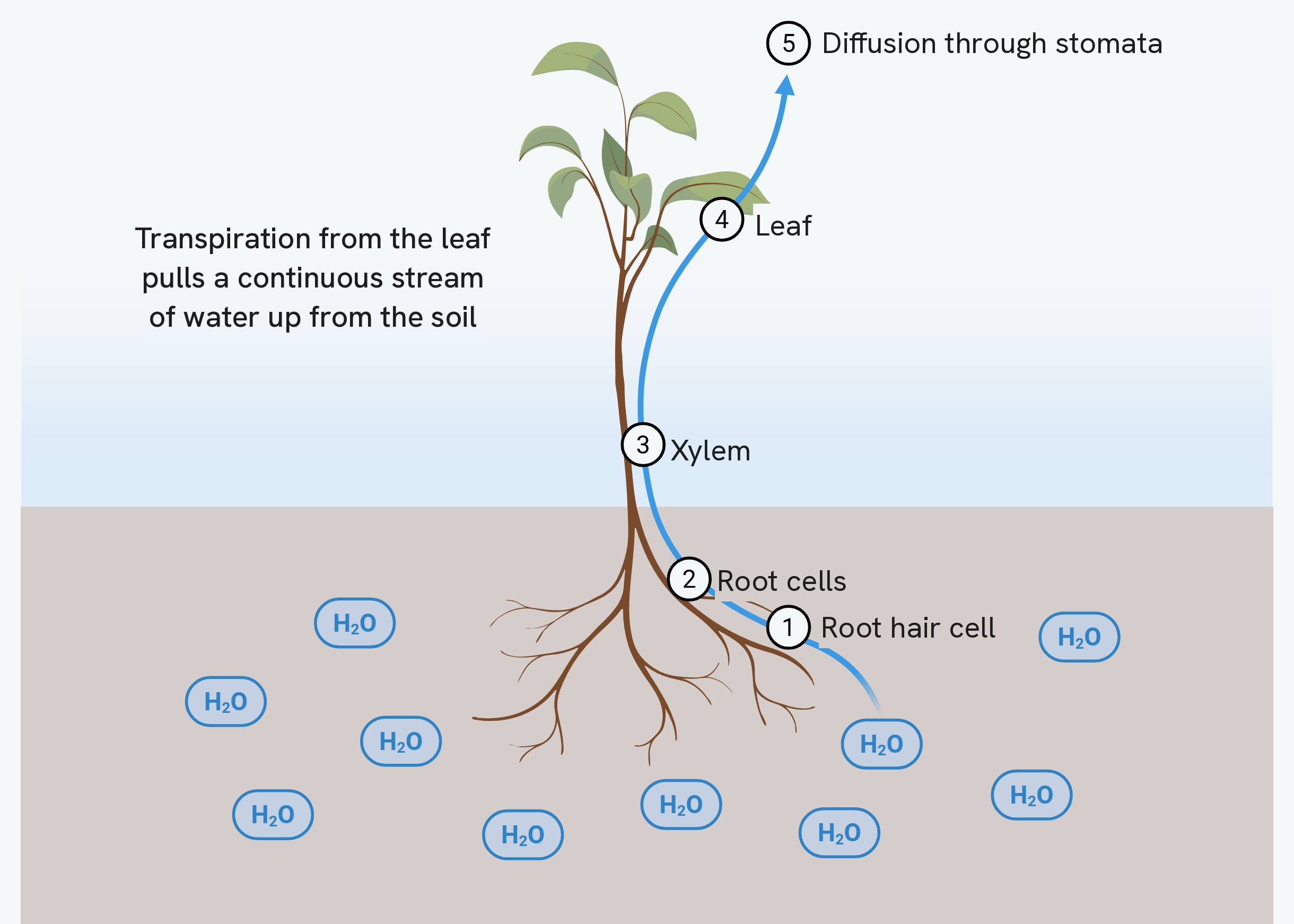
Follow the numbers and that is the whole transpiration stream. Water in the soil enters a root hair cell by osmosis, crosses the root, travels up the xylem, reaches the leaf, evaporates from the surfaces of the cells inside it, and the vapour diffuses out through the stomata.
The direction is worth pausing on, because it is the thing students most often get backwards. The plant does not push water up. Water is pulled up, and the pull comes from the top: as water evaporates out of the leaves, more is drawn up behind it. Stop the transpiration and the stream stops with it.
Guard cells and stomata
(Triple award only.) Guard cells control the size of the stomata, balancing gas exchange against water loss.
- In bright light, guard cells absorb water by osmosis, swell and become turgid, which opens the stomata. This lets carbon dioxide in for photosynthesis, but also lets water vapour escape.
- In hot, dry or dark conditions, guard cells lose water, become flaccid, and the stomata close. This reduces water loss, but also limits carbon dioxide entry.
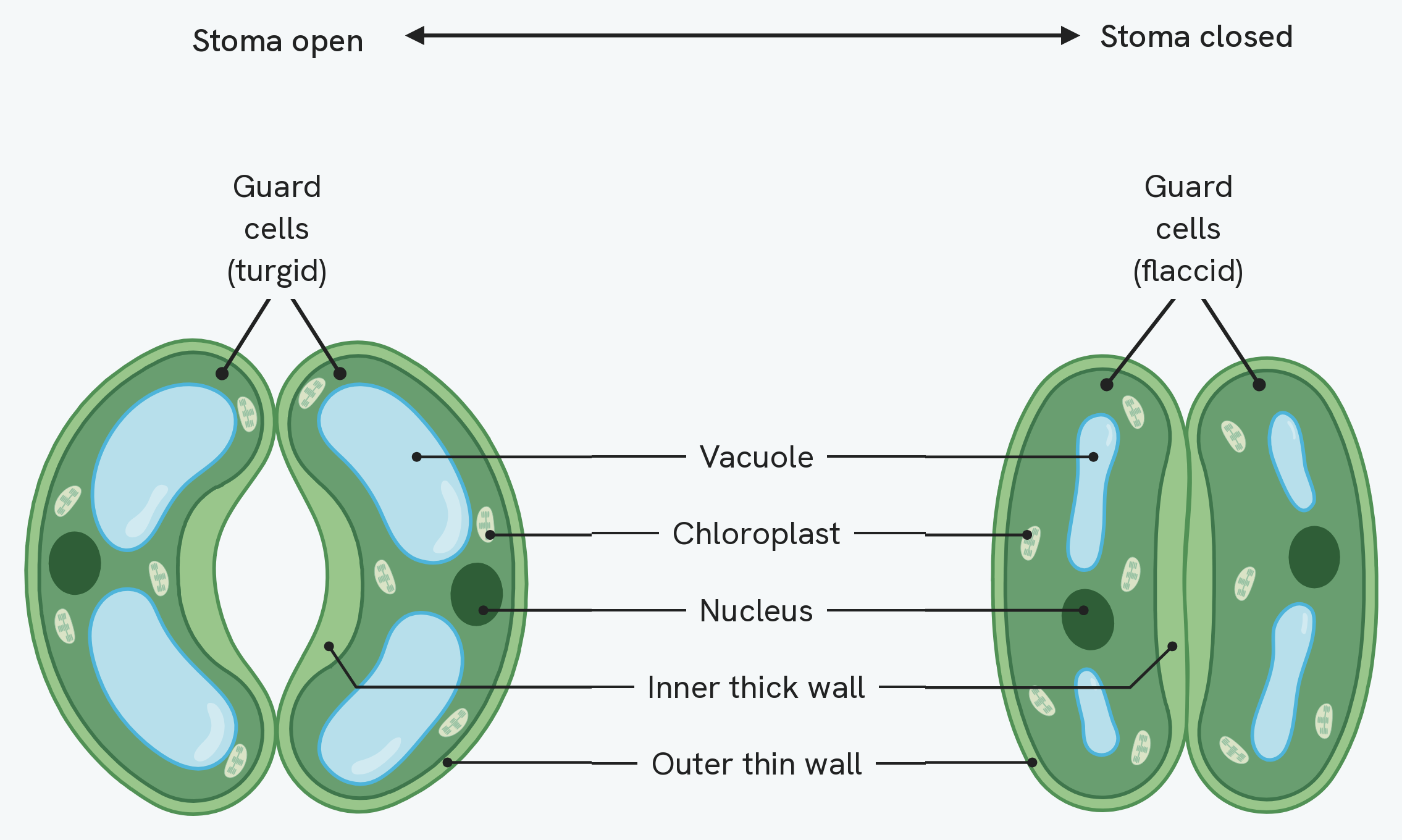
Both drawings are the same pair of cells. On the left they are turgid, bowed apart, and the stoma between them is open. On the right they are flaccid, pressed together, and it is shut.
Why do they bow apart rather than just swell? The wall facing the pore is thicker than the wall facing outwards, so as the cell fills with water the thin outer wall stretches more than the thick inner one and the cell curves away from its partner. AQA does not ask for that, but it is the reason a pair of guard cells opens a hole rather than simply getting fatter.
Factors affecting the rate of transpiration
(Triple award only.) Four factors change how fast a plant transpires.
- Light intensity: more light opens more stomata (to let carbon dioxide in), so more water vapour diffuses out and transpiration increases.
- Temperature: higher temperature gives water molecules more kinetic energy, so evaporation from the cell surfaces is faster and transpiration increases.
- Air flow (wind): moving air carries water vapour away from the leaf, keeping the concentration gradient steep, so transpiration increases.
- Humidity: more water vapour already in the air reduces the concentration gradient out of the leaf, so transpiration decreases.
The rate of transpiration can be measured with a potometer, which measures the rate of water uptake by a cut shoot. The distance an air bubble moves along a capillary tube in a set time is used to calculate the rate, assuming water uptake is proportional to water lost by transpiration.
Translocation
(Triple award only.) Translocation is the transport of dissolved sugars (such as sucrose) through the phloem. Sugars made in the leaves by photosynthesis are moved both upwards and downwards to wherever they are needed: to growing regions (meristems) for growth, to storage organs to be turned into starch, or to any cell that needs glucose for respiration.
How this fits together
Transport in plants completes Topic 2, which has covered organisation in both animals and plants, from cells and tissues up to whole organ systems. The same ideas of exchange and transport return throughout GCSE Biology.