AQA A-Level Biology: ATP, Water and Inorganic Ions
A clear revision guide to ATP, water and inorganic ions for AQA A-Level Biology: the structure and hydrolysis of ATP, why cells use it, the properties of water, and the roles of four key ions.
The last three sections of Topic 1 are short, and they are examined together here because they share a theme: each is a small molecule or ion whose importance is out of all proportion to its size. This guide covers ATP and why cells use it, the properties of water and where each one comes from, and the specific roles of four inorganic ions.
ATP
ATP (adenosine triphosphate) is a nucleotide, built from the same three parts as the nucleotides in the last guide:
- the base adenine,
- the pentose sugar ribose,
- and a chain of three phosphate groups.
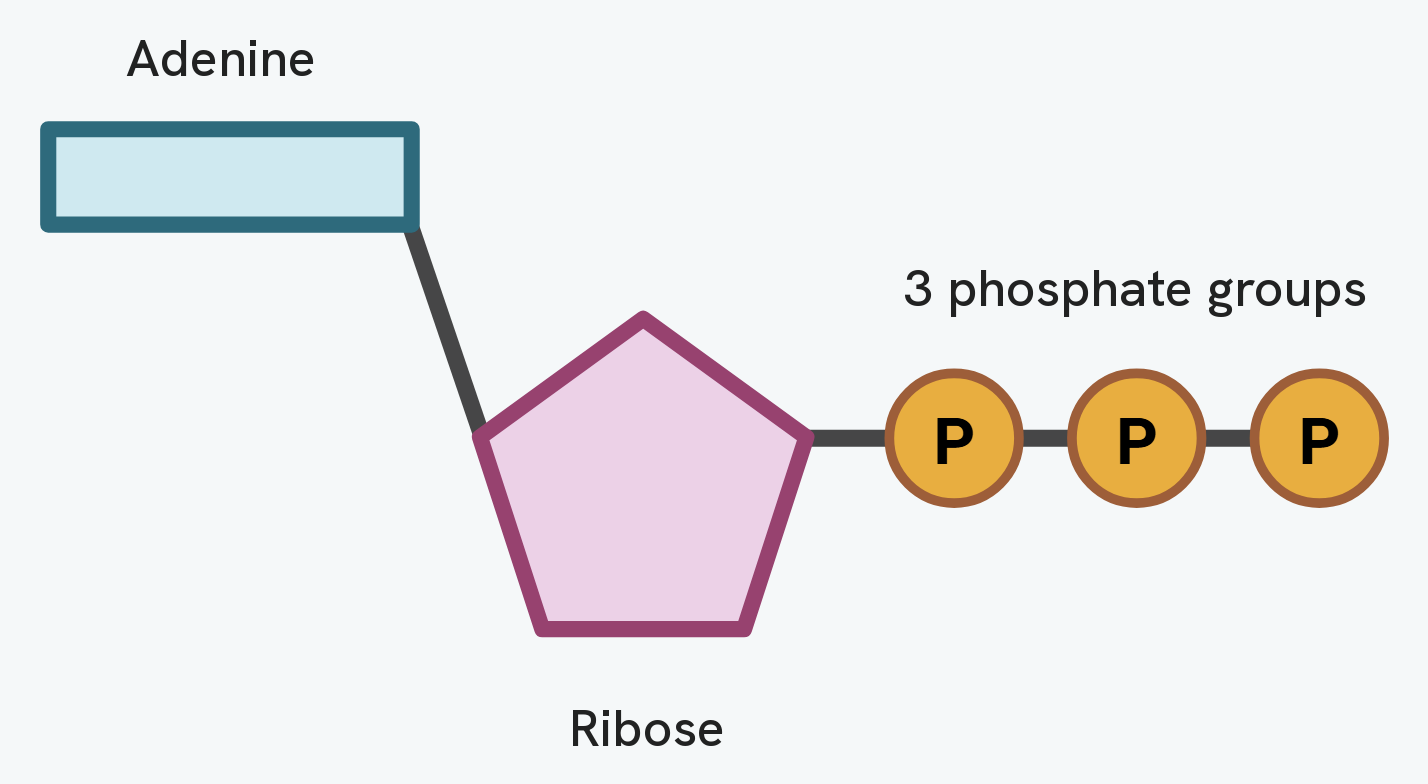
Energy is released when ATP is hydrolysed, a reaction catalysed by the enzyme ATP hydrolase. The bond to the third phosphate is broken by adding water, giving ADP (adenosine diphosphate) and a single inorganic phosphate group, and releasing energy.
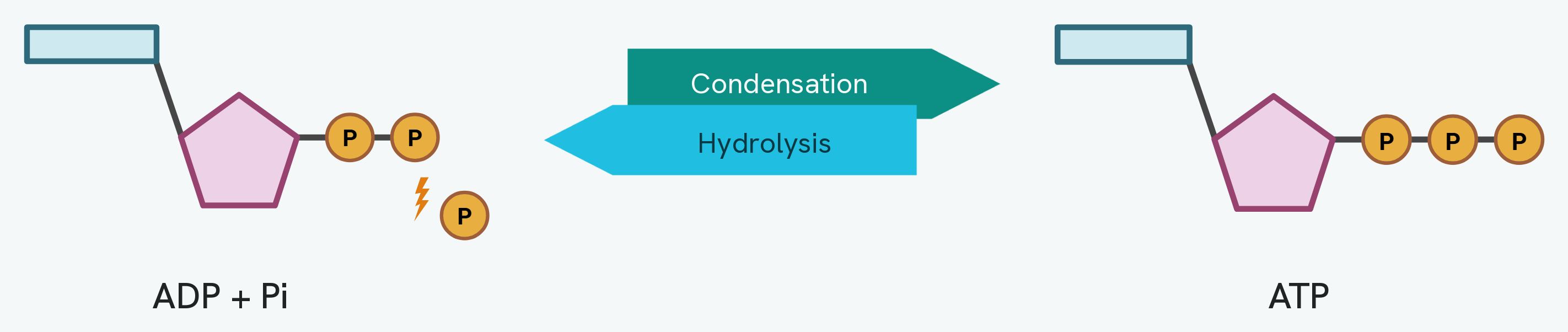
The reverse reaction, a condensation catalysed by ATP synthase, rebuilds ATP from ADP and inorganic phosphate during respiration and photosynthesis. ATP is therefore not a store but a currency: it is made and spent continuously, and a cell holds only a small amount at any moment.
The inorganic phosphate released is useful in its own right. Adding it to another molecule, called phosphorylation, makes that molecule more reactive, which is how ATP drives reactions that would not otherwise happen.
Why cells use ATP rather than glucose
Glucose holds far more energy than ATP, so the obvious question is why cells bother with an intermediate. The answer has several parts, and questions usually want more than one:
- Hydrolysing ATP is a single reaction, so energy is available immediately. Releasing energy from glucose takes many steps.
- It releases a small, manageable amount of energy, so little is wasted as heat. Breaking down glucose in one go would release far more than any one reaction needs.
- It is quickly resynthesised, so the same molecules are used over and over.
- It cannot cross the cell membrane, so it stays in the cell that made it and is used where it is made.
Water
Water makes up most of every cell, and nearly all of its useful behaviour comes from one feature. Water is dipolar: the oxygen atom carries a slight negative charge and the hydrogen atoms a slight positive charge. Opposite charges on neighbouring molecules attract, forming hydrogen bonds.
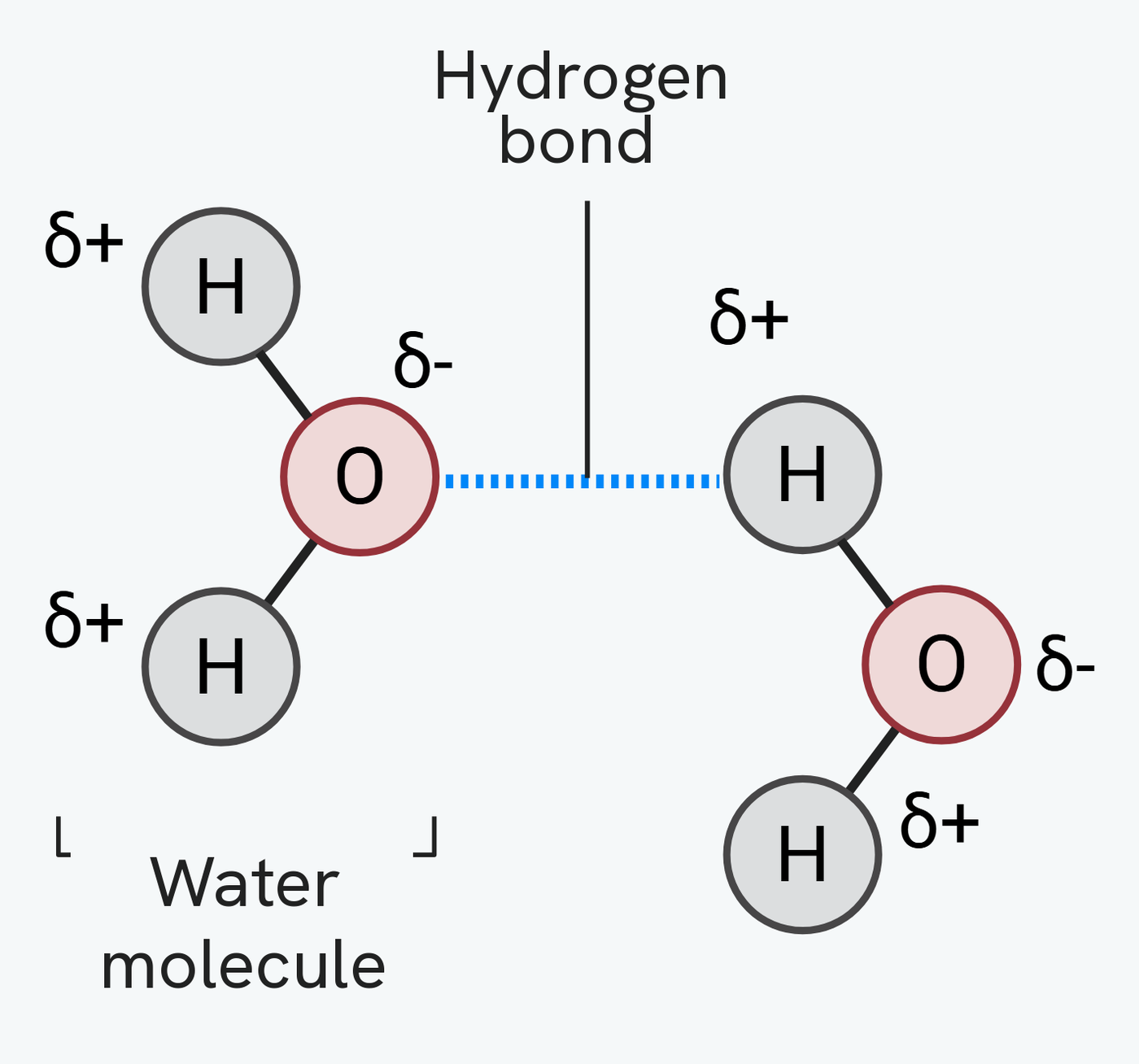
Water is also a metabolite, meaning it takes part in reactions rather than just surrounding them. It is released in every condensation reaction and used in every hydrolysis reaction, which covers most of the molecules in this topic.
Everything else follows from the hydrogen bonds.
| Property | Why water has it | Why it matters in biology |
|---|---|---|
| Good solvent | It is polar, so it surrounds charged and polar particles and separates them | Metabolic reactions happen in solution, and dissolved substances can be transported |
| High specific heat capacity | Hydrogen bonds absorb a lot of energy before the temperature rises | Buffers temperature changes, so cells and habitats stay stable |
| High latent heat of vaporisation | A lot of energy is needed to break the hydrogen bonds and evaporate water | Evaporation removes a great deal of heat for little water lost, so sweating cools effectively |
| Strong cohesion | Hydrogen bonds hold neighbouring molecules to one another | Columns of water are pulled up the xylem, and surface tension forms where water meets air |
Inorganic ions
Inorganic ions are charged particles that do not contain carbon, found dissolved in the cytoplasm and in body fluids. Some are needed in large amounts and others in tiny ones, and each has a specific role that follows from its properties. Four are named in the specification.
- Hydrogen ions (H⁺) determine pH. Since pH affects the bonds holding a protein's tertiary structure, it affects the shape of enzyme active sites and therefore the rate of enzyme-controlled reactions.
- Iron ions (Fe²⁺) are part of haemoglobin, where each one binds a molecule of oxygen so it can be carried round the body.
- Sodium ions (Na⁺) are needed for the co-transport of glucose and amino acids across cell membranes, for example in absorption from the small intestine.
- Phosphate ions (PO₄³⁻) are part of DNA, RNA, ATP and phospholipids, so they appear in information storage, energy transfer and membranes alike.
How this fits together
That completes Topic 1. The thread running through all of it is that structure determines function: the same few reactions build very different molecules, and the shape and properties of each one explain exactly what it does.
The molecules in this topic are the materials cells are built from. How those materials are assembled into a working cell is Topic 2.