AQA A-Level Biology: Lipids
A clear revision guide to lipids for AQA A-Level Biology: triglycerides and ester bonds, saturated and unsaturated fatty acids, phospholipids and the bilayer, and the emulsion test.
Lipids are the group that breaks the pattern: they are built by the same reaction as everything else in this topic, but they are not polymers. This guide covers triglycerides, the difference between saturated and unsaturated fatty acids, phospholipids and why they form membranes, and the emulsion test. The theme is that a molecule which will not mix with water is useful precisely because it will not.
Why lipids are not polymers
A polymer is a long chain of one repeating monomer. A triglyceride is not: it is one molecule of glycerol joined to three fatty acids, and there it stops. Nothing repeats, and the chain does not extend.
They are still made by condensation, which is why they sit in this topic. The bond formed is an ester bond, and since three bonds form, three molecules of water are released for every triglyceride built. Hydrolysis reverses it, using three molecules of water to give back glycerol and three fatty acids.
Being asked why lipids are not polymers is common, and the answer is not that they are small. It is that they are not made of many repeating identical units.
Triglycerides
Every triglyceride has the same glycerol, so what varies between one and another is the fatty acids. A fatty acid is a long hydrocarbon chain with a carboxyl group at one end.

Triglycerides are good energy stores, and the reasons are worth separating out because they are marked separately:
- The hydrocarbon tails carry a large amount of energy for their mass, more than twice as much per gram as a carbohydrate, so a store of fat is lighter than the same energy stored as glycogen.
- They are insoluble in water, so they do not affect the water potential of the cell and water is not drawn in by osmosis.
- Releasing energy from them also releases water, which matters to animals that cannot easily drink.
They do more than store energy. A layer of fat under the skin gives thermal insulation, fat around organs such as the kidneys gives physical protection, and waxy lipids on leaves and on insect cuticles are waterproofing.
Saturated and unsaturated
The tails differ in whether they contain carbon-to-carbon double bonds.
- A saturated fatty acid has no carbon-to-carbon double bonds. It holds as many hydrogens as it can, which is what saturated means, and the chain is straight.
- An unsaturated fatty acid has one or more double bonds. Each one puts a kink in the chain.
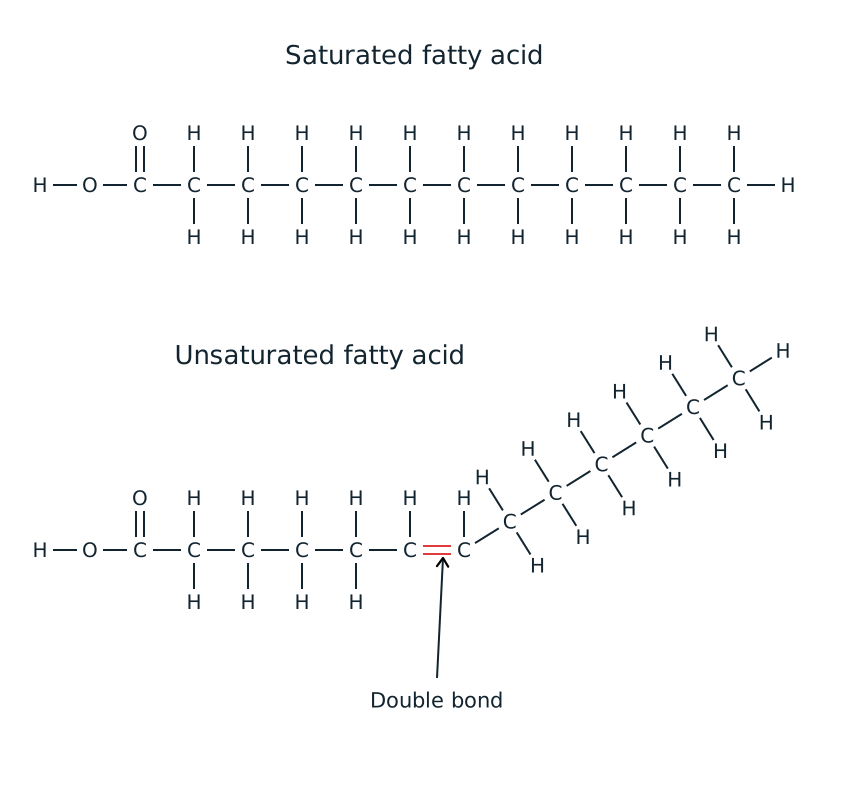
Kinked chains cannot pack together as closely as straight ones, so there are fewer forces holding them and less energy is needed to separate them. That is why unsaturated fats have lower melting points and tend to be liquid at room temperature, while saturated fats are solid.
Phospholipids
A phospholipid is a triglyceride with one of the three fatty acids replaced by a phosphate group. That single substitution gives the molecule two ends that behave in opposite ways:
- the phosphate head is charged, so it is hydrophilic and interacts with water;
- the two fatty acid tails are not, so they are hydrophobic and do not.
A molecule with both properties in one is described as amphipathic, and it cannot settle anywhere in water except at a boundary. Put many of them in water and they arrange themselves automatically into a bilayer, heads outward into the water on both sides and tails pointing inward away from it.
That is not a detail about lipids. It is the reason cells have an outside and an inside at all, and it is where this topic meets the cell membrane.
Testing for lipids
Lipids are found with the emulsion test:
- Shake the sample with ethanol so any lipid dissolves.
- Pour the solution into water.
- A milky-white emulsion forms if lipid is present.
Two points of wording matter more here than in any other test on the specification. The word that earns the mark is emulsion, so an answer must say one forms. And the reagent is ethanol, not water first: adding water before ethanol dissolves nothing and the test fails.
Describing the result as a precipitate is wrong and will lose the mark. Nothing has come out of solution as a solid. Tiny droplets of lipid are suspended in the water, which is what an emulsion is, and calling it something else says you have the wrong idea about what happened.
How this fits together
Lipids are defined by what they will not do, which is mix with water. The next group is defined by the opposite: its shape is decided by which parts of it are attracted to water and which are not, in the proteins guide.