AQA A-Level Biology: Genetic Fingerprinting
A clear revision guide to genetic fingerprinting for AQA A-Level Biology: variable number tandem repeats (VNTRs), how a fingerprint is made, and its uses in forensics, relationships, diversity and breeding.
Genetic fingerprinting produces a pattern of DNA fragments that is, in effect, unique to each individual. This guide explains what makes each person's DNA different in this way, how a fingerprint is made using the same tools as genetic screening, and how it is used, from crime scenes to paternity tests to conservation breeding. The key idea is that non-coding DNA varies enormously between individuals, and that variation can be read as a pattern.
Variable number tandem repeats
The basis of genetic fingerprinting is variable number tandem repeats (VNTRs): short sequences of bases (such as GATA) that are repeated many times, found in the non-coding regions of DNA at many sites across the genome.
VNTRs are ideal for identification because the number of repeats at each site varies a lot between individuals. Since the genome contains many VNTR sites, and the length at each one differs from person to person, the probability of two people (other than identical twins) having exactly the same set of VNTRs is extremely low.
Making a genetic fingerprint
A fingerprint is made using the same techniques as genetic screening, applied to the VNTRs.
- DNA is extracted from a sample, such as blood, and amplified by PCR.
- It is cut with restriction enzymes at recognition sites either side of the VNTRs.
- The VNTR fragments are separated by gel electrophoresis, so shorter fragments travel further, producing a pattern of bands according to length.
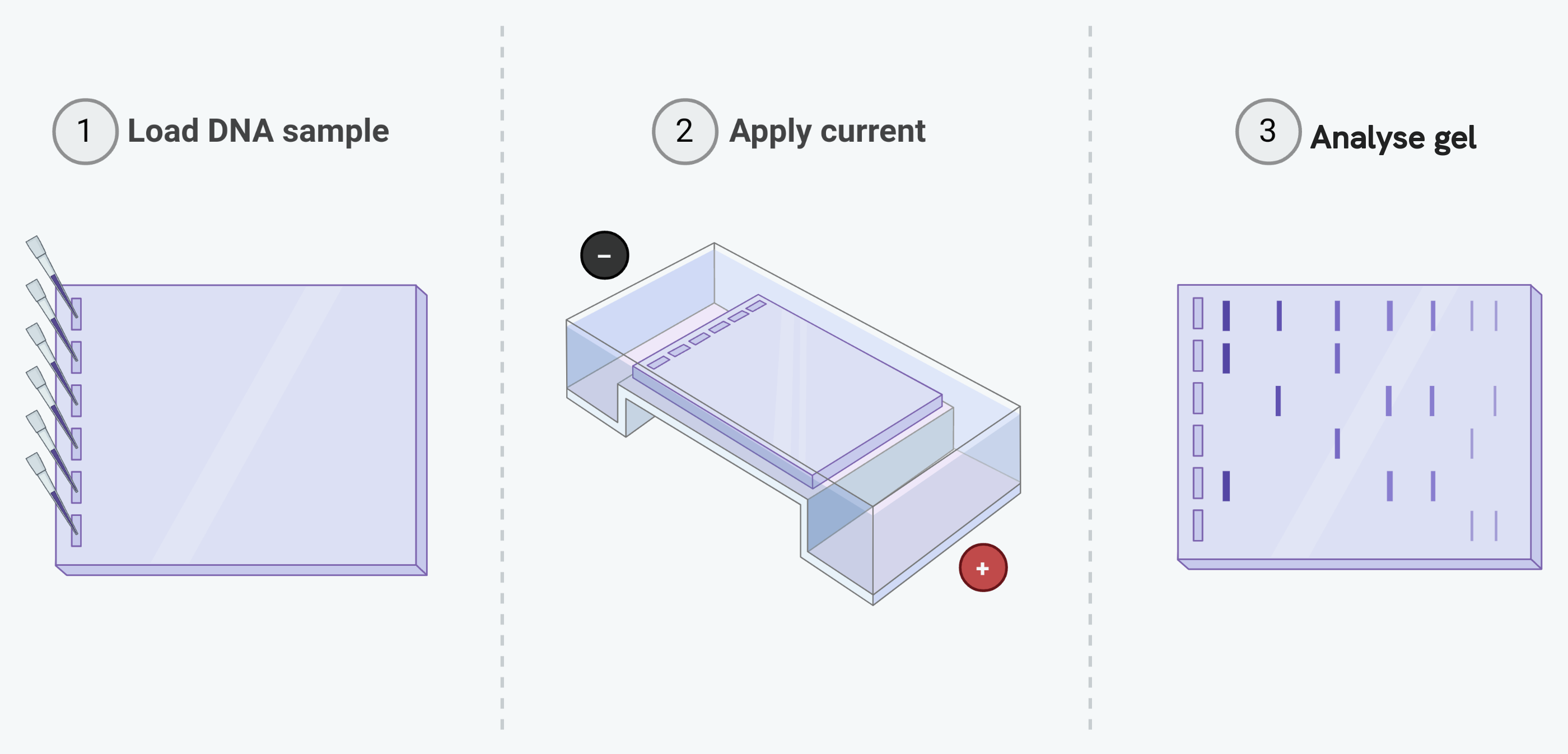
Look at which electrode is at which end, because the direction is a mark. DNA is negatively charged, owing to the phosphate groups in its backbone, so it moves away from the negative electrode and towards the positive one. The wells therefore have to be at the negative end.
Then compare the bands on the finished gel. They have all travelled for the same time through the same gel, so the only thing that separates them is length: shorter fragments move further, because they pass through the mesh of the gel more easily.
- The fragments are transferred to a nylon membrane and made single-stranded.
- Labelled DNA probes are added, which hybridise with the complementary VNTRs, and unbound probe is washed off.
- The bound probe is revealed using UV light (fluorescent probe) or autoradiography (radioactive probe), giving the banding pattern that is the fingerprint.
Genetic fingerprinting and genetic screening share most of these steps: both use PCR to amplify DNA, electrophoresis to separate fragments, and labelled probes to visualise them. The difference is what they target: fingerprinting analyses VNTRs, while screening analyses specific alleles of a gene.
Uses of genetic fingerprinting
The banding pattern can be compared between samples, which makes it useful in several fields.
- Determining relationships. More closely related individuals share more VNTRs, so their fingerprints are more similar. In a paternity test, a child should share about 50% of its bands with its biological father, because half of its DNA is inherited from him.
- Genetic variability. Because differences in VNTRs arise from mutations, more differences between individuals indicate greater genetic diversity within a population.
- Forensic science. The fingerprint from a crime scene is compared with those of suspects; if many bands match, the suspect was likely present.
- Medical diagnosis. Some VNTR patterns are associated with a higher risk of certain genetic disorders, such as Huntington's disease.
- Animal and plant breeding. Fingerprints show how closely related two individuals are, so breeders can avoid inbreeding by choosing pairs with dissimilar fingerprints, which keeps a population genetically healthy.
How this fits together
Genetic fingerprinting is a neat application of everything in this topic: PCR, restriction enzymes, electrophoresis and DNA probes, turned on the variable, non-coding DNA that makes each individual unique. It completes Topic 8, which has traced the control of gene expression from a single mutation, through the switching on and off of genes, to the technologies that let us read, compare and rewrite DNA itself.