AQA A-Level Biology: Recombinant DNA Technology and PCR
A clear revision guide for AQA A-Level Biology to recombinant DNA technology and PCR: making DNA fragments with reverse transcriptase, restriction enzymes and gene machines, and amplifying DNA by the polymerase chain reaction.
Recombinant DNA technology lets scientists move a gene from one organism into another and get it working there. This guide covers the first two steps: making a fragment of DNA that contains the gene you want, by three different methods, and then copying it millions of times using the polymerase chain reaction. Understanding why a gene from one species works in another is the starting point for the whole field.
What recombinant DNA technology is
Recombinant DNA technology is the transfer of DNA fragments from one organism, or species, to another. The transferred DNA can be translated in the recipient's cells because the genetic code is universal, meaning the same triplets code for the same amino acids in all organisms, and the mechanisms of transcription and translation are also universal. A human gene can therefore be read correctly by a bacterium.
Making DNA fragments
There are three ways to produce a fragment of DNA containing the gene you want.
1. Reverse transcriptase. This makes DNA from mRNA.
- Messenger RNA (mRNA) is isolated from a cell that readily makes the desired protein.
- The mRNA is mixed with DNA nucleotides and the enzyme reverse transcriptase, which uses the mRNA as a template to build a single strand of complementary DNA (cDNA).
- DNA polymerase then builds the second strand, using the cDNA as a template.
This method has two advantages: there is far more mRNA than DNA in a cell, so it is easier to extract, and because the mRNA has already had its introns removed by splicing, the resulting DNA has no introns, which matters because bacteria cannot remove introns themselves.
2. Restriction enzymes. These cut a gene out of existing DNA.
- Restriction endonucleases cut DNA at specific base sequences called recognition sequences. The shape of the recognition site is complementary to the enzyme's active site.
- Some restriction enzymes cut in a staggered way, leaving short lengths of unpaired, exposed bases called sticky ends, which are useful for joining the fragment to other DNA later.
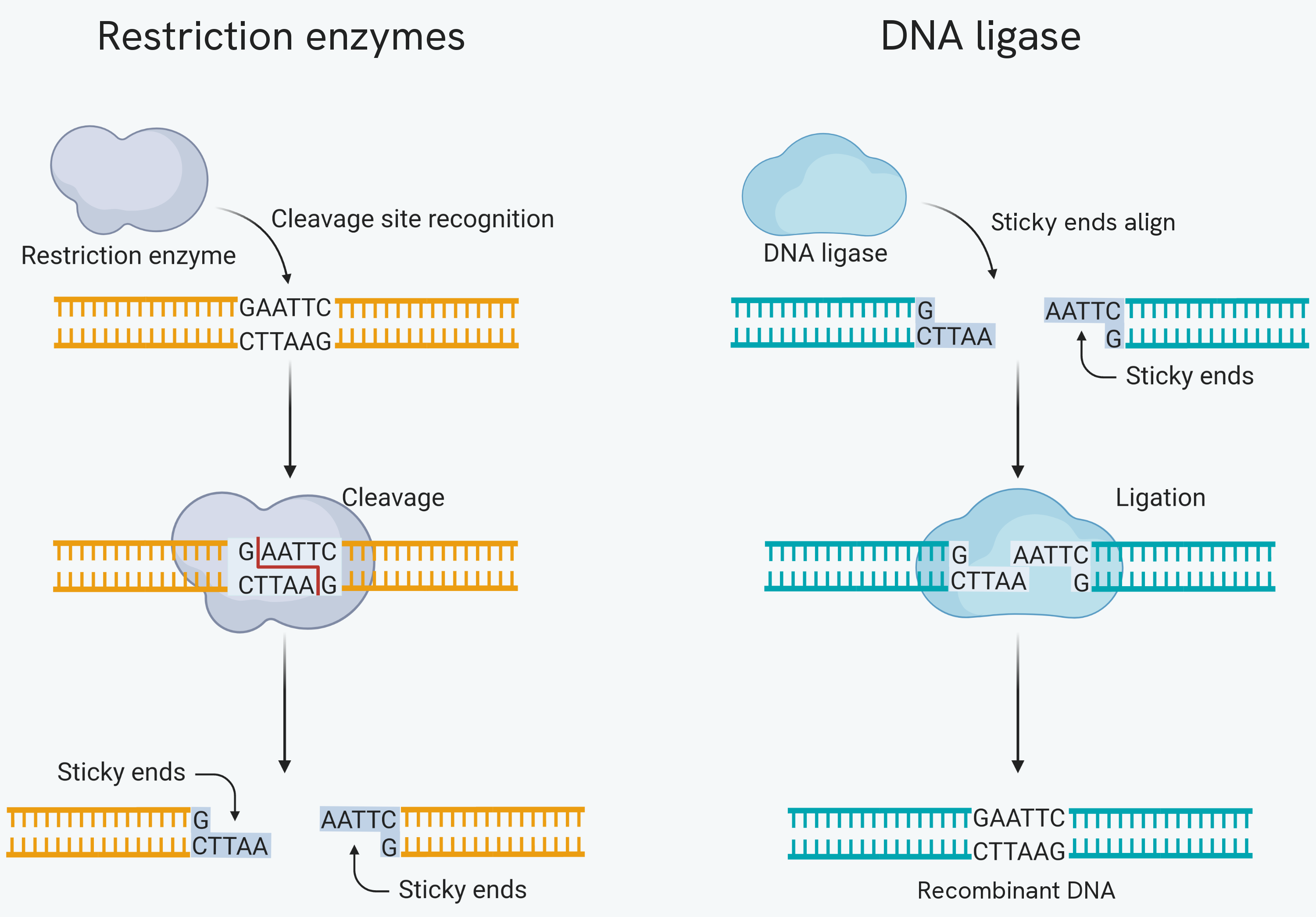
Read the sequence on the left and you can see why the cut is staggered. GAATTC on the top strand reads the same backwards on the bottom strand, and the enzyme cuts between the G and the A on both strands. Because those two cuts are not opposite each other, each fragment is left with a short run of unpaired bases.
That is the whole point of a sticky end. Any other fragment cut by the same enzyme has unpaired bases that are complementary to it, so the two will pair up. This is why the gene and the vector have to be cut with the same restriction enzyme, and it is the single most common mark lost on this topic.
3. A gene machine. This builds a gene from scratch, without a template.
- The amino acid sequence of the desired protein is used to work out the base sequence needed.
- The machine then synthesises the DNA fragment quickly and accurately. Because these fragments contain no introns, they can be transcribed and translated by prokaryotes.
Amplifying DNA by PCR
A single fragment is not enough; you usually need millions of copies. The polymerase chain reaction (PCR) copies DNA in vitro (outside a living cell). The reaction mixture needs the DNA fragment, DNA polymerase from a thermophilic organism (such as Taq polymerase, which survives high temperatures), primers, and free DNA nucleotides. It runs as a cycle of three temperatures.
- 95°C: the DNA strands separate, as the hydrogen bonds between the bases break.
- 55°C: the primers bind to the ends of the template strands, forming hydrogen bonds with complementary bases.
- 72°C: free nucleotides line up against the exposed bases, and DNA polymerase joins them together, forming phosphodiester bonds to build the new strands.
Each cycle doubles the amount of DNA, so the increase is exponential: after n cycles there are 2ⁿ times as many copies. The reaction eventually stops because the primers and nucleotides run out.
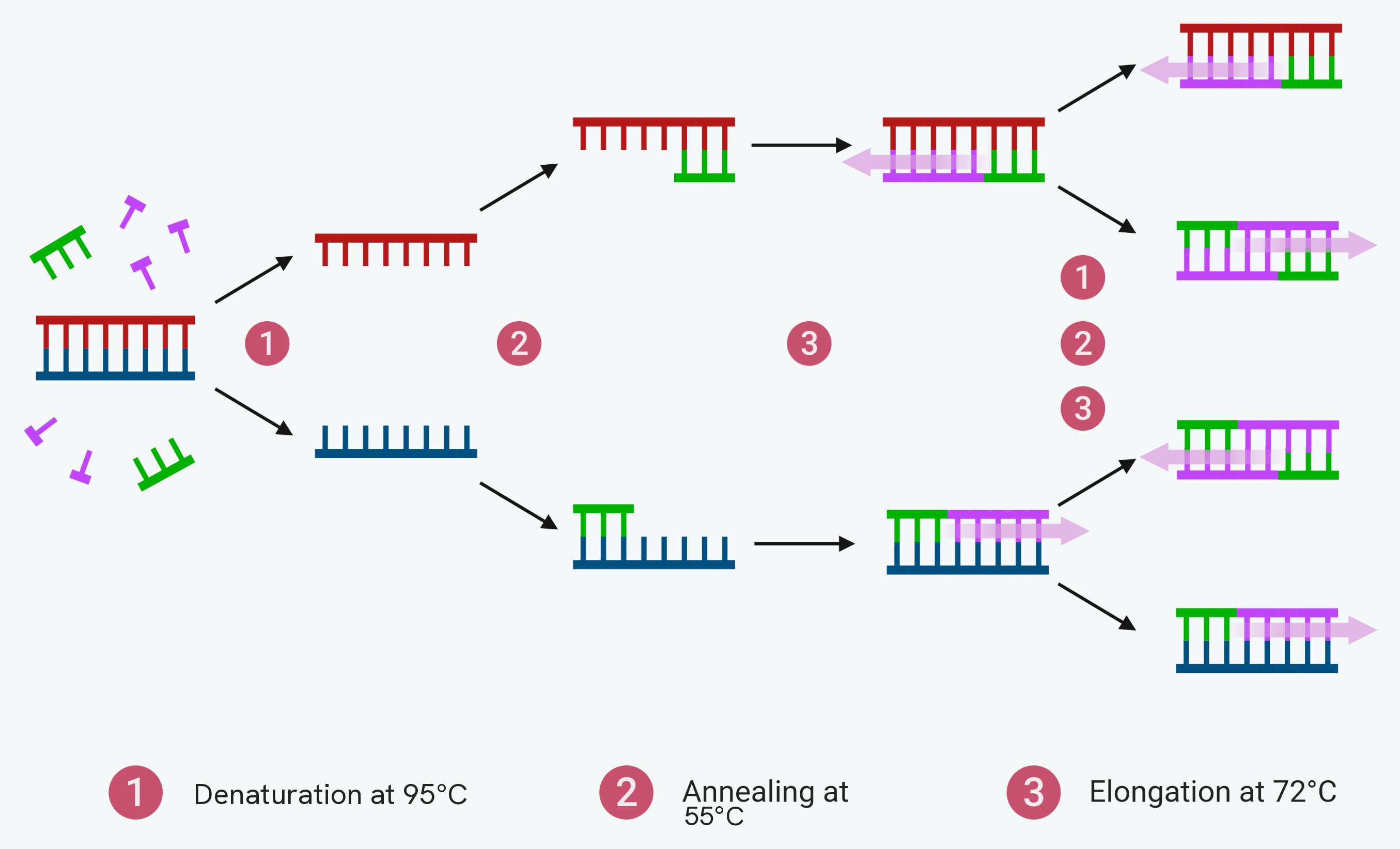
Follow one strand across the figure and the doubling explains itself. Every strand present at the start of a cycle ends it as a complete double strand, because each one acts as a template for a new partner. One becomes two, two become four, and that is why the increase is exponential rather than steady.
Notice where the primers sit: at the ends of the region being copied, one on each strand. Nothing is copied outside them, which is how PCR amplifies one chosen stretch of DNA and not the rest of the genome.
The role of primers
Primers are short, single-stranded pieces of DNA, complementary to the base sequences at the edges of the region to be copied. They are essential because DNA polymerase can only add nucleotides to an existing 3′ end, so it needs a primer to start from. Two different primers, a forward and a reverse one, are needed, because the sequences at the two ends of the fragment are different.
How this fits together
Making a gene fragment and copying it by PCR are the first half of genetic engineering. The next step is to get that gene into a living organism and expressed, using vectors and host cells, which, along with the uses and ethics of the technology, is the subject of the in vivo cloning and gene technology applications guide.