AQA A-Level Biology: Stem Cells and Cell Differentiation
A clear revision guide to stem cells for AQA A-Level Biology: totipotent, pluripotent, multipotent and unipotent cells, how cells differentiate, induced pluripotent stem cells, and treating disease.
Every cell in the body carries the same genes, yet a nerve cell and a muscle cell are utterly different. The difference is which genes are switched on, and that is decided as unspecialised stem cells become specialised. This guide explains what stem cells are, the types that exist, how they differentiate, and how they can be used to treat disease, including cells reprogrammed from a patient's own body. The theme is control of gene expression during development.
What stem cells are
Stem cells are cells that are:
- undifferentiated (unspecialised);
- able to divide by mitosis to replace themselves indefinitely;
- able to differentiate into other, specialised types of cell.
This combination, endless self-renewal plus the ability to become other cell types, is what makes them so useful, both in the body and in medicine.
The types of stem cell
Stem cells differ in how many cell types they can become, a property called their potency.
| Type | Found in | Can differentiate into |
|---|---|---|
| Totipotent | Early mammalian embryos (for a short time) | Any cell type, including extra-embryonic cells such as the placenta |
| Pluripotent | Mammalian embryos | Almost any cell type in the body, but not placental cells |
| Multipotent | Mature mammals | A limited range of cell types |
| Unipotent | Mature mammals | One cell type only |
Two examples to remember: multipotent cells in the bone marrow can become the different types of blood cell, and unipotent cells in the heart can become cardiomyocytes (heart muscle cells).
How cells become specialised
All the cells of an organism have the same genes, so differentiation is about which genes are expressed.
- A stimulus causes certain genes to be switched on, through proteins called transcription factors.
- Only those genes are transcribed into mRNA and then translated into proteins.
- These proteins permanently modify the cell, determining its structure and function.
Because only a specific set of genes is active, the cell takes on a specific, specialised form.
Induced pluripotent stem cells
Adult cells are normally specialised and cannot go back, but they can be reprogrammed into induced pluripotent stem cells (iPSCs).
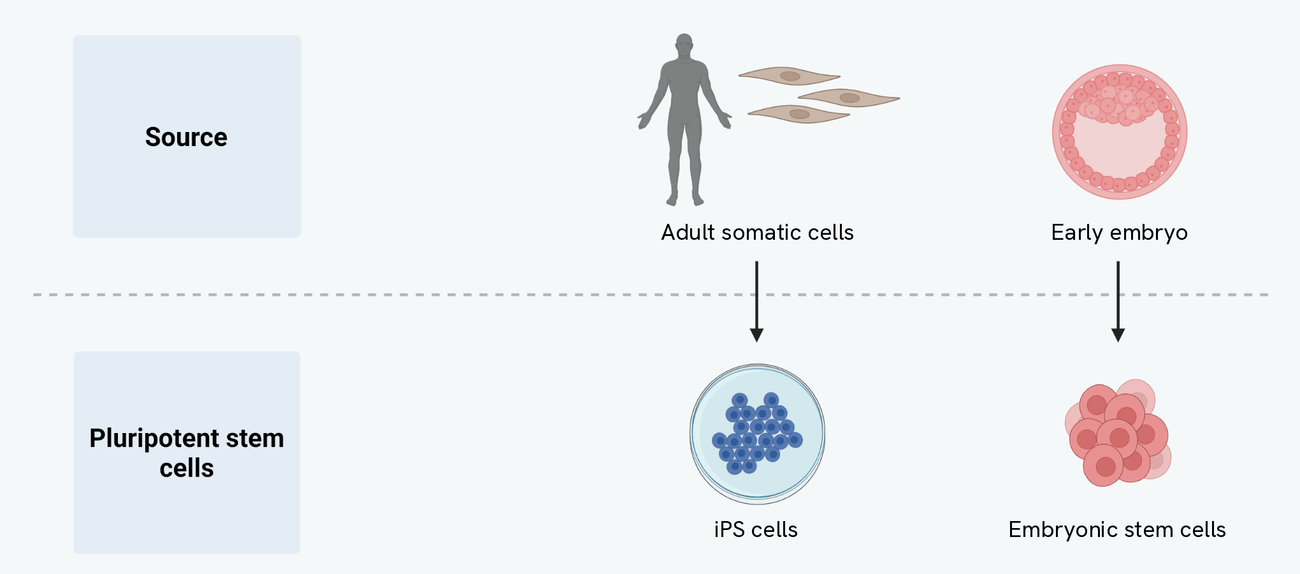
Both columns end in the same place. iPSCs and embryonic stem cells are both pluripotent, so either can become almost any body cell and neither can make placental tissue. In what they are able to do, they are the same.
Everything that separates them is in the top row. One route starts from somebody already alive, who can consent and is unharmed. The other starts from an embryo, which is destroyed in the process and cannot consent. That single difference is where every argument about stem cells comes from, which is why a question asking you to evaluate their use is really asking you to compare the two sources rather than the two cells.
There is a practical difference in that row as well. Because iPSCs are made from the patient's own body cells, they carry the patient's own DNA and are unlikely to be rejected. Embryonic stem cells come from a different individual, so they can be.
- Adult somatic cells are taken from the patient.
- Specific protein transcription factors associated with pluripotency are added, so the cells express genes associated with pluripotency, which reprograms them.
- These transcription factors bind to promoter regions of DNA, stimulating or inhibiting transcription.
- The cells are then cultured so they divide by mitosis.
The great advantage is that iPSCs are made from the patient's own cells, so once made they can divide and differentiate into healthy cells for transplant back into the same patient, and are unlikely to be rejected.
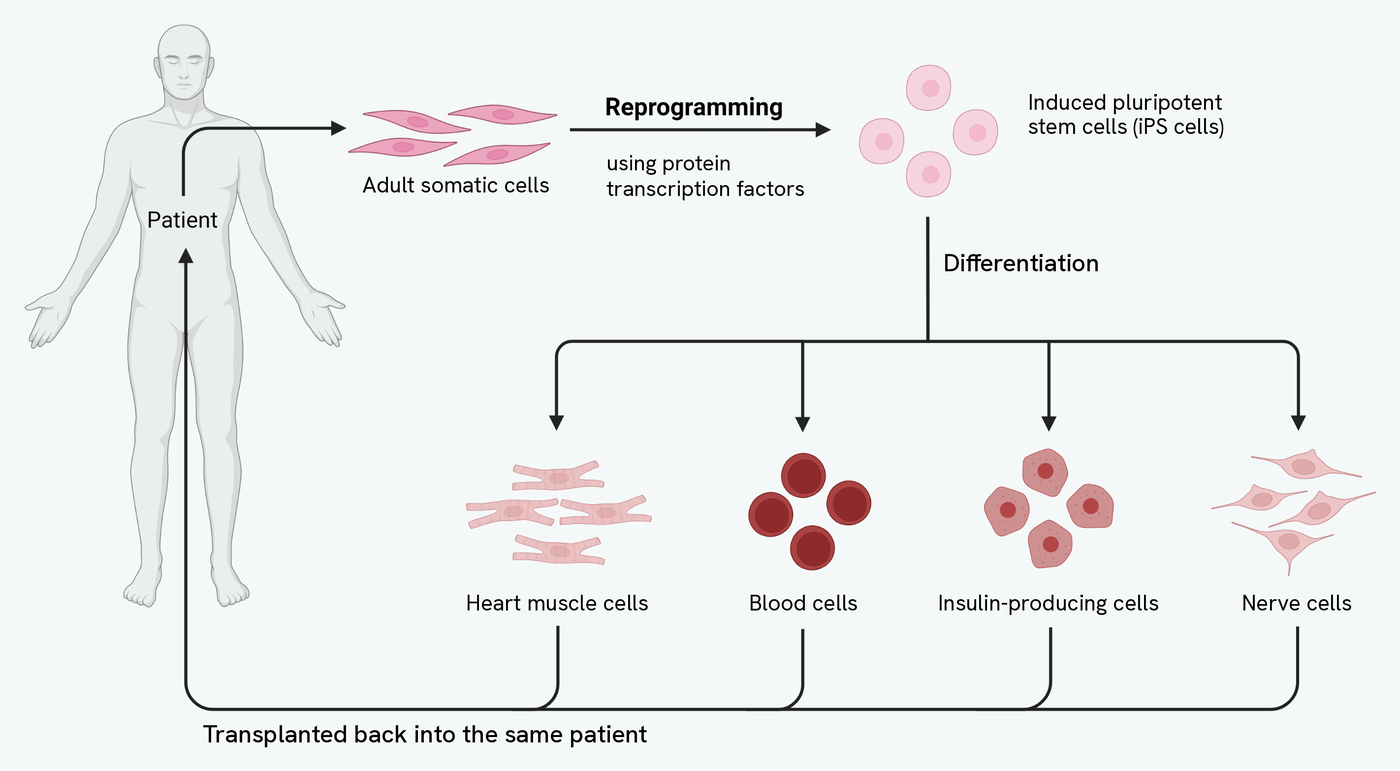
Two things on that diagram are worth more than they look.
The first is that it is a loop. The cells leave the patient at the top and return to the same patient at the bottom, and nothing from anybody else joins at any point. That is the whole argument for iPSCs in one picture: the transplanted cells carry the patient's own DNA, so the immune system has no reason to treat them as foreign, and no embryo is involved anywhere along the way.
The second is the word pluripotent. Every one of the four destinations is a body cell. There is no placenta on that diagram, and there could not be, because pluripotent cells cannot make extra-embryonic tissue. A totipotent cell could. If a question asks why these cells are called pluripotent and not totipotent, that is the answer.
The step that does the work is the arrow at the top, and reprogramming on its own is not an answer for it. The marks are for the protein transcription factors, which switch on the genes associated with pluripotency.
Treating disease with stem cells
Because stem cells can divide indefinitely and then differentiate, they can replace faulty or damaged cells.
- Stem cells are transplanted into a patient, where they divide and then differentiate into the healthy cells needed.
- For example, they could potentially treat type 1 diabetes by producing healthy islet cells that make insulin.
- Bone marrow stem cell transplants are used to treat blood cancers and sickle cell disease: the patient's own faulty bone marrow is destroyed first, then healthy donor stem cells are transplanted and divide and differentiate into healthy blood cells.
Their use raises questions, which are weighed on both sides. In favour: iPSCs and adult stem cells avoid destroying embryos, iPSCs are unlikely to be rejected, and embryos left over from IVF would otherwise be destroyed, while the treatments could relieve great suffering. Against: transplanted cells may be rejected, requiring immunosuppressant drugs; cells might divide uncontrollably and form tumours; and obtaining embryonic stem cells destroys an embryo, which raises ethical concerns.
How this fits together
Differentiation shows that controlling gene expression is what makes a cell what it is, and transcription factors are central to it. Those transcription factors, along with other mechanisms that switch genes on and off, are the subject of the regulation of transcription and translation guide.