AQA A-Level Biology: Regulation of Transcription and Translation
A clear revision guide for AQA A-Level Biology to controlling gene expression: transcription factors, the action of oestrogen, epigenetics (DNA methylation and histone acetylation), and RNA interference.
A cell controls which of its proteins are made, and it can do this at two points: when a gene is transcribed into mRNA, and when that mRNA is translated into protein. This guide explains the main mechanisms, transcription factors that switch genes on and off, oestrogen as a worked example, epigenetic changes that adjust how tightly DNA is packed, and RNA interference that blocks translation. The recurring idea is that gene expression is regulated, not automatic.
Transcription factors
Transcription factors are proteins that control the transcription of specific target genes in eukaryotes. They work by binding to a specific DNA base sequence on the promoter region of a gene.
- A transcription factor moves from the cytoplasm into the nucleus.
- It binds to the specific base sequence on the promoter region of its target gene.
- This either stimulates or inhibits transcription of that gene into mRNA, by allowing or preventing RNA polymerase from binding.
So a transcription factor acts like a switch, deciding whether a particular gene is read or not.
The action of oestrogen
Oestrogen is a good example of a molecule that controls transcription, although it is important to be precise: oestrogen is a steroid hormone, and it acts by switching on a transcription factor, rather than being one itself.
- Oestrogen is a lipid-soluble steroid, so it diffuses easily through the phospholipid bilayer into the cell.
- In the cytoplasm it binds to its receptor, which is an inactive transcription factor, forming an oestrogen-receptor complex.
- Binding changes the shape of the receptor, turning it into an active transcription factor.
- The complex moves from the cytoplasm into the nucleus.
- It binds to a specific base sequence on the promoter region of a target gene.
- This stimulates transcription of the target gene into mRNA, by helping RNA polymerase to bind.
Oestrogen only affects target cells, because only those cells have oestrogen receptors; cells without the receptor cannot respond.
Epigenetics
Epigenetics is heritable changes in gene expression without any change to the DNA base sequence. These changes are often caused by the environment, such as diet, stress or toxins. (Note that epigenetic changes do not cause mutations, because the base sequence itself is unchanged.)
The epigenome is all the chemical modifications of DNA and of the histone proteins that DNA is wrapped around, chiefly methyl groups added to DNA and acetyl groups added to histones. Two processes control expression.
- DNA methylation. Increased methylation adds methyl groups to cytosine bases, which makes the nucleosomes pack more tightly together, preventing transcription factors and RNA polymerase from binding to the promoter, so transcription is inhibited. Decreased methylation allows transcription.
- Histone acetylation. Decreased acetylation makes the histones more positively charged, so they bind the (negatively charged) DNA more tightly, again preventing binding at the promoter and inhibiting transcription. Increased acetylation loosens this and allows transcription.
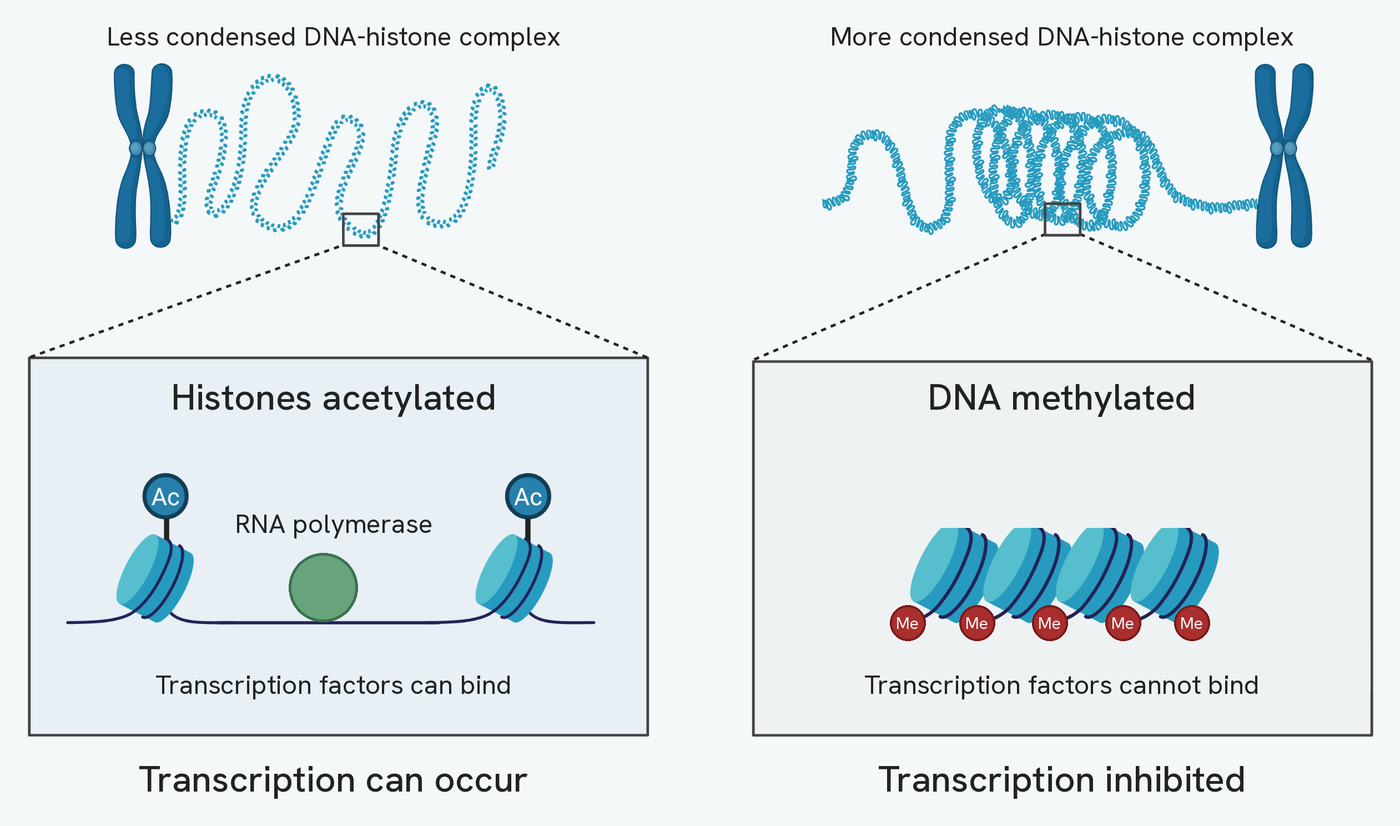
The thing to read off that figure is the spacing.
On the left the histones carry acetyl groups and sit far apart, leaving a long stretch of DNA exposed between them with room for RNA polymerase to sit on it. On the right the histones are packed tightly together, there is almost no DNA showing, and nothing can reach it. Nothing in the base sequence has changed anywhere on that diagram. Only how tightly the DNA is wound has changed, and that is exactly what makes this epigenetic rather than a mutation.
For acetylation the reason is charge. Take the acetyl groups away and the histones become more positively charged, so they grip the negatively charged DNA more tightly. Either way the promoter ends up buried, transcription factors cannot bind, and transcription is inhibited.
Notice where each chemical group sits, because this is the usual way to lose the mark here. The methyl groups are on the DNA, attached to cytosine bases, which is why they are drawn on the strand itself. The acetyl groups are on the histones. Keep that pairing the right way round.
Because environmental factors can trigger these changes, and the changes can switch disease-related genes on or off, epigenetics matters in medicine. Diagnostic tests can detect epigenetic changes before symptoms appear, and drugs can be designed to reverse them, for example by adjusting methylation or acetylation to restore normal gene expression.
RNA interference
RNA interference (RNAi) controls gene expression at the level of translation, by destroying the mRNA before it can be used. It is carried out by small RNA molecules: small interfering RNA (siRNA) and micro-RNA (miRNA). It occurs in eukaryotes and some prokaryotes.
- The siRNA or miRNA combines with a protein to form an RNA-induced silencing complex (RISC).
- The single-stranded RNA in the complex binds to a target mRNA that has a complementary base sequence.
- This leads to the mRNA being hydrolysed into fragments, which are degraded, or being blocked so that ribosomes cannot attach.
- Either way, the mRNA cannot be translated, so the target gene's protein is not made.
Note that these small RNAs bind to mRNA, not to the gene itself.
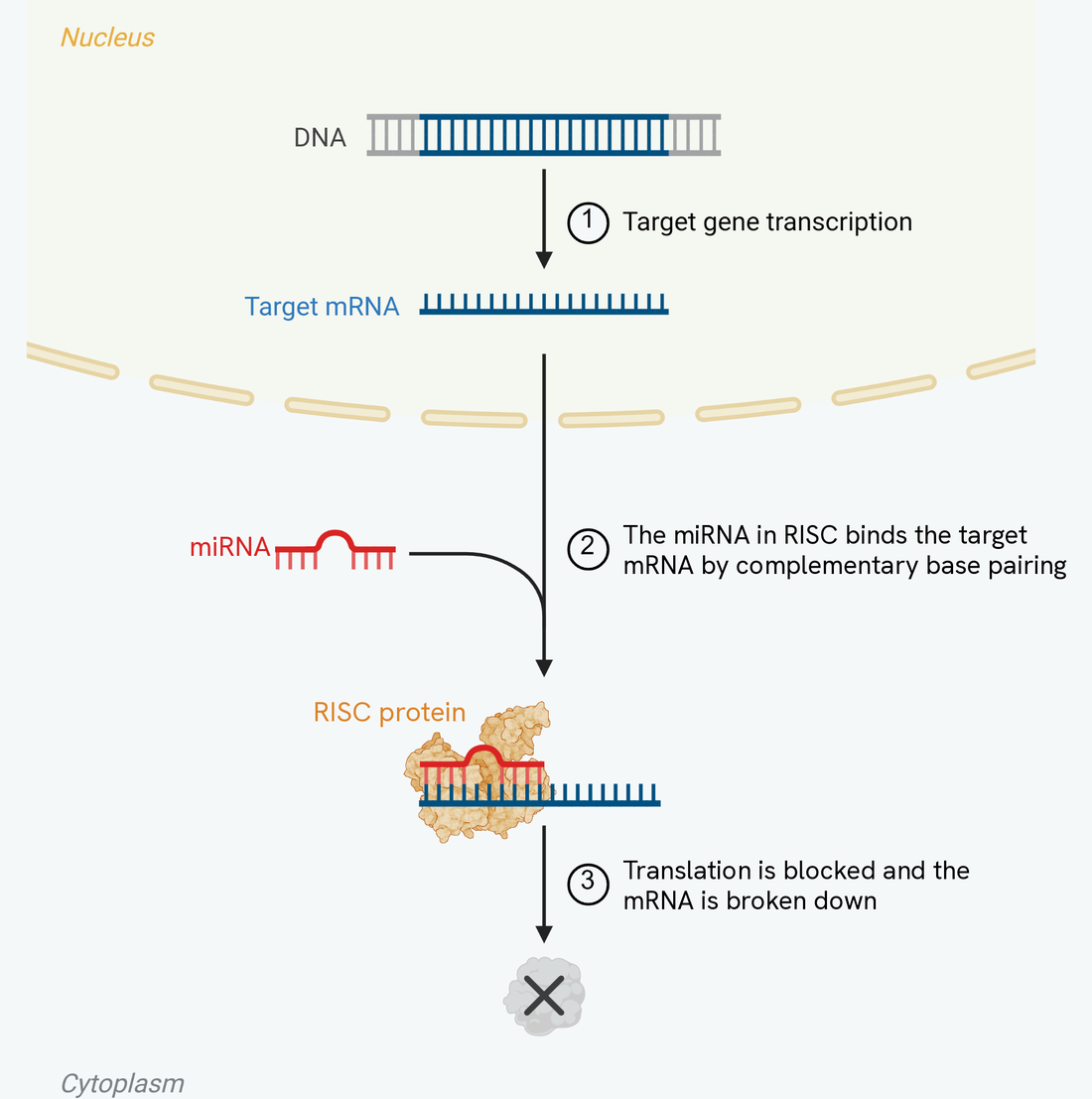
That note is the whole of step 1 on the diagram. The gene is transcribed normally, and the mRNA is made and leaves the nucleus exactly as it would if no miRNA existed anywhere in the cell. Nothing has been switched off at the DNA.
The control happens afterwards, in the cytoplasm, and the diagram splits it into two jobs. The red miRNA supplies the specificity: it binds the target mRNA, and only that mRNA, by complementary base pairing. The protein supplies the machinery. Together they are the RISC complex.
What follows is the point of the whole mechanism. The mRNA still exists, but a ribosome cannot translate it, and it is then broken down. The protein is never made, even though the gene was never silenced.
How this fits together
Between them, transcription factors, epigenetic modifications and RNA interference give a cell fine control over which proteins it makes and when. When this control breaks down, and genes that drive cell division are wrongly switched on or off, the result can be cancer, which is the subject of the gene expression and cancer guide.