AQA GCSE Biology: Classification
A clear GCSE Biology revision guide to classification: the Linnaean system and binomial names, the three-domain system, and evolutionary trees.
Classification is how biologists organise the huge variety of living things into groups. This guide covers the traditional Linnaean system and its naming, the newer three-domain system based on DNA, and how evolutionary trees show relationships. The theme is that classification increasingly reflects evolutionary relationships.
The Linnaean system
The classification system was developed by Carl Linnaeus in the 1700s. It arranges organisms in a hierarchy:
Kingdom → Phylum → Class → Order → Family → Genus → Species
It also gives each organism a two-part Latin name in the binomial system: the genus followed by the species, for example Homo sapiens. The genus is capitalised, the species is lower case, and both are written in italics.
Most people remember the order of the hierarchy with a sentence whose words start with the right letters, such as King Philip Came Over For Good Soup. The groups get smaller and more specific as you go down, so a kingdom holds millions of species and a genus holds only a handful of very similar ones.
The binomial name works like a surname and a first name written the other way round. The genus is the family name shared by close relatives, and the species picks out the individual kind within it. This matters because common names are unreliable: a robin in Britain and a robin in America are different birds, while one plant can have a dozen local names. A binomial name is the same in every country, so scientists always know which organism is meant.
Linnaeus could only classify organisms by the structures and characteristics he could see, since nothing else was available in the 1700s. That is the limitation the rest of this guide is about.
The three-domain system
As techniques improved, Carl Woese proposed the three-domain system in the 1990s, based on DNA and chemical analysis. It divides life into three domains:
- Archaea: primitive prokaryotes, often living in extreme environments.
- Bacteria: modern prokaryotes.
- Eukaryota: protists, fungi, plants and animals.
This system was developed because DNA analysis revealed that some organisms that look similar are not closely related, so grouping by biochemistry and DNA gives a more accurate picture of evolutionary relationships.
Classification systems change when the evidence improves, and AQA asks about that process rather than just the result. Three developments did it: better microscopes, which revealed internal structures Linnaeus could never have seen; understanding of biochemical processes, showing how cells actually work; and finally DNA sequencing, which compares organisms directly at the level of their genes.
The three-domain system's biggest change was splitting what Linnaeus would have called one group of bacteria into two separate domains, Archaea and Bacteria. Under a microscope they look much alike, both being small cells without a nucleus. Their DNA and cell chemistry turned out to be so different that they are now considered no more closely related to each other than either is to us.
Appearance can mislead in the other direction too. Two unrelated species living in similar conditions often evolve to look alike, which is precisely the kind of false grouping that DNA evidence corrects.
Evolutionary trees
Evolutionary trees show how species are related. The branch points represent common ancestors, and the more recent the common ancestor two species share, the more closely related they are, because there has been less time for them to diverge.
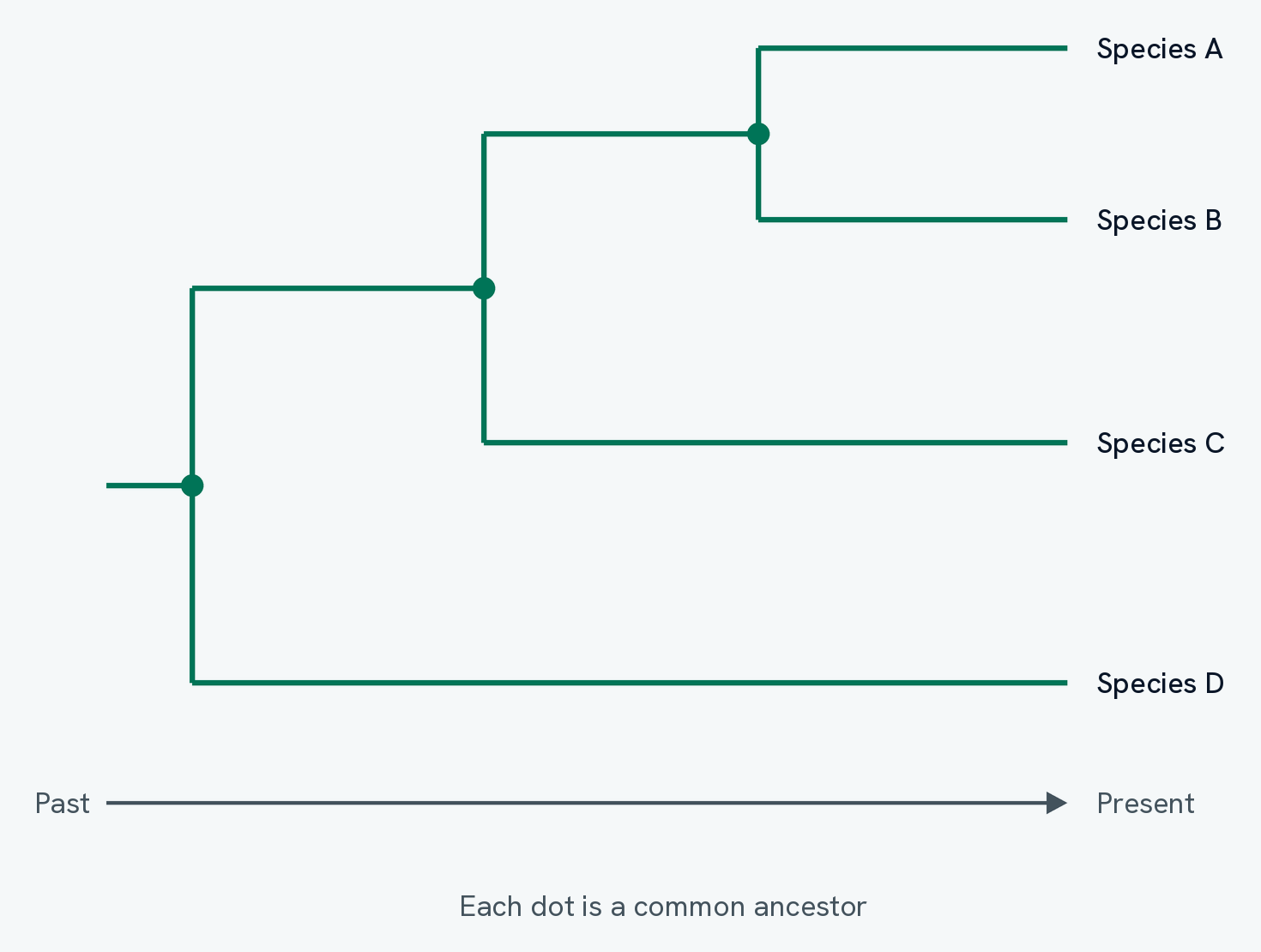
Read a tree by its branch points, not by how close two labels sit on the page. A and B meet at the branch point furthest to the right, so their common ancestor is the most recent and they are the most closely related. D splits off first, so it is the least closely related to any of the others.
That second habit is worth breaking on purpose. C and D are drawn next to each other at the right-hand edge, which makes them look like a pair, but trace the lines back and their most recent shared ancestor is the very first branch point on the tree. Distance down the page means nothing. Only where the lines meet does.
How this fits together
Classification completes Topic 6, drawing together inheritance, variation and evolution: the groupings we use reflect how organisms are related through their shared evolutionary history.