AQA GCSE Biology: Inherited Disorders and Sex Determination
A clear GCSE Biology revision guide to inherited disorders and sex determination: polydactyly, cystic fibrosis, embryo screening, and how the sex chromosomes determine sex.
Some conditions are caused by particular alleles and are passed down through families, and a person's sex is also decided by inheritance. This guide covers two inherited disorders, the debate around embryo screening, and how the sex chromosomes determine whether a person is male or female. The link to hold onto is that a dominant disorder needs one allele, a recessive one needs two.
Two inherited disorders
- Polydactyly (extra fingers or toes) is caused by a dominant allele. Because it is dominant, it can be inherited from just one affected parent, and a person with the genotype PP or Pp has the condition.
- Cystic fibrosis is a disorder of the cell membranes caused by a recessive allele. It causes thick, sticky mucus in the lungs and pancreas. A person must be homozygous recessive (cc) to have it, so both parents must either have it or be carriers.
Reading a family tree
A family tree, sometimes called a pedigree, shows a disorder running through several generations. A question gives you one and asks whether the allele is dominant or recessive, and which people must be carriers.
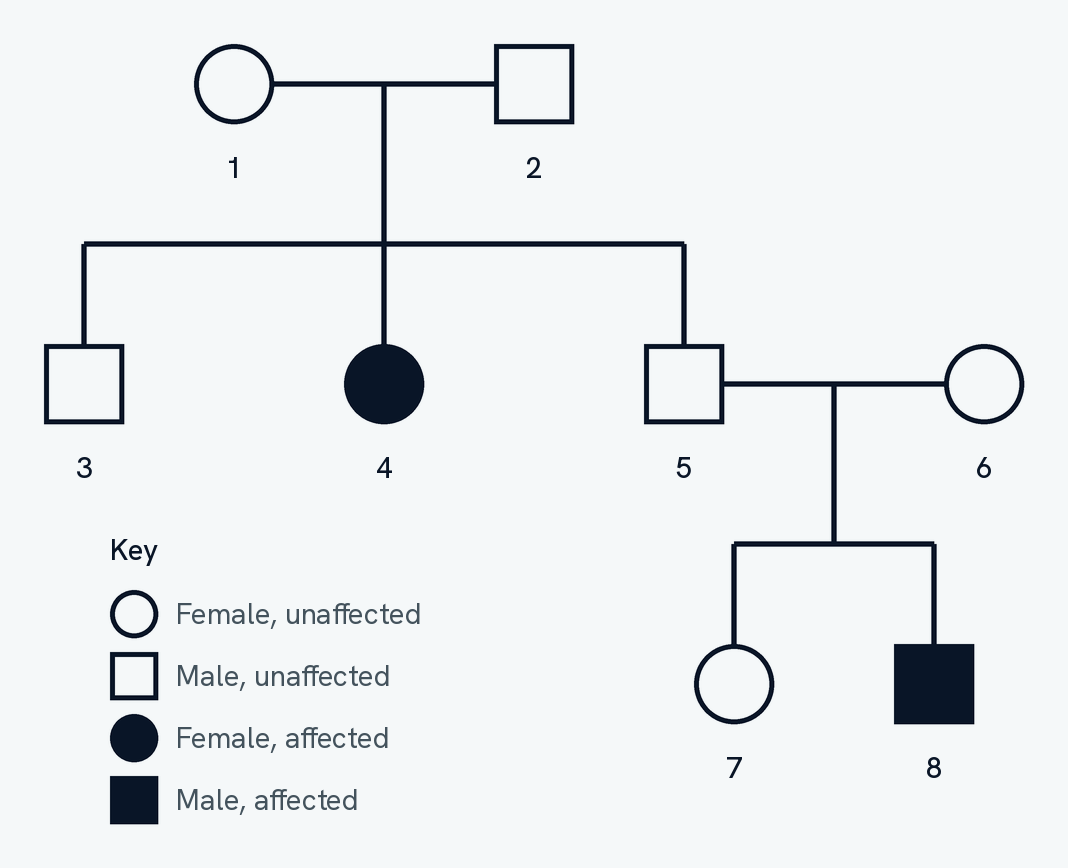
One observation settles it, and it is the thing to look for first. 1 and 2 do not have the disorder, but their daughter 4 does. An allele cannot skip a generation like that if it is dominant, because a dominant allele always shows in the phenotype. So the allele is recessive, and 1 and 2 must both be carriers: each passed on one copy without having the condition.
The same thing happens again lower down. 5 and 6 are unaffected and their son 8 is affected, so they are carriers too.
Once you know the allele is recessive you can start writing genotypes. Anyone affected, so 4 and 8, is homozygous recessive. Anyone with an affected child is a carrier. Everyone else who is unaffected is either homozygous dominant or a carrier, and usually there is no way to tell which, which is a perfectly good thing to write when a question asks for their genotype.
Embryo screening
Embryo screening tests an embryo's DNA for alleles linked to inherited disorders. It is a subject of debate.
- For: it can reduce suffering, and reduce healthcare costs.
- Against: there is a risk of miscarriage, it is expensive, it raises difficult decisions about termination, and there are ethical concerns about discrimination and the chance of false results.
Sex determination
Humans have 23 pairs of chromosomes. 22 pairs control general characteristics, and the 23rd pair are the sex chromosomes.
- Females are XX, and males are XY.
- Whether a child is male or female depends on whether the sperm carries an X or a Y chromosome.
A genetic cross of XX × XY shows that each child has a 50% chance of being male and a 50% chance of being female.
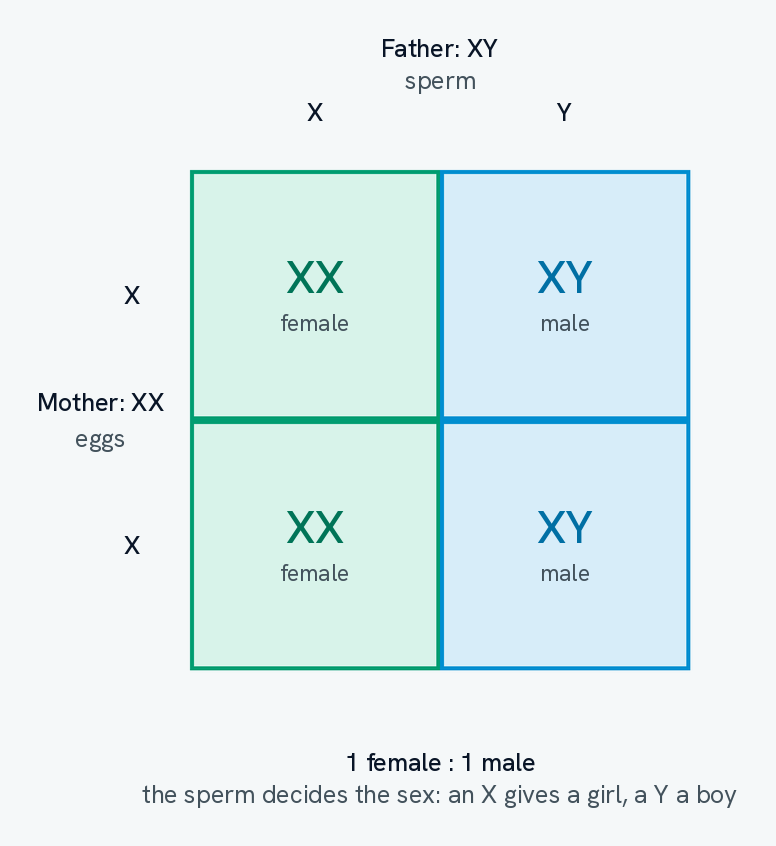
It is the same square as any other genetic cross, and that is the point. Sex is inherited in exactly the same way as any other characteristic, so nothing new is needed to work it out.
The mother can only give an X, so both rows of eggs are the same and all the variation comes from the father's two columns of sperm. That is why the sperm decides the sex. The 1:1 is a probability for each child separately, so a family of four girls is unremarkable rather than evidence of anything.
How this fits together
Inheritance produces the differences between individuals, part of the wider idea of variation, which, together with evolution, is the subject of the variation and evolution guide.