AQA GCSE Biology: Cloning
A Triple award GCSE Biology revision guide to cloning: plant cloning by cuttings and tissue culture, animal cloning by embryo transplant and adult cell cloning, and the risks.
This whole guide is Triple award only. Cloning makes genetically identical copies of an organism. This guide covers the ways plants and animals are cloned, and the risks involved. The common thread is that every clone is genetically identical to its source.
Cloning plants
Plants are relatively easy to clone, in two ways.
- Cuttings: a section of a plant is removed and replanted, often with rooting powder to help it grow roots.
- Tissue culture: small groups of cells are grown in a sterile growth medium, and the tiny plantlets that form are then transferred to soil.
Tissue culture is important for preserving endangered species and for commercial production of large numbers of plants.
Cloning animals
Animals are harder to clone, and there are two main methods.
- Embryo transplants: an early embryo is split before its cells specialise, and the pieces are implanted into surrogate mothers. The offspring are identical to each other, but not to their parents.
- Adult cell cloning: the nucleus of an adult body cell is transferred into an egg cell whose own nucleus has been removed. An electric shock stimulates the egg to divide into an embryo, which is implanted into a surrogate. The offspring is genetically identical to the nucleus donor.
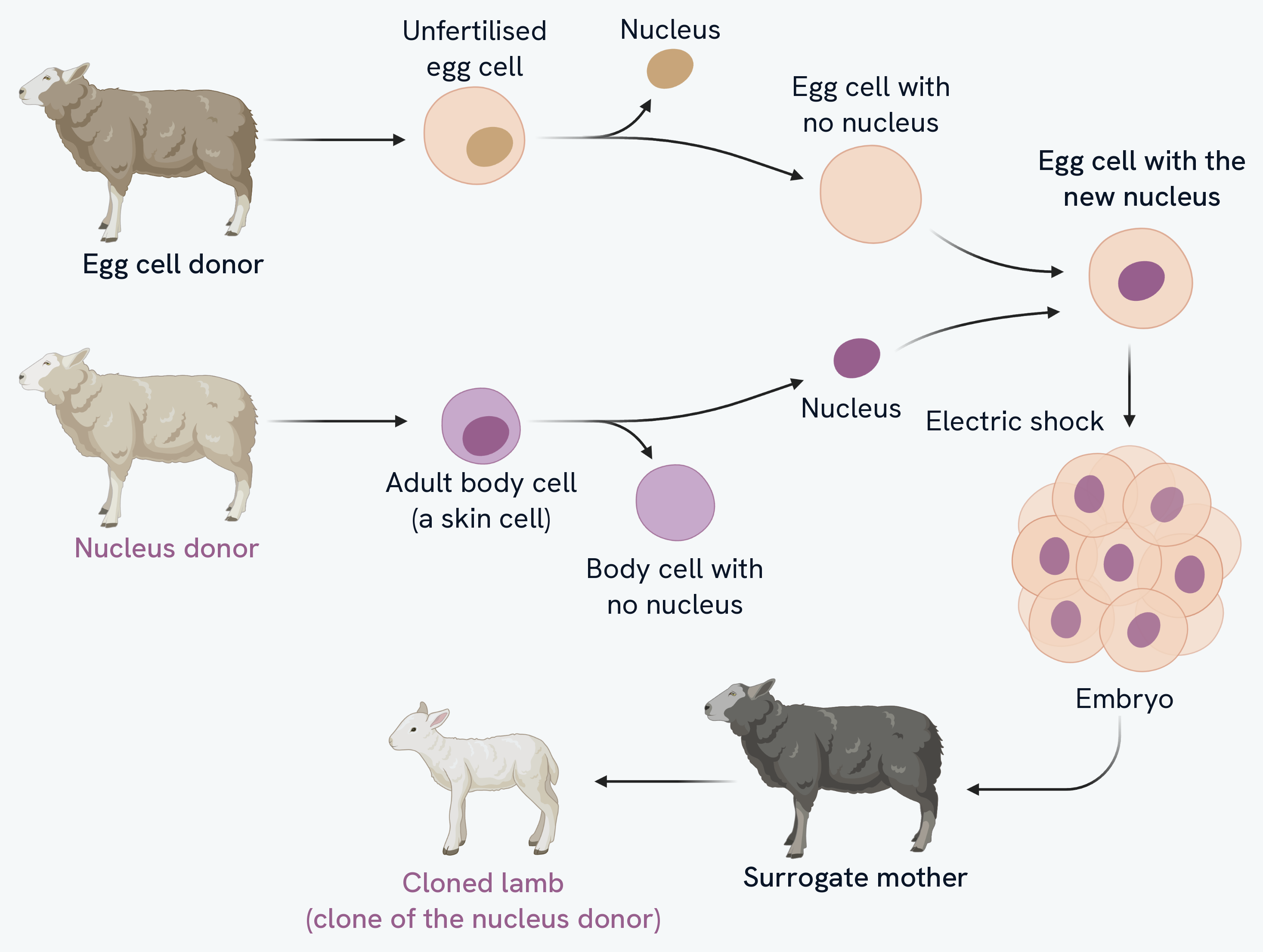
Two sheep go in at the left and the lamb that comes out at the bottom is a copy of only one of them. The egg cell donor supplies a cell, and its own nucleus is taken out and thrown away. The nucleus donor supplies the genes. That is why the lamb and the nucleus donor are named in the same colour, and why the lamb has the nucleus donor's pale fleece rather than the egg donor's brown or the surrogate's dark grey. It is genetically identical to the sheep whose body cell was used, and to neither of the other two.
The purple nucleus is the thing to follow. It starts in the body cell, moves into the egg cell that has had its own nucleus taken out, and from there it is in every cell of the ball of cells and every cell of the lamb. Nothing of the egg donor's own DNA goes any further than the first step.
The electric shock is the step most often left out of an answer, and it is usually worth a mark. It is what makes the egg cell, now carrying its new nucleus, begin dividing by mitosis into a ball of cells.
Almost every exam question on this process is a version of the same question: which sheep is the clone a copy of? Follow the nucleus.
The risks of cloning
Cloning has drawbacks: it reduces genetic variation, adult cell cloning has low success rates, cloned animals may have developmental problems, and there are ethical concerns.
How this fits together
Cloning completes the section on how humans use genetics. The rest of Topic 6 turns to the theory of evolution itself, its history and the evidence behind it, starting with the theory of evolution and speciation guide.