AQA GCSE Biology: DNA and the Genome
A clear GCSE Biology revision guide to DNA and the genome: what DNA, genes and the genome are, the structure of DNA, how genes code for proteins, and mutations.
DNA is the molecule that carries the genetic instructions for building an organism. This guide explains what DNA, a gene and the genome are, and then the Triple-award detail of DNA's structure, how genes code for proteins, and mutations. The central idea is that the order of bases in DNA determines the proteins a cell makes.
DNA, genes and the genome
DNA (deoxyribonucleic acid) is the chemical that makes up the genetic material in the nucleus. It is held in structures called chromosomes, and it is a polymer made of two strands twisted into a double helix.
- A gene is a small section of DNA that codes for a particular sequence of amino acids, which make a specific protein.
- The genome is the entire genetic material of an organism.
Understanding the human genome is important in medicine: it helps identify genes linked to diseases, improves understanding of inherited disorders, and lets scientists trace human migration in the past.
The structure of DNA
(This section is Triple award only.) DNA is a polymer made from four nucleotides. Each nucleotide has a common sugar group, a phosphate group, and one of four bases: A (adenine), T (thymine), C (cytosine) or G (guanine).
- The two strands are made of alternating sugar and phosphate sections.
- The strands are complementary: A always pairs with T, and C always pairs with G.
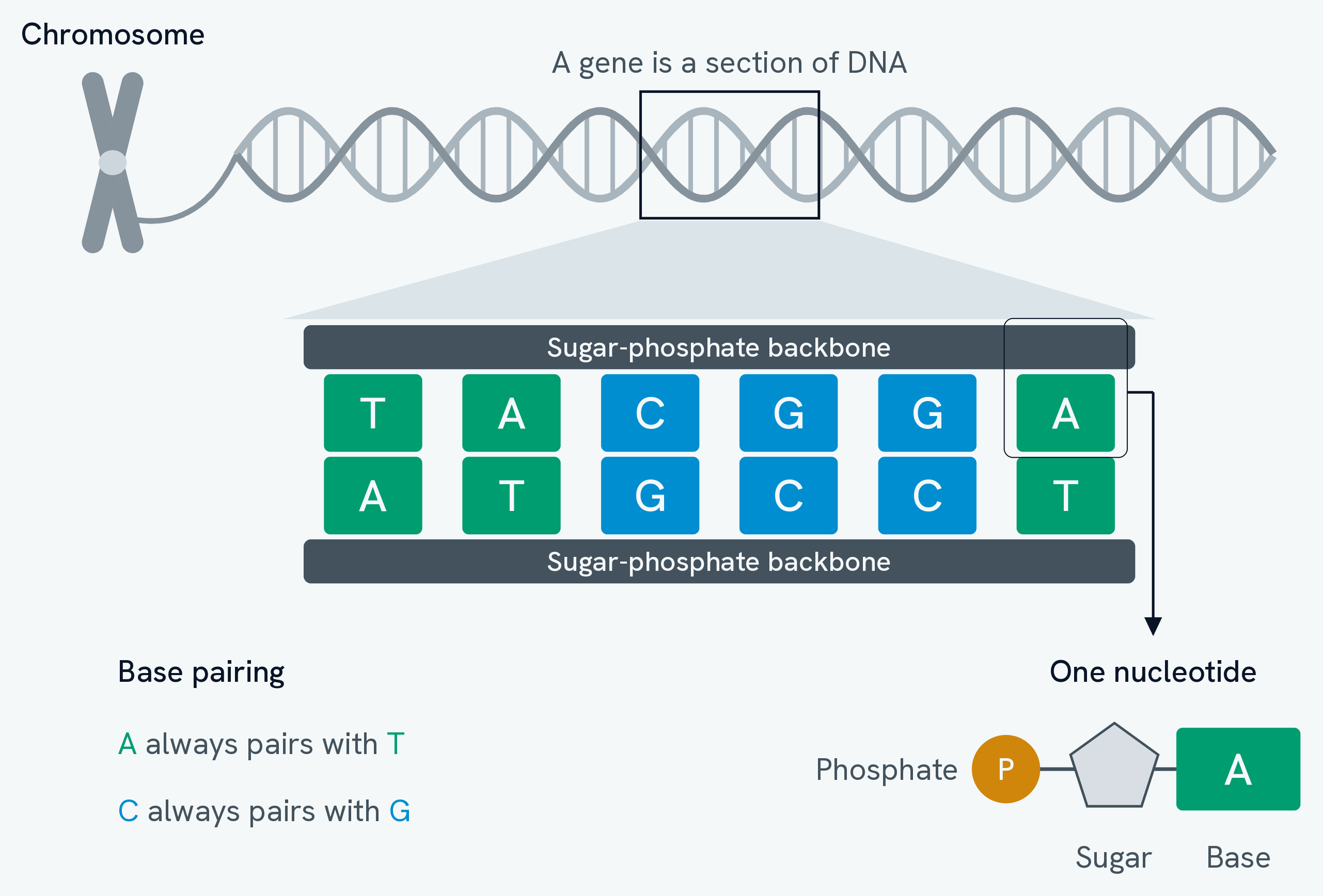
The drawing magnifies three times over: a chromosome, the DNA unwound from it into a double helix, a short section of that helix opened out as a ladder, and one repeating unit of that ladder, which is a nucleotide.
The colours are the pairing rule, not the bases. A and T are both green and C and G are both cyan, so every rung of the ladder is a single colour and a green base is never opposite a cyan one. Giving each of the four bases its own colour would have looked livelier and told you nothing, because what you are asked about the bases is which one goes with which.
Notice that the two strands read differently. The top is TACGGA and the bottom is ATGCCT, and each one fixes the other: given either strand you can write out its partner. Those six bases along the top are the first two triplets of the next drawing, which is the same piece of DNA again.
Genes code for proteins through the order of the bases. Each group of three bases (a triplet) codes for a particular amino acid, so the order of bases sets the order of amino acids, building a protein with a unique shape.
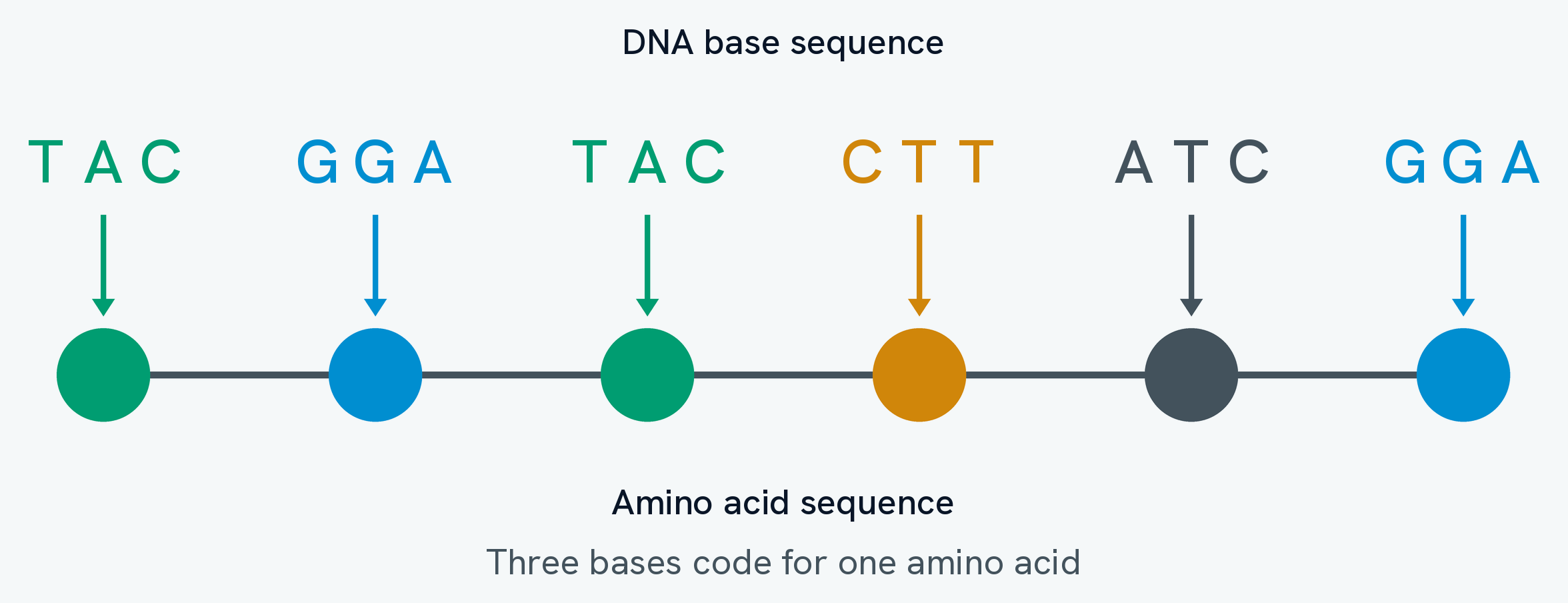
Six triplets give six amino acids, in the same order. That is the whole idea: the order of the bases sets the order of the amino acids, and the order of the amino acids is what folds into a protein of a particular shape.
Follow the colours rather than the letters. TAC appears twice and gives the same amino acid both times, and so does GGA. That is what makes it a code rather than a list. A triplet means the same thing wherever it turns up, in any gene and in any organism, which is why a human gene put into a bacterium still produces the human protein.
The bases also have to be read in threes from the start. Real DNA is not spaced out into groups the way the drawing is, so if a base is inserted or deleted near the beginning, every triplet after it is read out of step and almost the whole protein comes out wrong. That is what the next section is about.
How proteins are made
(Higher tier only.) Proteins are made on ribosomes.
- A template molecule (mRNA) is copied from the base sequence of a gene.
- The mRNA leaves the nucleus and attaches to a ribosome.
- Carrier molecules (tRNA) bring specific amino acids to the ribosome, adding them to the protein chain in the correct order.
- The finished protein folds into a unique 3D shape that lets it do its job, for example as an enzyme, a hormone or a structural protein like collagen.
Mutations and non-coding DNA
(Higher tier only.) A mutation is a random change to the DNA base sequence. Mutations happen continuously and randomly, and most have no effect or only alter a protein slightly. A few change the amino acid sequence enough to alter the protein's shape, which can affect its function, for example changing an enzyme's active site so the substrate no longer fits.
Some DNA is non-coding, meaning it does not code for proteins. Certain non-coding regions can switch genes on and off, so a mutation there may affect whether a protein is made at all (its expression).
How this fits together
DNA carries genes, and how those genes are passed on and expressed as characteristics is the subject of the genetic inheritance guide.