AQA GCSE Biology: Meiosis
A clear GCSE Biology revision guide to meiosis: how it produces gametes, why it halves the chromosome number, and what happens after fertilisation.
Meiosis is the special cell division that makes gametes. This guide explains how meiosis works, why it must halve the chromosome number, and what happens once two gametes fuse. The key point is that meiosis produces four genetically different cells, each with half the chromosomes.
The process of meiosis
Meiosis is the type of cell division that produces gametes. It halves the chromosome number, so that when two gametes fuse at fertilisation, the full number is restored.
The process runs as follows:
- the DNA replicates (copies itself);
- the cell then divides twice;
- this produces four genetically different cells (gametes), each with a single set of chromosomes, half the number of the original cell.
Halving the number matters because it keeps the chromosome number constant from one generation to the next: two half-sets combine at fertilisation to make a full set again.
It is worth seeing what would happen without it. If gametes carried a full 46 chromosomes each, a zygote would have 92, its own offspring 184, and the number would double every generation until nothing worked. Meiosis is the step that stops that, which is why it is sometimes called a reduction division.
Meiosis happens only in the reproductive organs, the ovaries and the testes. Every other dividing cell in the body uses mitosis.
The other half of the definition is that the four cells are genetically different from one another. This is because the chromosomes of each pair are distributed randomly between the gametes, so each one ends up with a different mixture of the chromosomes that came originally from the mother and the father. That is the source of the variation between brothers and sisters, and it is why meiosis matters for inheritance as well as for counting.
Mitosis and meiosis compared
| Mitosis | Meiosis | |
|---|---|---|
| Number of divisions | One | Two |
| Cells produced | Two | Four |
| Chromosome number | Stays the same (46) | Halved (23) |
| Daughter cells are | Genetically identical | Genetically different |
| Where | All body cells | Reproductive organs only |
| Used for | Growth, repair, asexual reproduction | Making gametes |
If you can reproduce that table, most questions in this section answer themselves. The commonest error by far is saying mitosis when a question is about gametes, or meiosis when it is about growth or repair.
After fertilisation
Once a gamete fuses with another at fertilisation, the new cell is a zygote.
- The zygote divides repeatedly by mitosis, increasing the number of cells and forming an embryo.
- As the embryo develops, its cells differentiate into specialised cell types.
Mitosis is used here, rather than meiosis, because it produces genetically identical cells, so every cell in the new organism has the same complete set of genes.
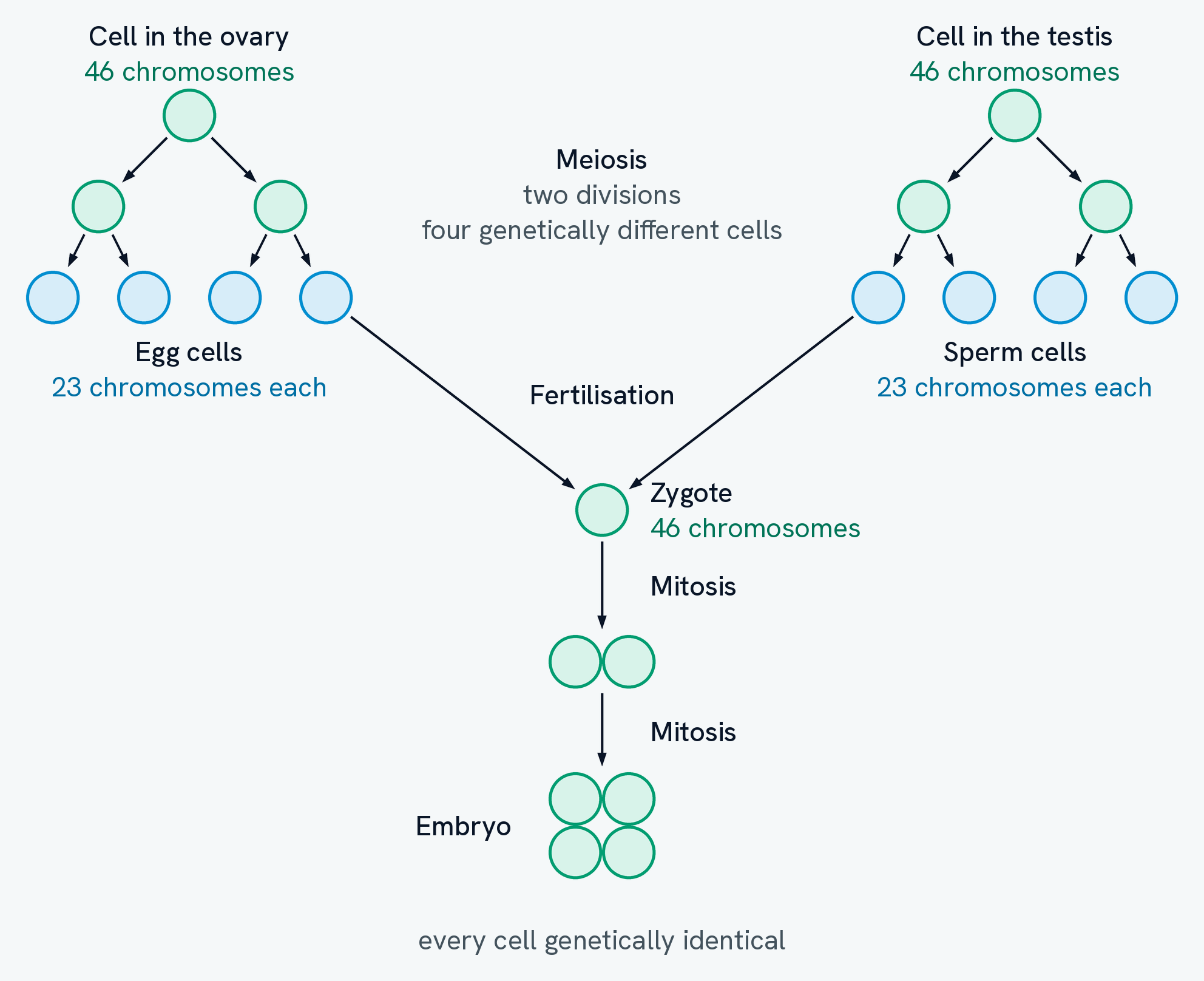
Follow the colour rather than the shapes. Green is a cell with the full set of chromosomes and cyan is a cell with half a set, and the chromosome counts are written in the same two colours. The colour changes once at meiosis and changes back at fertilisation, and that single swap and swap back is the whole reason meiosis exists.
For humans the numbers are worth knowing. A body cell has 46 chromosomes, arranged as 23 pairs, which is covered in the chromosomes and the cell cycle guide. Each gamete gets 23, one from each pair. Two gametes fuse, and the zygote is back to 46.
Two details in the drawing are easy to skim past. Meiosis produces four cells from one, not two, which is what makes it a double division rather than a single one. And only one egg and one sperm meet at any one fertilisation, however many gametes were made.
The bottom half is a different division doing a different job. Every arrow below the zygote is mitosis, so the cells stay at 46 chromosomes and stay genetically identical, which is why the embryo is drawn in a single colour while the gametes above it are not.
How this fits together
Meiosis and fertilisation pass DNA from parents to offspring. What that DNA is, and how it carries the instructions for building an organism, is the subject of the DNA and the genome guide.