AQA GCSE Biology: Genetic Inheritance
A clear GCSE Biology revision guide to genetic inheritance: the key genetic terms, and how to use Punnett squares to predict the outcome of a genetic cross.
Genetic inheritance is about which versions of a gene an organism has, and how they show up. This guide sets out the key genetic vocabulary and shows how a Punnett square predicts the offspring of a cross. Getting the vocabulary firm is what makes the crosses easy.
The key terms
Genetics has a precise vocabulary that you need to use accurately.
- A gene is a small section of DNA that codes for a specific protein.
- An allele is a different version of the same gene.
- A dominant allele is always expressed in the phenotype, even with only one copy.
- A recessive allele is only expressed when two copies are present (no dominant allele).
- Homozygous means two identical alleles, for example BB or bb.
- Heterozygous means two different alleles, for example Bb.
- The genotype is the combination of alleles an organism has.
- The phenotype is the organism's observable characteristics.
Most characteristics are controlled by several genes interacting, not just one.
Punnett squares
A Punnett square predicts the outcome of a genetic cross.
- Identify the parents' genotypes.
- Work out the possible alleles in the gametes.
- Combine them in the square to find all possible offspring genotypes and phenotypes.
- Express the results as ratios or percentages.
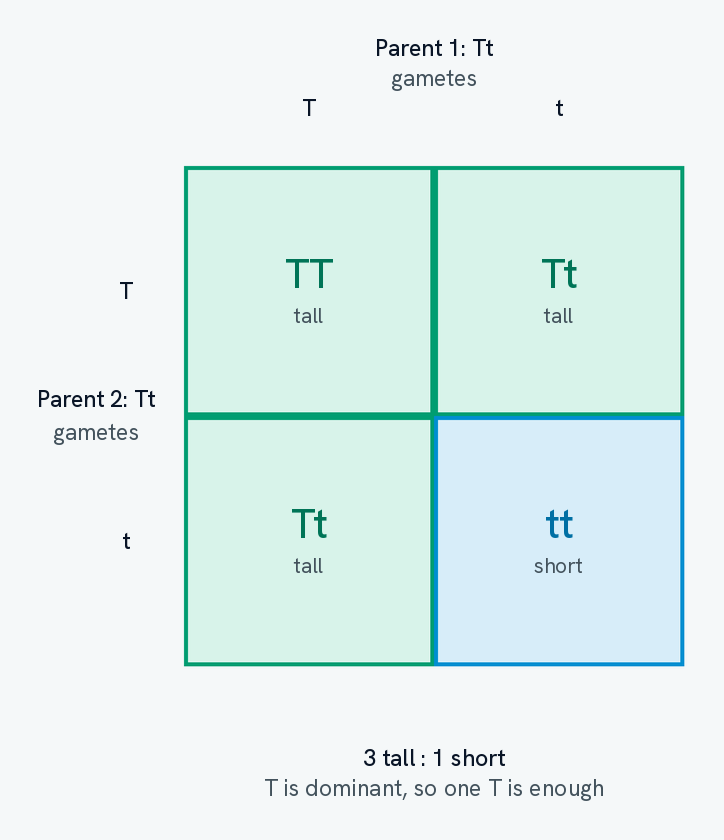
The colour does the counting for you. Three boxes give a tall plant and one gives a short one, which is the 3:1 ratio without working anything out.
One thing in that square catches people out. The genotypes are not in the same ratio as the phenotypes. They are 1 TT : 2 Tt : 1 tt, which is 1:2:1, and the 3:1 only appears once you ask what each genotype actually looks like. A question asking for the ratio of genotypes and one asking for the ratio of phenotypes have different answers from the same square, so read which one is being asked for.
For example, crossing two heterozygous tall pea plants (Tt × Tt, where tall T is dominant) gives offspring in the ratio 3 tall : 1 short. Remember that these are probabilities: the actual numbers in a real family or cross may differ from the predicted ratio by chance.
Working a cross through, step by step
Every genetic cross question is the same seven steps in the same order. This one is a fruit fly cross, where long wings (L) are dominant and vestigial wings (l) are recessive, and one parent is heterozygous while the other is homozygous recessive.
| Step | |
|---|---|
| 1. Parents' phenotype | long wings × vestigial wings |
| 2. Parents' genotype | Ll × ll |
| 3. Gametes | L and l from one parent, l and l from the other |
| 4. Punnett square | the four boxes give Ll, ll, Ll, ll |
| 5. Offspring genotype | 1/2 or 50% Ll, 1/2 or 50% ll |
| 6. Offspring phenotype | 50% long wings (Ll), 50% vestigial wings (ll) |
| 7. Ratio | long : vestigial, 1 : 1 |
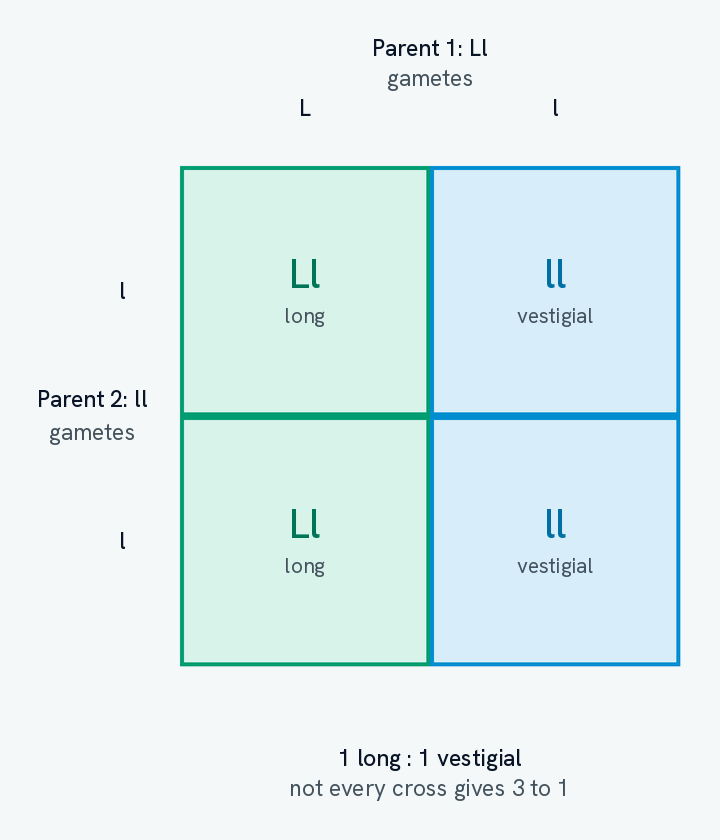
Compare that ratio with the 3:1 from the cross further up this guide. Same method, same seven steps, different answer, and the only thing that changed was the parents. 3:1 is not a rule, it is what you get from two heterozygous parents, and a question that hands you different parents expects a different number.
The step most often skipped is 3. Writing the gametes out before filling the square is what stops the wrong letters going in the boxes, and in a cross like this one it also makes something obvious: a parent that is ll can only ever give an l, so one whole side of the square is the same letter twice.
How this fits together
The same rules explain how certain genetic disorders are inherited, and how a person's sex is determined, which are covered in the inherited disorders and sex determination guide.