AQA A-Level Biology: Gas Exchange in Organisms
A clear revision guide to gas exchange for AQA A-Level Biology: adaptations in single-celled organisms, insects, fish and plants, counter-current flow, and the problem of water loss.
Every organism needs to take in oxygen and remove carbon dioxide, but the way it does so depends on its size and where it lives. This guide works through gas exchange in single-celled organisms, insects, fish and plants, and the constant trade-off between exchanging gases and losing water. It builds directly on surface area to volume ratio.
What a good exchange surface needs
Whatever the organism, an efficient gas exchange surface has the same features: a large surface area, a short diffusion distance (thin), and a way of maintaining a concentration gradient so diffusion keeps going. Watch for these three ideas in every example below.
Single-celled organisms
A single-celled organism, such as an amoeba, exchanges gases straight across its cell-surface membrane. It can do this because it is small, with a large surface area to volume ratio and a short diffusion distance to every part of the cell, so oxygen and carbon dioxide diffuse quickly enough with no special structures at all.
Insects: the tracheal system
Insects have a rigid, waterproof exoskeleton, so they cannot exchange gases across the body surface. Instead they have a tracheal system of air-filled tubes.
Air enters through pores called spiracles, which can open and close. From the spiracles, large tubes called tracheae carry air into the body, branching into finer and finer tracheoles that reach the tissues directly. Because the tracheoles have thin walls and are highly branched, they give a short diffusion distance and a large surface area, and because the tubes are full of air, gases diffuse quickly (diffusion is faster in air than in liquid).
The gradient is maintained in two ways. By contracting its abdominal muscles the insect can pump air in and out, and during exercise the fluid at the ends of the tracheoles is drawn into the tissues by osmosis (lactate from anaerobic respiration lowers the water potential of the cells). As the fluid withdraws, air moves further towards the cells, speeding up diffusion where it is needed most.
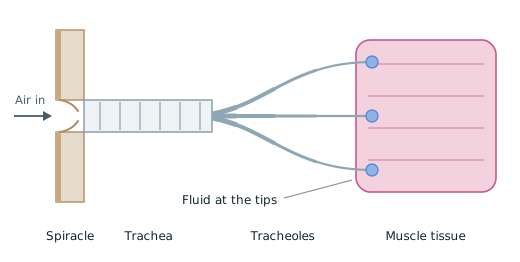
The figure answers the question insects raise: there is no blood carrying oxygen anywhere in it. The tubes go all the way to the tissue themselves, which is why an insect's circulatory system does not transport respiratory gases at all.
Follow the tubes from left to right and the three features of a good exchange surface appear in order. One trachea becomes many tracheoles, which is the large surface area. Each one narrows as it goes, so its wall ends up thin: the short diffusion distance. And the tubes carry air, not liquid, so diffusion through them is fast.
The drops at the tips are the detail worth holding on to. At rest the tracheole ends are full of fluid, and gases have to dissolve to cross it. During exercise that fluid is drawn into the muscle by osmosis, so air moves further down the tracheole, right up against the cells that need it. The diffusion path shortens exactly where and when the demand is highest.
Because they are on land, insects also face water loss. Their adaptations are a compromise: a thick, waxy cuticle lengthens the diffusion path for water, the spiracles can close when gas exchange is not needed, and hairs around the spiracles trap moist air, all of which reduce evaporation.
Fish: gills and counter-current flow
Water holds far less oxygen than air, so fish need a very efficient system. Their gills are made of stacks of filaments, each covered in tiny folds called lamellae. This gives an enormous surface area, the lamellae have very thin walls for a short diffusion distance, and a rich supply of capillaries carries oxygen away and brings carbon dioxide, keeping the gradient steep.
The clever part is counter-current flow: blood in the capillaries flows in the opposite direction to the water passing over the lamellae. This means that all along the lamella, the water always has a higher oxygen concentration than the blood next to it, so oxygen diffuses into the blood across the whole length of the gill. If the two flowed in the same direction (parallel flow), they would quickly reach equilibrium and diffusion would stop halfway along.
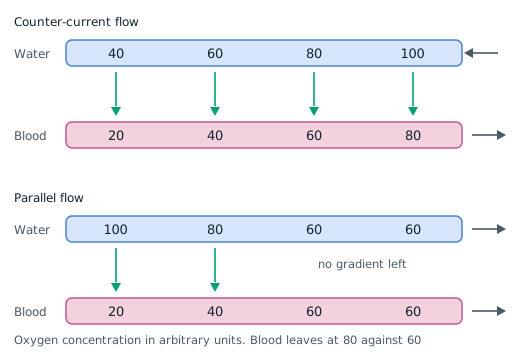
Read the figure in columns, not along the rows. At every point in the top diagram the water is 20 units richer than the blood directly beneath it, so there is a concentration gradient at every point and oxygen diffuses across the whole length of the lamella. That phrase, a gradient maintained along the whole length, is what the mark scheme is listening for.
The lower diagram shows what the alternative costs. With both flowing the same way, the water falls while the blood rises until they meet in the middle at 60. From there the columns read the same, there is no gradient left, and nothing more diffuses however much lamella remains.
The arithmetic at the end makes the point without any explaining. Counter-current blood leaves at 80; parallel blood leaves at 60. Same water, same gill, same distance, and the only difference is which way the blood was sent.
Plants: leaves and the water-loss trade-off
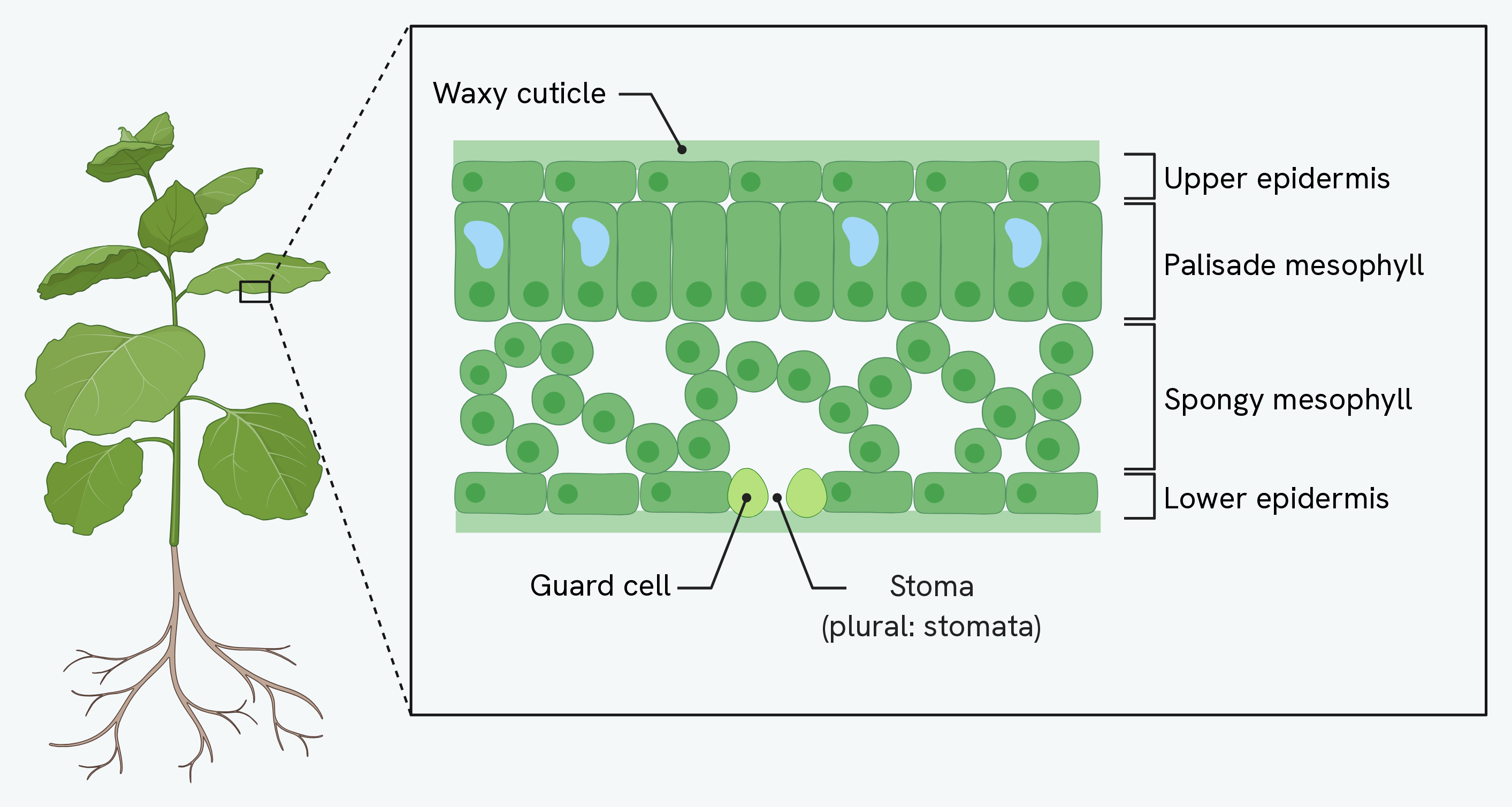
In plants, gas exchange happens mainly in the leaf. Pores called stomata, opened and closed by guard cells, let gases in and out, and inside the leaf the spongy mesophyll has many air spaces that give a large surface area for diffusion. Leaves are also thin, giving a short diffusion distance.
Seen from above rather than in section, the stomata are scattered across the leaf surface, and at any moment some are open and some are closed. The same pore carries traffic both ways: carbon dioxide diffuses in, while oxygen and water vapour diffuse out.
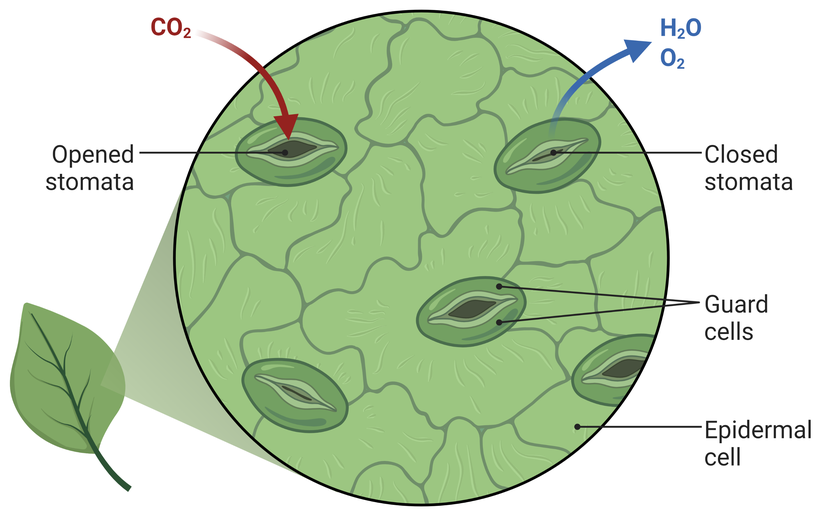
How guard cells open and close a stoma
A stoma is a pore between two guard cells, and whether it is open depends on how much water those two cells hold.
- In bright light, guard cells take in water by osmosis. They swell and become turgid, and the stoma opens, letting carbon dioxide in for photosynthesis.
- In darkness, or hot and dry conditions, guard cells lose water by osmosis. They become flaccid, and the stoma closes, which conserves water.
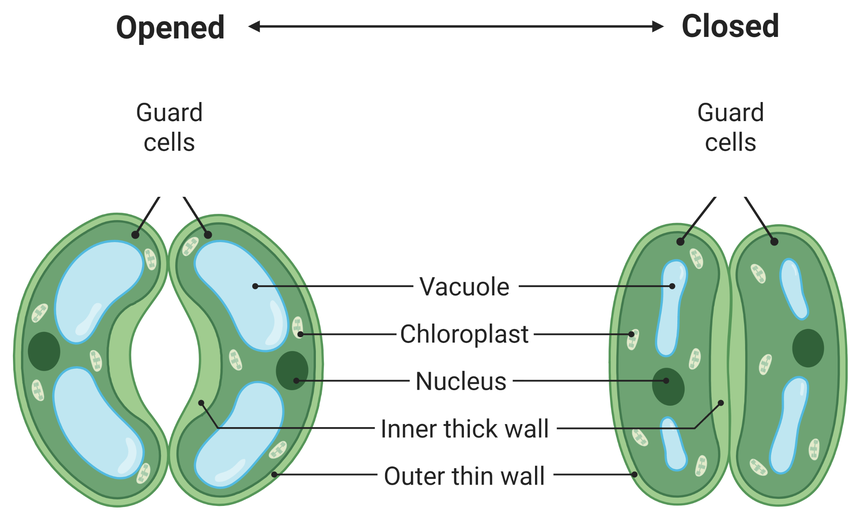
The shape change is the part worth understanding, and the diagram shows why it happens. The wall of each guard cell is not the same thickness all the way round: the inner wall, facing the pore, is thick and inflexible, while the outer wall is thin. So when water enters and the cell swells, the thin outer wall stretches much more than the thick inner one, and the cell is forced to curve away from the pore. Two cells curving apart leave a gap between them.
Lose the water and the cells straighten, close together, and the pore shuts. Note that the guard cells do not pull the pore open; they bend, and the pore is simply the space left between them.
Plants face the same conflict as insects: an open stoma that lets carbon dioxide in also lets water vapour out. Xerophytes, plants adapted to very dry places such as cacti and marram grass, show extreme adaptations to reduce water loss. A thicker waxy cuticle lengthens the diffusion path for water; sunken stomata, rolled leaves and hairs all trap water vapour close to the leaf, which reduces the water potential gradient between the leaf and the air and so slows evaporation; and reducing leaves to spines cuts the surface area from which water is lost.
Once gases and other substances are exchanged, larger organisms must carry them around the body. That is the job of the mass transport systems, starting with haemoglobin and oxygen transport.