AQA A-Level Biology: Mass Transport in Plants
A clear revision guide to mass transport in plants for AQA A-Level Biology: xylem and the cohesion-tension theory, transpiration, and phloem and the mass flow hypothesis.
Plants move water and sugars over long distances through two separate tissues, each with its own mechanism. This guide covers water transport in the xylem by cohesion-tension, what affects the rate of water loss, and sugar transport in the phloem by mass flow.
Xylem and the transport of water
Xylem tissue transports water and mineral ions from the roots, up through the stem, to the leaves. It is beautifully adapted for the job. The cells are joined end to end with no end walls, forming a long continuous tube through which water flows as an unbroken column. The cells are dead and empty, with no cytoplasm or nucleus, so nothing obstructs the flow. Their walls are thickened with lignin, which supports the plant and withstands the tension in the column, and pits in the side walls let water move sideways between vessels.
The cohesion-tension theory
Water is pulled up the xylem by a mechanism called the cohesion-tension theory, and it is driven from the top, by evaporation from the leaves.
It works in a chain. In the leaf, water evaporates from the mesophyll cells into the air spaces and diffuses out through the open stomata, a process called transpiration. This lowers the water potential of the mesophyll cells, so water is drawn out of the nearest xylem to replace it. Pulling water out of the top of the column creates tension, a negative pressure, throughout the xylem.
The column does not break because of cohesion: the hydrogen bonds between water molecules make them stick to one another, so the whole column is pulled up as one continuous thread. Water molecules also stick to the walls of the xylem, which is called adhesion. At the bottom, water enters the roots by osmosis to replace what is lost.
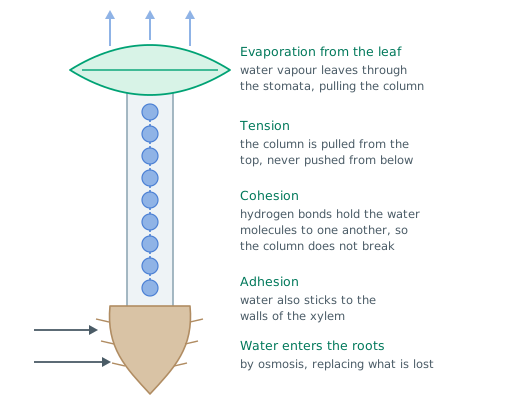
Read the figure top down, in that order, because the order is the answer. The process starts at the leaf, not at the root. Every mark scheme for this topic wants evaporation named first, and a description that begins with the roots pushing water up has the mechanism backwards.
The column of molecules in the xylem is drawn joined because that is what cohesion means in practice. Pull on the top molecule and the whole thread comes with it, the way a rope moves when you pull one end. A rope is also the reason the water is pulled and never pushed: you cannot push a rope, and you cannot push a column of water up a tree.
Transpiration is really the unavoidable cost of having open stomata for photosynthesis, but the pull it creates is what moves water up the whole plant.
What affects the rate of transpiration
Anything that changes how fast water evaporates from the leaf changes the transpiration rate.
- Light: in the light, stomata open to let in carbon dioxide for photosynthesis, so more water can evaporate. In the dark they close and transpiration is slow.
- Temperature: higher temperatures give water molecules more kinetic energy, so they evaporate faster.
- Wind: moving air blows away the water vapour that gathers around the stomata, which lowers the water potential of the air next to the leaf, steepens the water potential gradient, and speeds up evaporation.
- Humidity: more water vapour in the air raises its water potential, which reduces the gradient between leaf and air, so evaporation slows.
The rate of water uptake can be estimated with a piece of apparatus called a potometer, which measures how quickly a shoot takes up water. It is only an estimate, though: not all the water taken up is transpired (some is used in photosynthesis or to keep cells turgid), and a cut shoot does not behave in exactly the same way as a whole, rooted plant.
Phloem and the transport of sugars
Phloem tissue transports organic substances, mainly sucrose, around the plant. It is made of two cell types working together. Sieve tube elements carry the sucrose: they have little cytoplasm and few organelles, leaving space for flow, and their end walls are perforated into sieve plates that let solution pass. Alongside them, companion cells are packed with mitochondria, which make the ATP needed for the active transport that loads sugar into the phloem.
Translocation and the mass flow hypothesis
Translocation is the movement of dissolved organic substances, such as sucrose, from a source (where they are made or stored, such as a leaf) to a sink (where they are used or stored, such as a root). The accepted explanation is the mass flow hypothesis.
At the source, sucrose is actively transported into the sieve tubes by the companion cells. This lowers the water potential inside the sieve tube, so water enters by osmosis from the nearby xylem. The extra water raises the hydrostatic pressure at the source. At the sink, sucrose is removed from the phloem to be used or stored, water follows it out by osmosis, and the hydrostatic pressure falls. The result is a pressure gradient from source to sink, and the whole solution flows down it by mass flow.
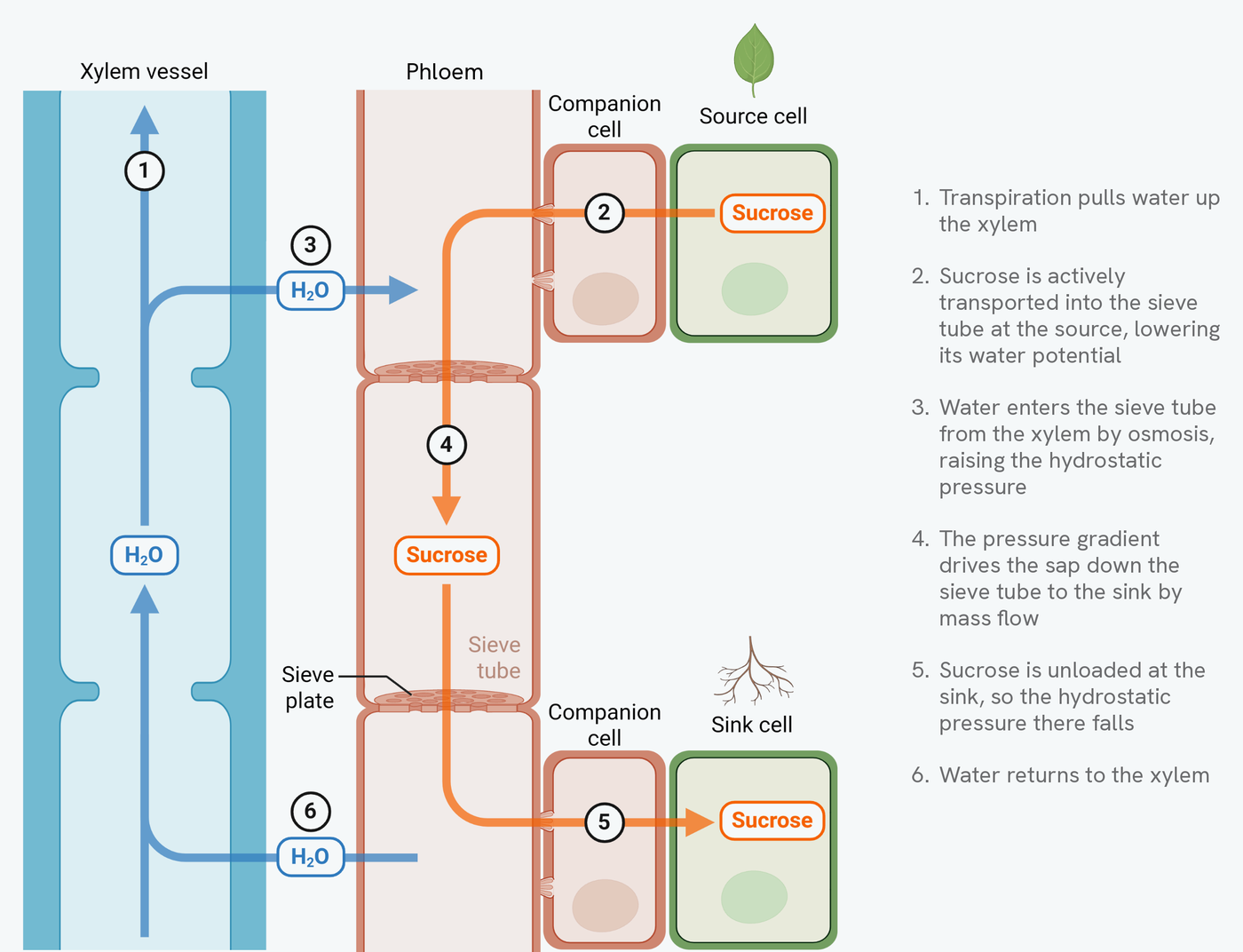
Follow the orange and the blue separately on that diagram, because they are two different movements.
The orange is sucrose, and it moves under its own steam only at the two ends: loaded into the sieve tube at the source in step 2, and unloaded at the sink in step 5. In between, at step 4, it is not being pushed along by itself at all. It is carried in the sap, which is moving as a whole, and that is exactly what mass flow means.
The blue is water, and it is on loan from the xylem. It enters the sieve tube near the top at step 3 and returns to the xylem near the bottom at step 6. This is why the xylem is drawn alongside. The two tissues carry different things by different mechanisms, but the phloem borrows the xylem's water to build its pressure, and hands it back.
The step that needs ATP is step 2, the active loading at the source. That is what the companion cells are packed with mitochondria for.
This is why a metabolic poison that blocks ATP production stops translocation: without ATP, sucrose cannot be actively loaded into the phloem at the source, so the water potential does not fall, water does not enter, no pressure gradient builds, and mass flow cannot occur.
Evidence for phloem transport
Two classic experiments support the idea that sugars travel in the phloem. In ringing experiments, a ring of bark (which contains the phloem) is removed from a stem. Sugars build up in a bulge above the ring, and the tissues below it, cut off from their sugar supply, die. This shows that sugar is carried downwards in the phloem. In tracer experiments, a plant is supplied with carbon dioxide containing the radioactive isotope carbon-14. The radioactive carbon is built into sugars during photosynthesis, and following where the radioactivity goes, using autoradiography, tracks the movement of those sugars through the phloem.
Water transport and sugar transport are two separate processes in two separate tissues: cohesion-tension moves water up the xylem, driven by transpiration, while mass flow moves sucrose through the phloem, driven by pressure differences between source and sink.