AQA A-Level Biology: Surface Area to Volume Ratio
A clear revision guide to surface area to volume ratio for AQA A-Level Biology: how it changes with size, its link to metabolic rate, and why larger organisms need exchange surfaces.
Why can a single-celled organism survive by simple diffusion, while a mammal needs lungs, a heart and blood vessels? The answer starts with a single idea: the surface area to volume ratio. This guide explains what it is, how it changes with size, and why it shapes the whole of the rest of this topic.
What surface area to volume ratio means
An organism exchanges substances, such as oxygen, carbon dioxide and heat, across its surface, but it uses and produces those substances throughout its volume. The balance between the two is the surface area to volume ratio (SA:V), found by dividing surface area by volume.
The key fact is that as an object gets bigger, its volume increases faster than its surface area, so the SA:V ratio decreases. A simple cube shows this clearly:
| Cube side | Surface area | Volume | SA:V |
|---|---|---|---|
| 1 cm | 6 cm squared | 1 cm cubed | 6 : 1 |
| 3 cm | 54 cm squared | 27 cm cubed | 2 : 1 |
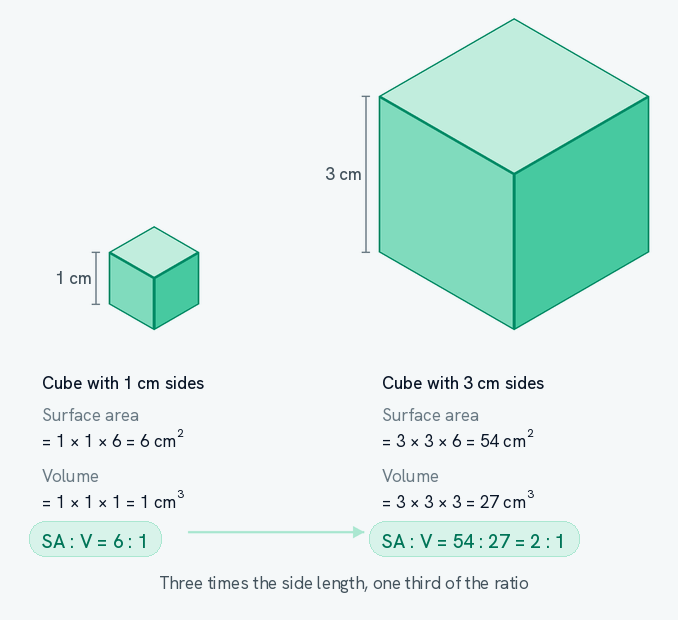
Tripling the side cuts the ratio to a third. A small organism therefore has a large surface area relative to its volume, while a large organism has a small one.
Be careful not to read that as the ratio simply following the side length. It does not: the ratio falls because volume is a cube of the side length while surface area is only a square of it, so volume grows faster. For any cube the ratio is exactly 6 divided by the side length, which is why it keeps falling however large the cube gets, and never reaches zero.
Because real organisms are irregular shapes, their volume is awkward to measure. It is often easier and more accurate to compare surface area to mass instead, which is quicker to find and avoids the problem of measuring an odd shape.
SA:V and metabolic rate
Metabolic rate is the amount of energy an organism uses in a given time. It is often estimated by measuring oxygen uptake, because oxygen is used in aerobic respiration to release energy as ATP.
Small organisms have a high SA:V, and this drives up their metabolic rate per unit of body mass. The reason is heat loss: with so much surface relative to their volume, small animals lose heat quickly, so they must respire faster to release enough heat to keep their body temperature constant. A mouse, gram for gram, respires far faster than an elephant.
Why larger organisms need exchange surfaces
A low SA:V creates two linked problems for a large organism. There is not enough surface to supply the whole volume, and the distance from the surface to the innermost cells is too great for diffusion to be quick enough.
Organisms overcome this in two ways. Some change shape, becoming flattened, folded or elongated, which raises the SA:V and shortens the diffusion distance. Most larger organisms also evolve specialised exchange surfaces and transport systems: a gas exchange organ such as lungs or gills provides a large internal surface area and a short diffusion distance, while a good blood supply or ventilation keeps a steep concentration gradient across it so diffusion stays fast.
The rest of Topic 3 is really a series of examples of this principle. The gas exchange guide shows how different organisms solve the exchange problem, and the mass transport guides show how substances are then carried around the body.