AQA GCSE Biology: The Endocrine System
A clear GCSE Biology revision guide to the endocrine system: what hormones are, the main endocrine glands, why the pituitary is the master gland, and how it compares with the nervous system.
The endocrine system is the body's second coordination system, using chemicals carried in the blood. This guide explains what hormones are, the main glands and the hormones they make, why the pituitary is called the master gland, and how hormonal control differs from nervous control. The contrast with the nervous system is worth learning carefully.
Hormones and the endocrine system
The endocrine system is made of endocrine glands that secrete hormones directly into the bloodstream. A hormone is a chemical messenger that travels in the blood to a target organ, where it produces an effect.
That phrase target organ raises an obvious question. The blood goes everywhere, so how does a hormone affect only one organ? The answer is that only the target organ has cells with the right receptors to respond to it. Every other organ receives the hormone and ignores it.
A radio broadcast is the easiest way to picture this. The signal fills the whole town, but only a radio tuned to that station plays anything. The hormone is the broadcast, and the receptors on the target organ are the tuning.
The main endocrine glands
You need to know the main glands and their hormones.
- Pituitary gland: many hormones, including FSH and LH.
- Thyroid gland: thyroxine.
- Adrenal glands: adrenaline.
- Pancreas: insulin and glucagon.
- Ovaries (in females): oestrogen and progesterone.
- Testes (in males): testosterone.
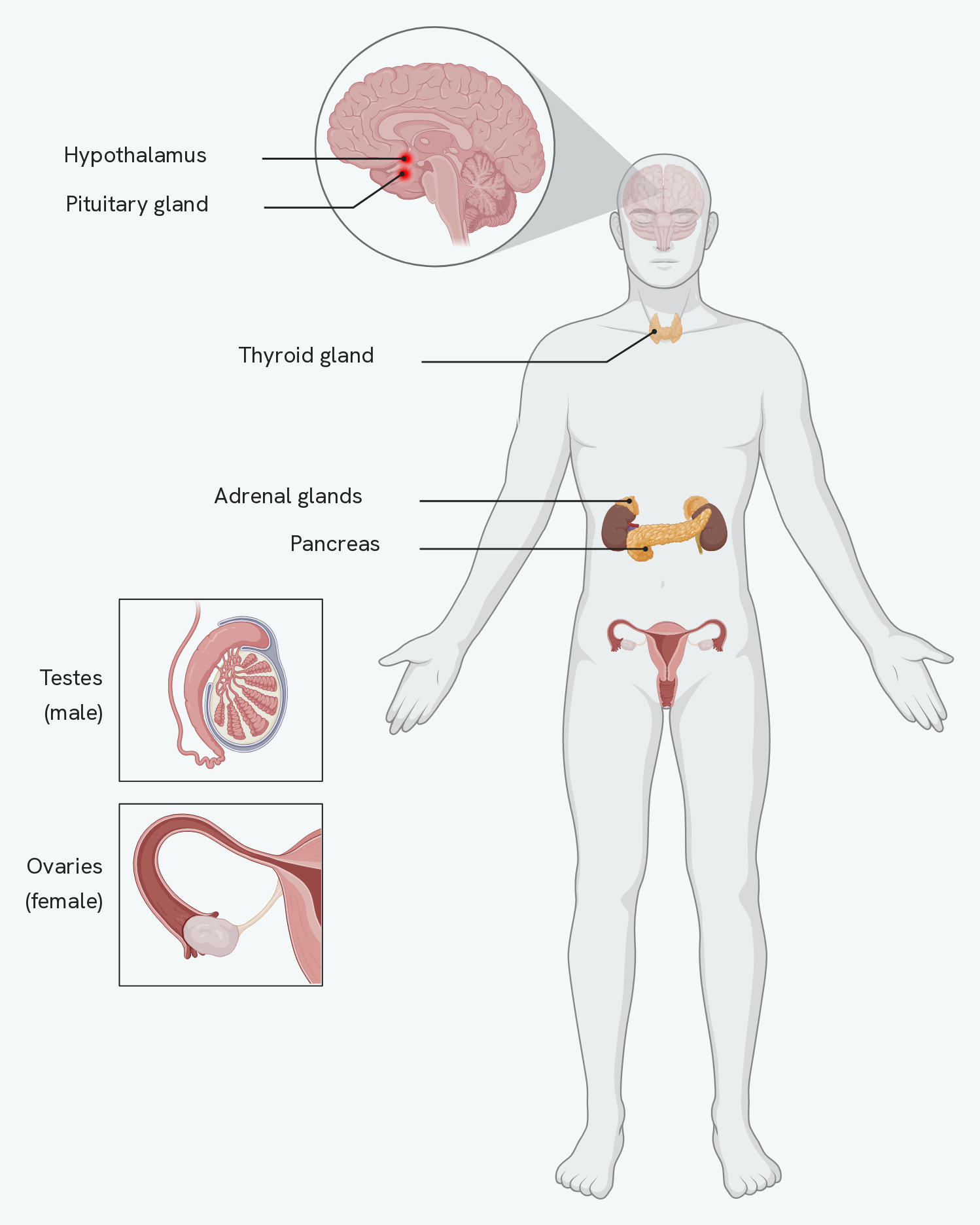
The six glands you are asked to place on a diagram are the pituitary, thyroid, adrenal glands, pancreas, ovaries and testes — the ones in the list above.
The hypothalamus is marked as well, and you meet it again later in this topic: it is the thermoregulatory centre, the part of the brain that monitors the temperature of the blood, covered in the control of body temperature guide.
Two positions are worth fixing in your memory, because questions often give an unlabelled outline: the adrenal glands sit on top of the kidneys, and the pancreas lies between them, below the stomach.
The pituitary as the master gland
The pituitary gland is called the master gland because it secretes several hormones in response to body conditions, and these hormones act on other endocrine glands, stimulating them to release their own hormones. In this way the pituitary controls much of the rest of the endocrine system.
Endocrine and nervous coordination compared
The two coordination systems work in different ways.
- The endocrine system uses chemical messengers (hormones) carried in the blood, and its responses are slower to start but longer-lasting.
- The nervous system uses electrical impulses along neurones, and its responses are fast but short-lived.
| Nervous system | Endocrine system | |
|---|---|---|
| Message carried by | Electrical impulses | Hormones (chemicals) |
| Travels along | Neurones | The bloodstream |
| Speed | Very fast | Slower |
| How long the effect lasts | Short | Long |
| Area affected | A precise, localised target | A more general target organ |
The reason behind the speed difference is worth being able to state, because questions ask for it rather than for the fact. A nerve impulse travels as electricity along a dedicated neurone, which is close to instant. A hormone has to be released into the blood and carried all the way round the circulation before enough of it reaches the target organ, which takes seconds at best.
That difference suits each system to a different job. Pulling your hand off something hot has to happen in a fraction of a second, so it is nervous. Growing through puberty takes years, so it is hormonal. If a question asks you to justify which system controls something, argue from how fast and how long-lasting the response needs to be.
One naming point catches people out: the pancreas produces two hormones, insulin and glucagon, with opposite effects. Writing that the pancreas produces insulin alone is incomplete.
How this fits together
One of the most important jobs of the endocrine system is keeping blood glucose steady, using hormones from the pancreas. That is the subject of the blood glucose and diabetes guide.