AQA GCSE Biology: The Nervous System
A clear GCSE Biology revision guide to the nervous system: the CNS, neurones and synapses, the pathway from stimulus to response, and reflex actions.
The nervous system lets an organism react quickly to changes around it. This guide explains how the system is structured, how signals pass along neurones and across synapses, the pathway from stimulus to response, and how reflexes give a fast, automatic reaction. The key idea is that electrical impulses carry information, with a chemical step at each junction.
The structure of the nervous system
The nervous system lets organisms react to changes in their surroundings and coordinate their behaviour.
- The central nervous system (CNS) is the brain and spinal cord, made of billions of connected neurones.
- Nerves are bundles of neurones that run to and from the CNS, connecting it to the rest of the body.
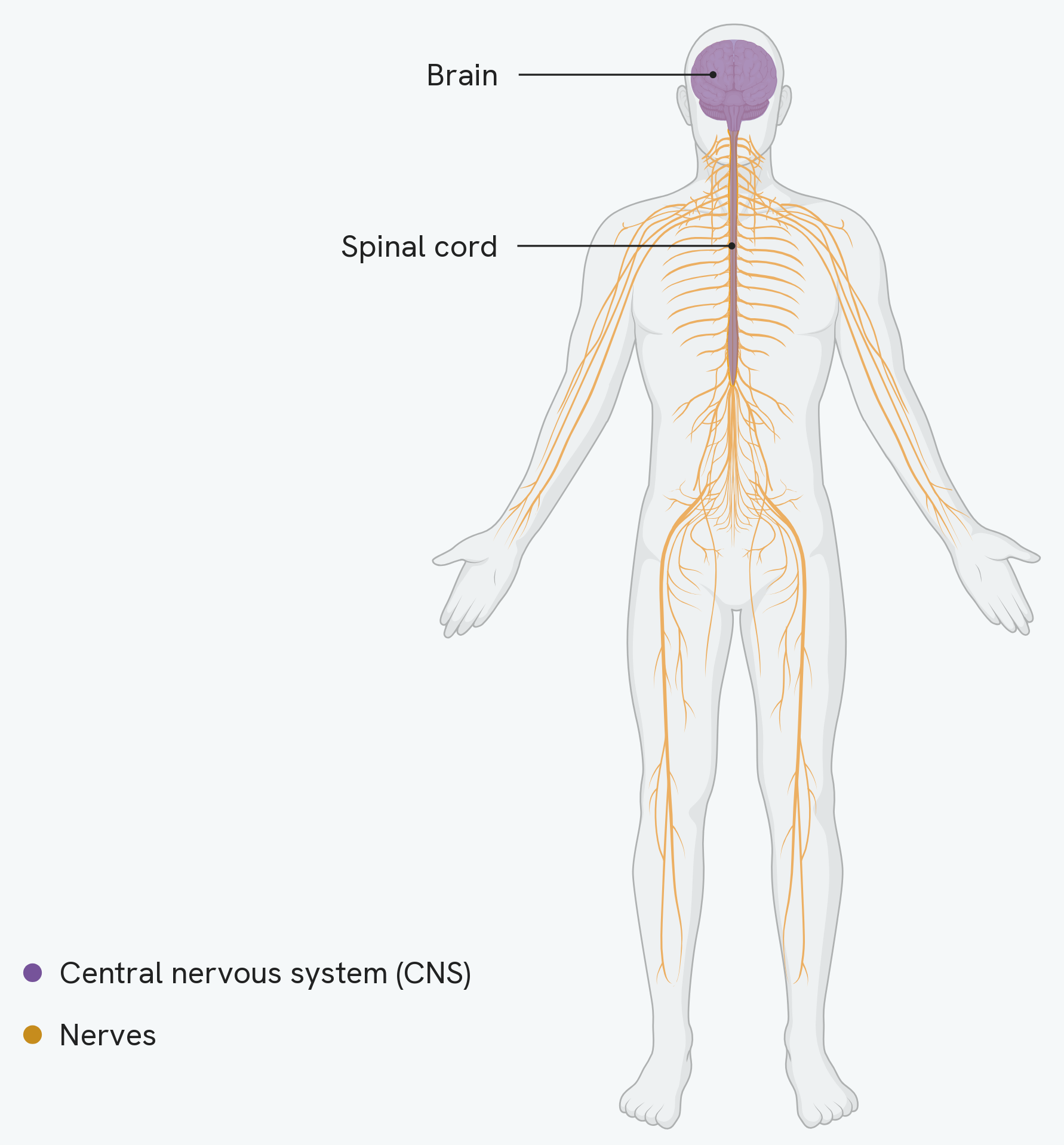
Notice how little of the nervous system is the CNS. Only the brain and the spinal cord are shaded as the CNS, and everything else on the diagram is nerves carrying information to and from it.
Information travels along neurones (nerve cells) as electrical impulses.
Synapses
Where two neurones meet, there is a small gap called a synapse, and the signal crosses it as a chemical.
- When an electrical impulse reaches the end of the first neurone, a chemical (neurotransmitter) is released into the synapse.
- The chemical diffuses across the gap.
- It attaches to receptors on the second neurone, triggering a new electrical impulse in it.
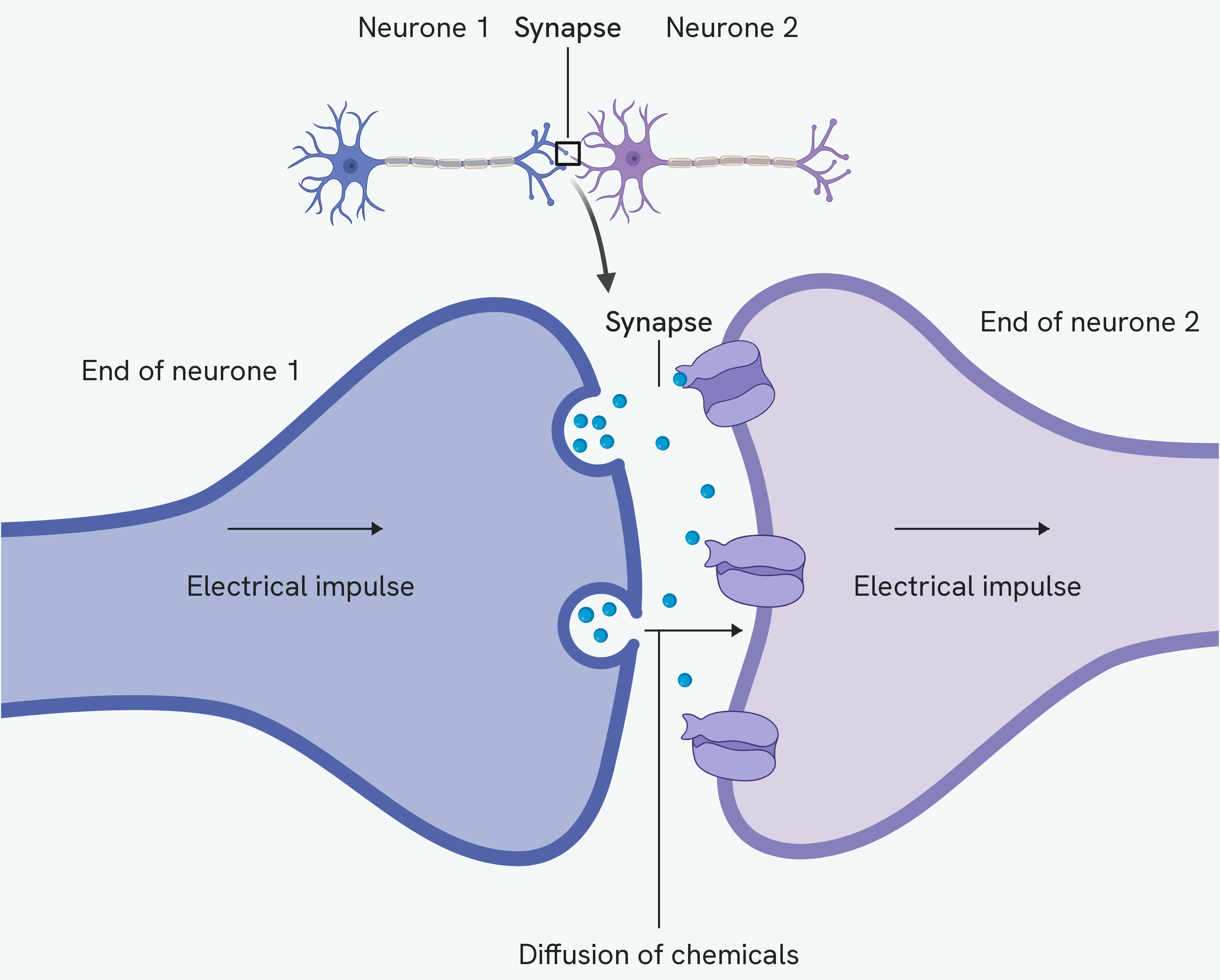
Follow the two electrical impulses in the diagram. Neither of them crosses the gap. The signal is electrical along each neurone and chemical across the synapse, and that switch is what most marks on this topic are testing.
From stimulus to response
A nervous response follows a set pathway from the stimulus to the effector.
stimulus → receptor → sensory neurone → CNS → motor neurone → effector → response
- The receptor detects the stimulus and starts an impulse.
- The sensory neurone carries the impulse to the CNS.
- The CNS coordinates the response.
- The motor neurone carries the impulse to the effector.
- The effector (a muscle or a gland) responds: a muscle contracts, or a gland secretes a hormone.
Two of these words are examined as definitions in their own right, so learn them precisely. A receptor is a cell that detects a stimulus. An effector is a muscle or a gland that carries out the response. If an answer names anything other than a muscle or a gland as the effector, it is wrong.
The pathway is also worth being able to apply rather than recite. Given any example, you should be able to fill in all seven stages. For a hand touching a hot pan: the stimulus is the heat, the receptor is a temperature receptor in the skin, the effector is a muscle in the arm, and the response is the arm contracting to pull the hand away.
Reflex actions
A reflex action is an automatic, rapid response that does not involve the conscious part of the brain. Reflexes are protective, helping to minimise damage to the body, for example pulling a hand away from something hot.
The pathway is called a reflex arc:
receptor → sensory neurone → relay neurone (in the spinal cord) → motor neurone → effector
Because the impulse does not travel to the conscious brain, the response is faster than a normal decision.
Compare the two pathways and the difference is clear. In a conscious response the impulse goes up to the brain, which decides what to do before sending an impulse back down. In a reflex the relay neurone in the spinal cord passes the signal straight from the sensory neurone to the motor neurone, cutting the brain out of the decision entirely. The journey is shorter and nothing has to be thought about, which is why it is so much faster.
It works like a fire alarm wired directly to the sprinklers. Nobody has to find the manager and ask permission, which is exactly why it saves the building.
Note that the relay neurone sits in the spinal cord, so a reflex arc still passes through the CNS. The brain is bypassed, not the central nervous system. You do become aware of the pain a moment later, but only after your hand has already moved.
How this fits together
The nervous system is the body's fast coordination system. In Triple award biology, you also study the brain and the eye in detail, starting with the brain guide. The slower, chemical coordination system is the endocrine system.