AQA GCSE Biology: Plant Hormones
A Triple award GCSE Biology revision guide to plant hormones: tropisms, how auxin controls phototropism and gravitropism, and the uses of auxins, ethene and gibberellins.
This whole guide is Triple award only. Plants respond to their surroundings by growing, controlled by hormones such as auxin. This guide explains tropisms, how auxin bends shoots and roots, and how plant hormones are used in farming and gardening. The key idea is that auxin has opposite effects in shoots and roots.
Tropisms
A tropism is the growth of part of a plant in response to a directional stimulus, controlled by plant hormones including auxin.
- Phototropism is a growth response to the direction of light.
- Gravitropism (geotropism) is a growth response to the direction of gravity.
How auxin controls growth
Auxin is made at the tips of shoots and roots and controls growth by changing how much cells elongate. It has opposite effects in the two organs: in shoots it stimulates elongation, and in roots it inhibits it.
Shoots and light. When light shines from one side, auxin moves to the shaded side of the shoot. Because auxin stimulates elongation in shoots, the shaded-side cells grow more, so the shoot bends towards the light.
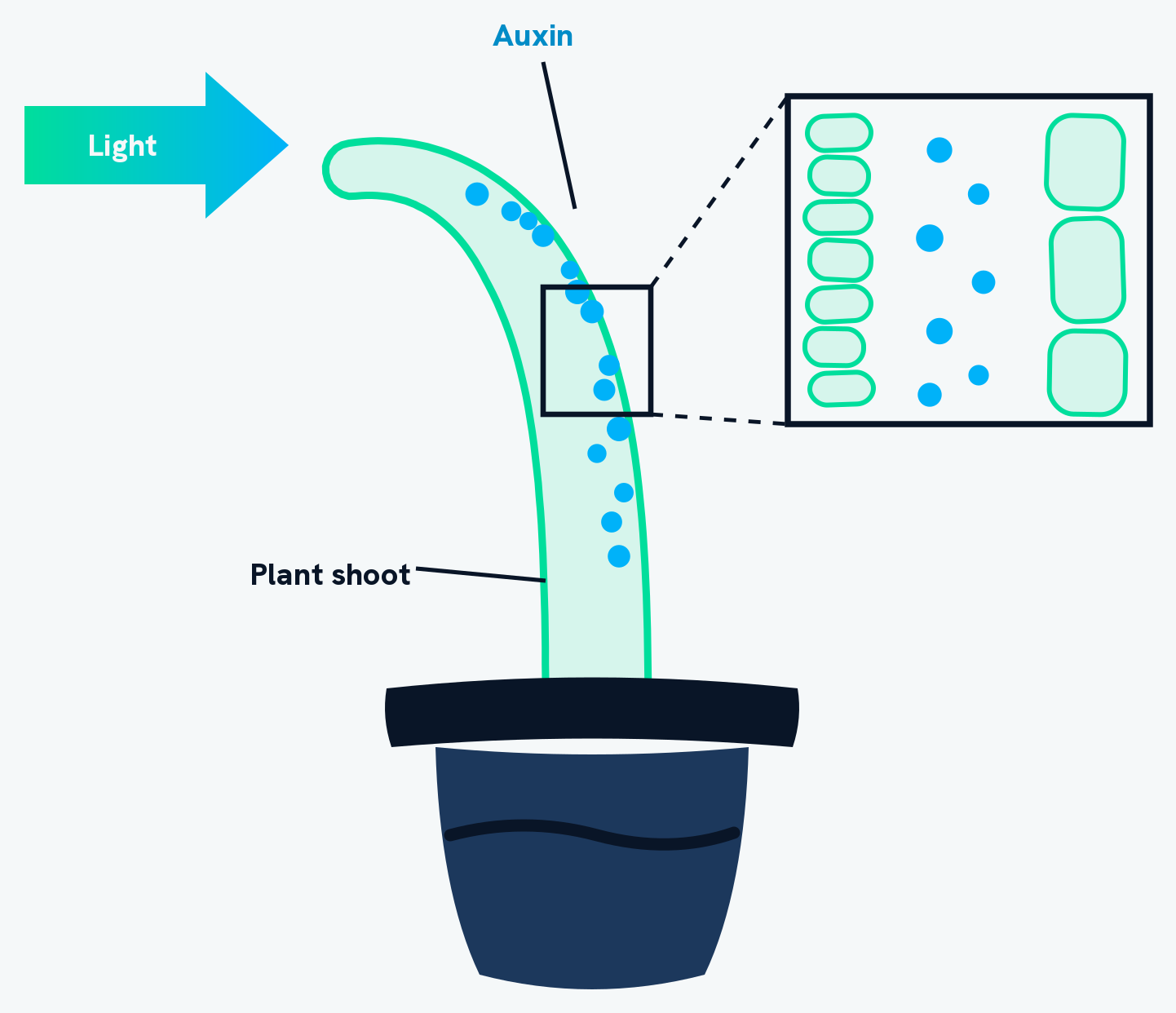
The inset is where the marks are. The dots gather on the shaded side, and it is the cells on that side that have elongated, while the cells on the lit side stay short. A longer side on the outside of a bend is what makes the shoot curve towards the light.
Both cases below work the same way, so answer them in the same two steps: first say which side the auxin gathers on, then say whether auxin makes that side grow faster (a shoot) or slower (a root).
Shoots and gravity. In a horizontal shoot, auxin gathers on the lower side. Because auxin stimulates elongation in shoots, the lower-side cells grow faster, so the shoot bends upwards, against gravity (negative gravitropism).
Roots and gravity. In a horizontal root, auxin also gathers on the lower side. But because auxin inhibits elongation in roots, the lower-side cells grow more slowly, so the root bends downwards, in the direction of gravity (positive gravitropism).
Two other plant hormones are gibberellins, which start seed germination, and ethene, a gas that controls cell division and the ripening of fruit. (Gibberellins and ethene are Higher tier.)
Uses of plant hormones
(This section is Higher tier only.) Plant hormones are widely used in agriculture and horticulture.
Auxins are used:
- as selective weed killers: broad-leaved weeds absorb more of the synthetic auxin than narrow-leaved crops, and the excess disrupts their growth and kills them, leaving the crop mostly unharmed;
- in rooting powders, to make cuttings develop roots so they can be grown as clones;
- in tissue culture, to promote growth and division so new plants can be grown from small pieces of tissue.
Ethene is used in the food industry to control the ripening of fruit: fruit can be picked unripe, so it travels well, then exposed to ethene to ripen it just before sale.
Gibberellins are used to end seed dormancy (so crops can be grown out of season), to promote flowering, and to increase fruit size.
How this fits together
Plant hormones complete Topic 5, which has covered how both animals and plants detect changes and respond, by nervous impulses, by hormones, and by growth. These responses all keep the organism working well in a changing environment.