AQA GCSE Biology: Hormones in Reproduction
A clear GCSE Biology revision guide to hormones in human reproduction: puberty, the main reproductive hormones, and the hormonal control of the menstrual cycle.
Hormones control reproduction, from the changes of puberty to the monthly menstrual cycle. This guide covers puberty, the main reproductive hormones, and how four hormones control the menstrual cycle. The interactions between those four hormones are the trickiest part, so they are worth taking slowly.
Puberty and the reproductive hormones
During puberty, reproductive hormones cause secondary sexual characteristics to develop, such as facial and pubic hair, breast development and a deepening voice. In females, eggs begin to mature in the ovaries and one is released about every 28 days, a process called ovulation.
The main reproductive hormones are:
- Testosterone, produced by the testes in males, which stimulates sperm production;
- Oestrogen, produced by the ovaries in females, which is involved in the menstrual cycle.
The menstrual cycle
Four hormones control the menstrual cycle.
- FSH (follicle stimulating hormone), from the pituitary gland, stimulates an egg to mature in the ovary. (Higher tier: it also stimulates the ovaries to produce oestrogen.)
- Oestrogen, from the ovaries, causes the uterus lining to thicken. (Higher tier: it also inhibits FSH and stimulates LH.)
- LH (luteinising hormone), from the pituitary gland, triggers ovulation, the release of the mature egg, at around day 14. (Higher tier: it also stimulates the release of progesterone.)
- Progesterone, from the ovaries, maintains the uterus lining in the second half of the cycle. (Higher tier: it also inhibits FSH and LH.)
If no pregnancy occurs, progesterone levels fall, the uterus lining breaks down and is shed as the menstrual flow, and the cycle restarts.
Before learning the interactions, fix where each hormone comes from, because that alone is worth a mark and is easily muddled. FSH and LH are released by the pituitary gland in the brain. Oestrogen and progesterone are released by the ovaries. So the brain sends two hormones down to the ovaries, and the ovaries send two back up.
The cycle as a sequence (Higher tier)
The four hormones are easier to hold onto as one story running through a 28 day cycle than as four separate facts.
- FSH rises first. It travels from the pituitary to the ovary, where it makes an egg mature and tells the ovary to start releasing oestrogen.
- Oestrogen rises as the egg matures. It thickens the uterus lining, ready for a possible pregnancy. It also does two things to the pituitary: it inhibits FSH, so no further eggs begin maturing, and it stimulates LH.
- LH spikes sharply at around day 14, triggering ovulation. It then causes the remains of the follicle to release progesterone.
- Progesterone stays high through the second half of the cycle, maintaining the thickened lining. It inhibits both FSH and LH, which stops another cycle starting while a pregnancy is still possible.
If no pregnancy happens, progesterone falls. With it no longer inhibiting FSH, FSH can rise again, and the whole sequence begins once more. The falling progesterone is both the reason the lining is shed and the reason the next cycle can start, which is why it is the hinge of the whole system.
Why the inhibition matters
Those inhibiting steps are negative feedback, the same principle as a thermostat: a rising output switches off the thing that caused it. The purpose is to make sure only one egg matures at a time. High oestrogen and progesterone are the body's signal that an egg is already on its way, so FSH is switched off until that attempt is over.
This is also exactly how the contraceptive pill works. It keeps oestrogen and progesterone artificially high, so FSH is permanently inhibited and no egg ever matures. If you understand the feedback here, that part of the next guide needs no extra learning.
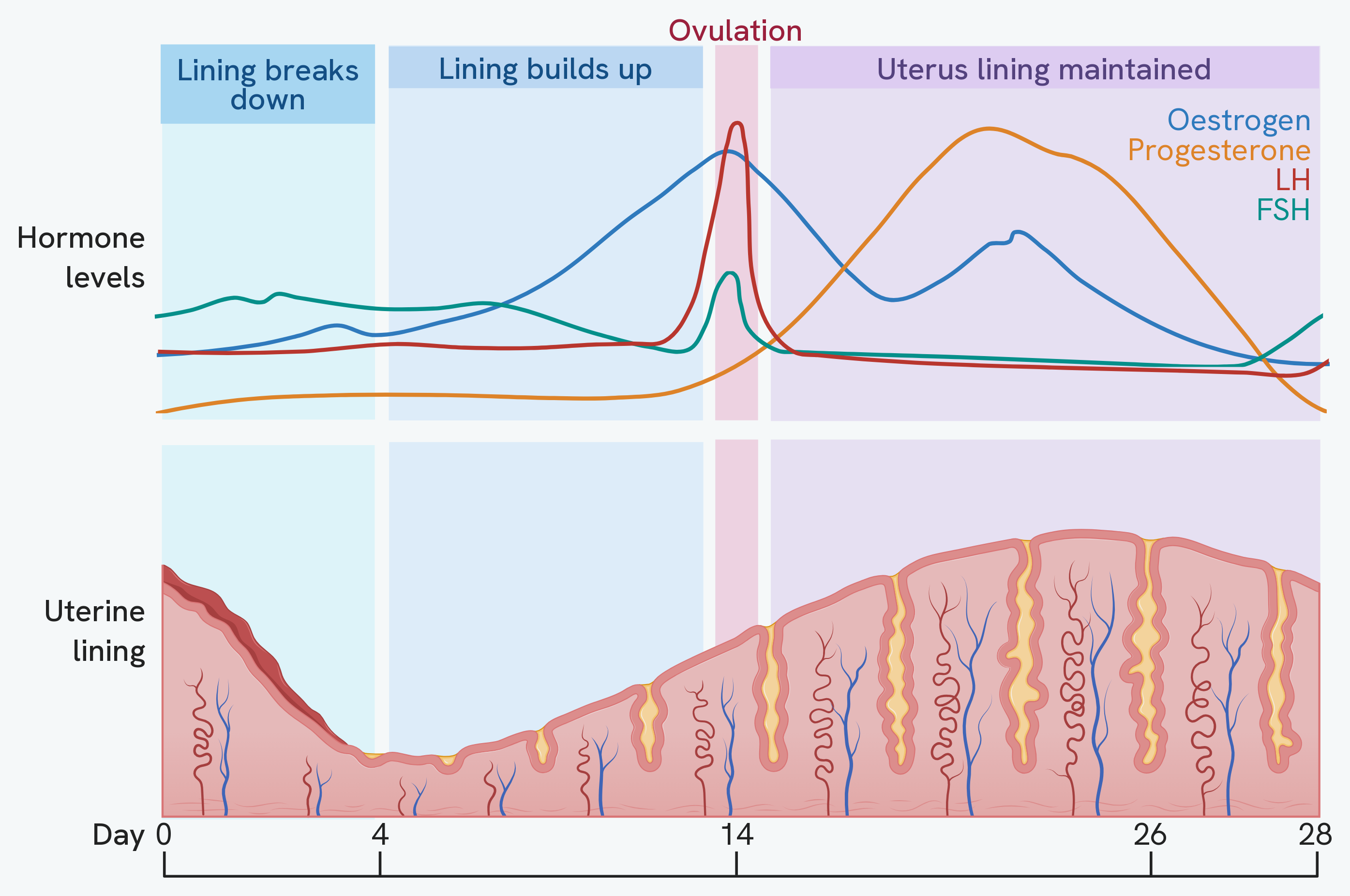
Read the two halves together. The LH spike at day 14 is the sharpest feature on the graph and it lines up exactly with ovulation; the progesterone curve in the second half is what holds the lining thick, so when it falls at the end of the cycle the lining breaks down. Questions often give you one of these graphs unlabelled and ask which hormone a curve is, so it is worth learning the shapes as well as the jobs.
Interpreting the graph (Higher tier)
You need to be able to interpret graphs showing hormone levels during a menstrual cycle, and this is Higher tier only. The figure above is the standard version of one: the four hormones on the upper graph, the uterus lining on the lower one, and the same 28 days running along the bottom of both. Work through it in the four blocks the shading marks out.
Days 0 to 4, the lining breaks down (menstruation). Oestrogen and progesterone are both low, because progesterone fell at the end of the last cycle. Without it the lining cannot be maintained, so it breaks down and leaves the body as the period, which you can see as the sharp thinning in the lower panel. FSH (green) is relatively high, and is already stimulating a new egg to mature in the ovary.
Days 4 to 14, the lining builds up. FSH stimulates the ovary to produce oestrogen, so the blue line climbs steadily to a peak just before day 14. Oestrogen makes the uterus lining thicken again, which is why the lining in the lower panel grows through this section. As oestrogen rises it inhibits FSH, so the green line falls. Very high oestrogen then stimulates LH, which sets up the spike at day 14.
Day 14, ovulation. LH (red) surges to a sharp peak, and this is what triggers ovulation, the release of the mature egg. FSH has a smaller spike at the same time. Oestrogen has just peaked and is starting to fall.
Days 14 to 28, the uterus lining is maintained. The empty egg follicle is stimulated by LH to make progesterone (orange), which rises to a peak around day 21. Progesterone maintains the thick lining ready for a fertilised egg, which is why the lining is at its thickest here, and it also inhibits FSH and LH, so both stay low. Oestrogen has a smaller second rise in this section. If there is no pregnancy, progesterone falls from about day 26, FSH starts rising again at day 28, and the lining breaks down to start the next cycle.
How this fits together
Understanding these hormones explains how fertility can be controlled, both to prevent pregnancy and to treat infertility, which is the subject of the contraception and fertility treatment guide.