AQA GCSE Biology: Culturing Microorganisms
A clear GCSE Biology revision guide to culturing microorganisms: binary fission, calculating bacterial population size, growing cultures, and aseptic technique.
Bacteria can be grown in the lab to study them and to test substances such as antibiotics. This guide explains how bacteria reproduce and how quickly, how to work out how many there will be after a given time, and the aseptic techniques used to grow a pure, uncontaminated culture. Careful technique is the theme throughout: keeping unwanted microbes out.
How bacteria multiply
Bacteria reproduce by binary fission: the single loop of DNA (and any plasmids) is copied, and then the cell splits into two. Under ideal conditions, with enough nutrients and a suitable temperature, bacteria can divide as often as once every 20 minutes, so their numbers grow extremely quickly.
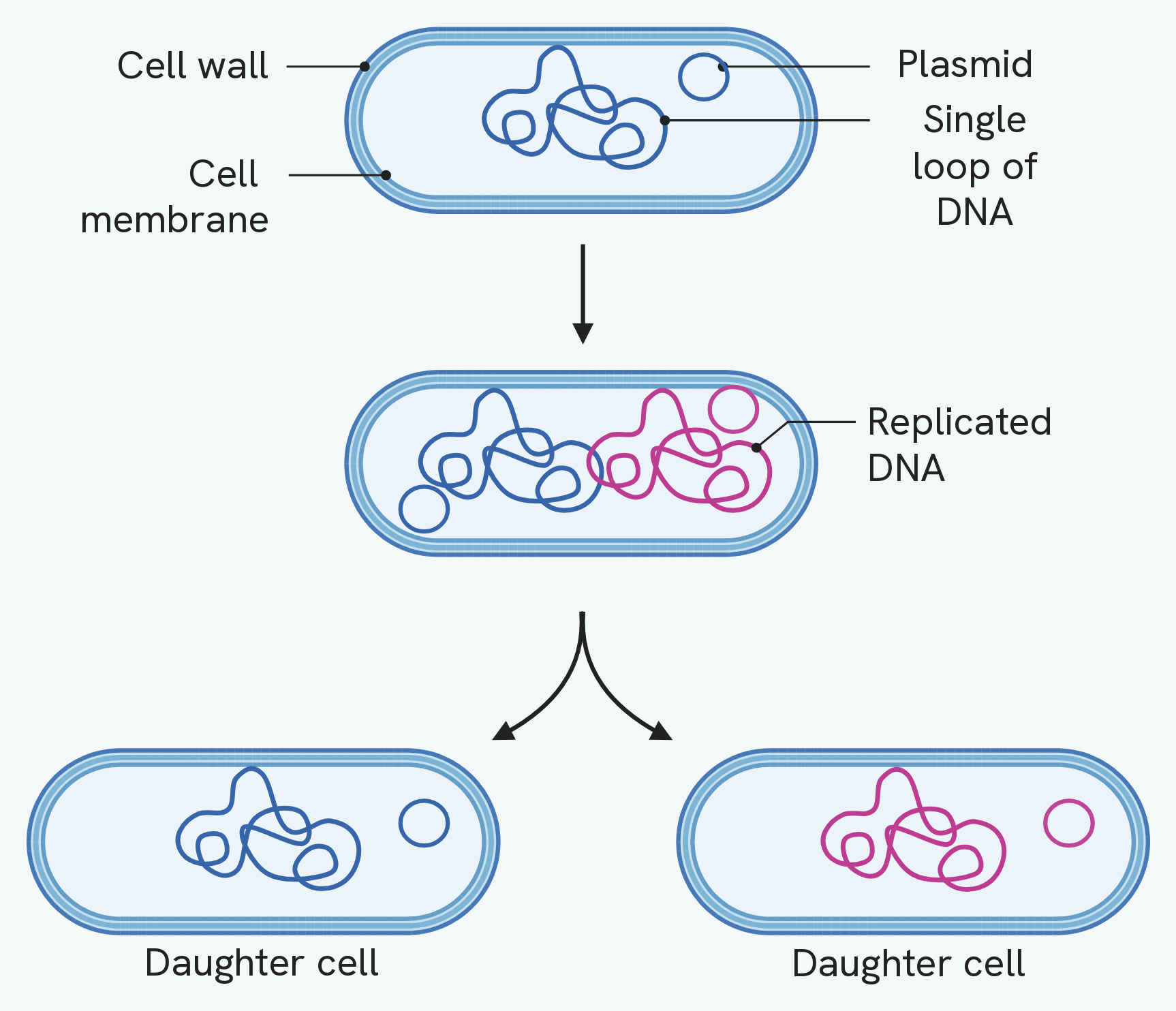
Calculating population size
Because the number of bacteria doubles with each division, you can work out the population in two steps.
- Find the number of divisions: total time ÷ mean division time (in the same unit).
- Find the population using number of bacteria = 2ⁿ, where n is the number of divisions.
For example, a cell dividing every 24 minutes over 6 hours (360 minutes) makes 360 ÷ 24 = 15 divisions, giving 2¹⁵ = 32 768 bacteria, or about 3.3 × 10⁴.
Growing cultures
Bacteria can be grown in a nutrient broth (a liquid) or as colonies on an agar gel plate.
Either way the bacteria need a culture medium supplying what they cannot make for themselves: carbohydrate as an energy source, plus nitrogen and other mineral ions for building proteins. Agar is simply that mixture set into a jelly, which is what lets colonies stay in one place and be counted.
A colony is a visible patch of bacteria that has grown from a single original cell, which is why colonies can be counted to estimate how many bacteria were present at the start.
Aseptic technique
To grow a pure, uncontaminated culture, you must stop unwanted microbes getting in, using aseptic technique.
- Sterilise the Petri dishes, the culture medium (agar) and the work surfaces to kill unwanted microorganisms.
- Sterilise the inoculating loop by passing it through a Bunsen flame until it glows red, killing any microbes on it.
- Transfer the bacteria with the sterilised loop, lifting the Petri dish lid as little as possible to keep airborne microbes out.
- Tape the lid on with a couple of strips (not fully sealed), which keeps airborne microbes out while still letting oxygen in, so that harmful anaerobic microbes are less likely to grow.
- Store the plate upside down, so condensation collects on the lid instead of dripping onto the agar.
- Incubate at no more than 25°C in school labs: warm enough for the bacteria to grow, but not warm enough to encourage harmful human pathogens.
Testing antibiotics and antiseptics
Cultures can be used to test how well substances kill bacteria. Paper discs soaked in different antibiotics or antiseptics are placed on a lawn of bacteria on agar. Where a substance kills or stops the bacteria, a clear zone of inhibition appears around the disc. A larger zone means the substance is more effective. A disc soaked in sterile water is used as a control, to show that any effect is due to the substance and not the disc itself.
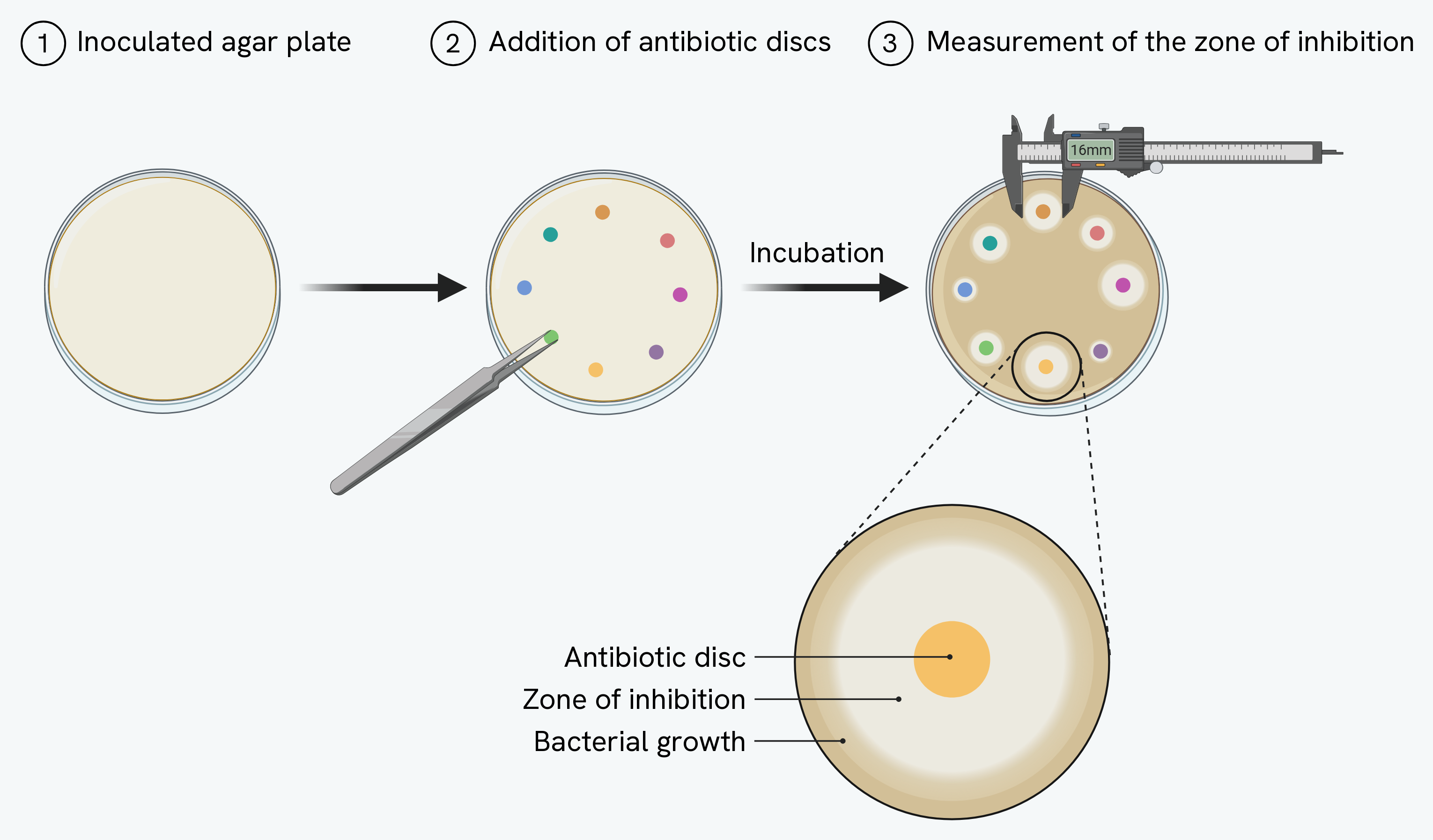
You are often asked to calculate the area of a zone of inhibition rather than just measure it, because area is the fairer comparison. The zone is a circle, so use area = πr², and remember that what you measure across the zone is the diameter, which must be halved first. A zone measuring 18 mm across has a radius of 9 mm, giving an area of π × 9² = 254 mm² to three significant figures. Forgetting to halve the diameter is the single most common error in this calculation.
How this fits together
Growing bacteria safely is an important practical skill and links to how microbes cause and are treated for disease. The way body cells (rather than bacteria) divide is covered in the chromosomes and the cell cycle guide.