AQA GCSE Biology: Osmosis and Active Transport
A clear GCSE Biology revision guide to osmosis and active transport: how water moves across a partially permeable membrane, and how cells move substances against a concentration gradient.
Alongside diffusion, cells move substances in and out by two other processes: osmosis, which moves water, and active transport, which moves substances the "wrong" way using energy. This guide explains both, with the examples you need. The contrast to hold onto is that osmosis is passive, while active transport costs energy.
Osmosis
Osmosis is the diffusion of water molecules from a dilute solution (where the water concentration is higher) to a more concentrated solution (where the water concentration is lower), through a partially permeable membrane.
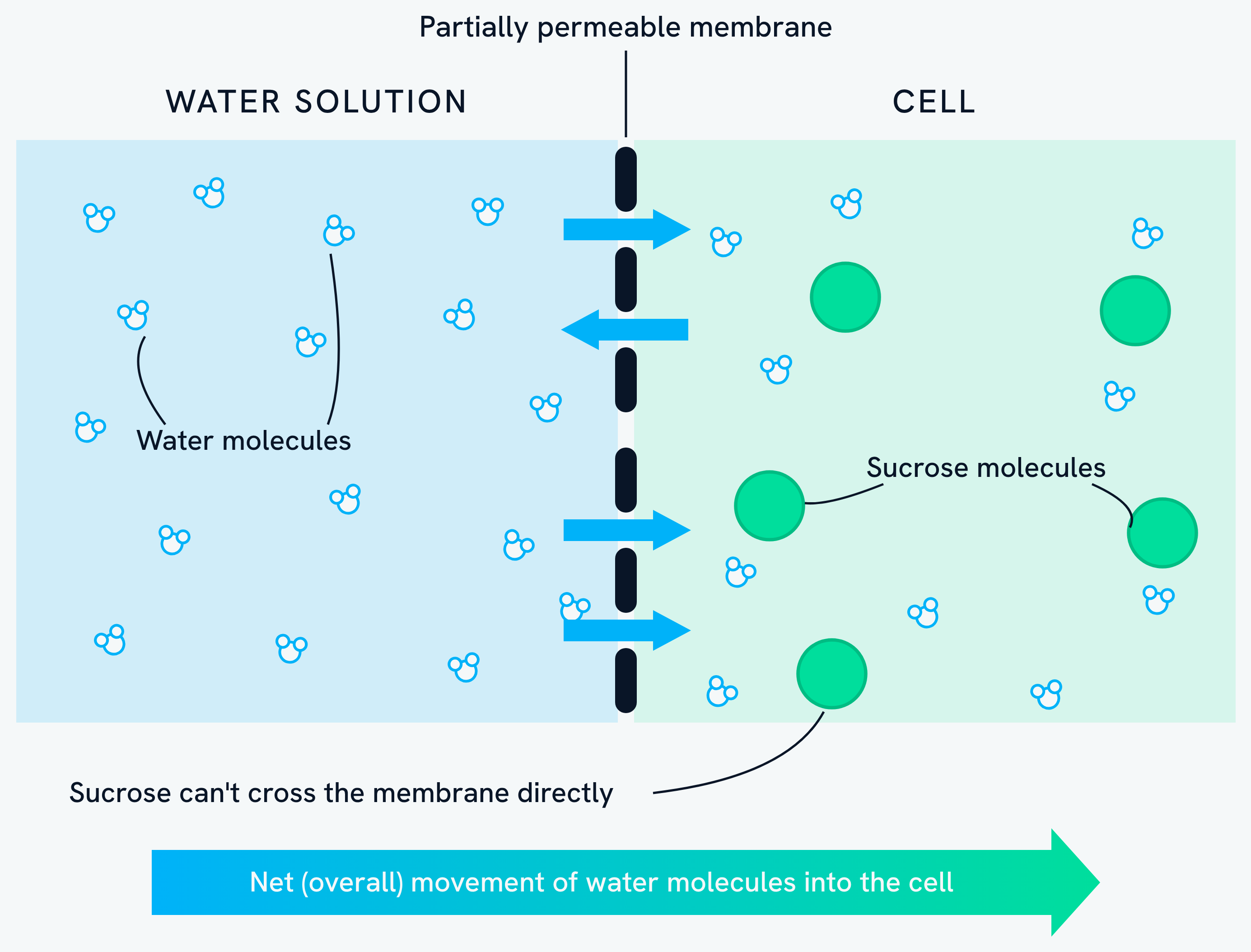
Every part of that definition is examined, so learn it word for word. Water molecules is the first half of it: osmosis moves water and nothing else. A partially permeable membrane is what makes it possible, because it lets the small water molecules through while holding back the larger dissolved solute molecules. And the movement is a net movement, not a one-way one. Water crosses in both directions the whole time; there is simply more of it going one way than the other.
The trap is writing that water moves "from a high concentration to a low concentration" without saying a concentration of what. Water moves from where the water concentration is high to where it is low, which is from the dilute solution to the concentrated one. Said carelessly, it sounds like the opposite of the truth, and the mark is lost.
Osmosis explains why the concentration of the fluid around cells matters. If the solution outside a cell is more concentrated than the inside, water moves out of the cell by osmosis and the cell shrinks; if the outside is more dilute, water moves in and the cell swells. This is why a very high blood glucose concentration can damage cells: water leaves them by osmosis, and they shrink.
The effect of solution concentration on plant tissue can be measured by placing potato cylinders in a range of sugar solutions and finding the percentage change in mass. In dilute solutions the potato gains mass, as water enters the cells; in concentrated solutions it loses mass, as water leaves; and where there is no change, the solution has the same concentration as the cell contents, so there is no net movement of water. Percentage change is used, rather than raw mass change, so that pieces starting at slightly different masses can be compared fairly.
Active transport
Active transport moves substances from a more dilute solution to a more concentrated one, that is, against the concentration gradient. Unlike diffusion and osmosis, this needs energy, supplied by respiration.
The energy requirement is the whole point, and an everyday comparison makes it stick. Diffusion and osmosis are like walking down a hill: things naturally spread from where there are many of them to where there are few, and no effort is needed. Active transport is walking up that hill, and nothing moves uphill for free. The energy comes from respiration, which is why cells that do a lot of active transport are packed with mitochondria.
Two examples to know:
- Mineral ions into plant roots. Mineral ions such as nitrate ions are at a lower concentration in the soil than inside the root hair cells. Active transport moves them into the cells against the gradient, where they are needed for healthy growth (nitrate ions are used to make amino acids and proteins).
- Sugar absorption in the gut. After digestion, the sugar concentration in the small intestine can fall below that in the blood. Active transport moves the remaining sugar from the gut into the blood against the gradient, so none is wasted.
Because active transport needs energy from respiration, and aerobic respiration needs oxygen, anything that cuts off the oxygen supply, such as waterlogged soil around plant roots, reduces active transport and stops the plant taking up enough mineral ions.
Comparing the three processes
| Diffusion | Osmosis | Active transport | |
|---|---|---|---|
| What moves | Any dissolved substance or gas | Water only | Dissolved substances |
| Direction | Down the gradient | Down the water gradient | Against the gradient |
| Energy needed | No | No | Yes, from respiration |
| Membrane needed | No | Yes, partially permeable | Yes |
The fastest way to identify which process a question is describing is to ask two questions in order. Is it water moving? If so it is osmosis. If not, is it moving against the gradient? If so it is active transport, and if not it is diffusion.
How this fits together
Diffusion, osmosis and active transport are the three ways substances cross cell membranes, and together they complete Topic 1. The same ideas return throughout GCSE Biology, in gas exchange, digestion, the kidneys and plant transport.