AQA GCSE Biology: Diffusion and Exchange Surfaces
A clear GCSE Biology revision guide to diffusion and exchange surfaces: what diffusion is, what affects its rate, surface area to volume ratio, and how exchange surfaces are adapted.
Substances have to move in and out of cells all the time, and one of the main ways they do this is diffusion. This guide explains what diffusion is, what makes it faster, and why large organisms need special exchange surfaces and transport systems rather than relying on diffusion alone. The idea of surface area to volume ratio ties it all together.
What diffusion is
Diffusion is the spreading out of the particles of a gas, or of a substance in solution, so that there is a net movement from a higher concentration to a lower concentration, that is, down a concentration gradient. Diffusion is a passive process: it does not need energy from respiration.
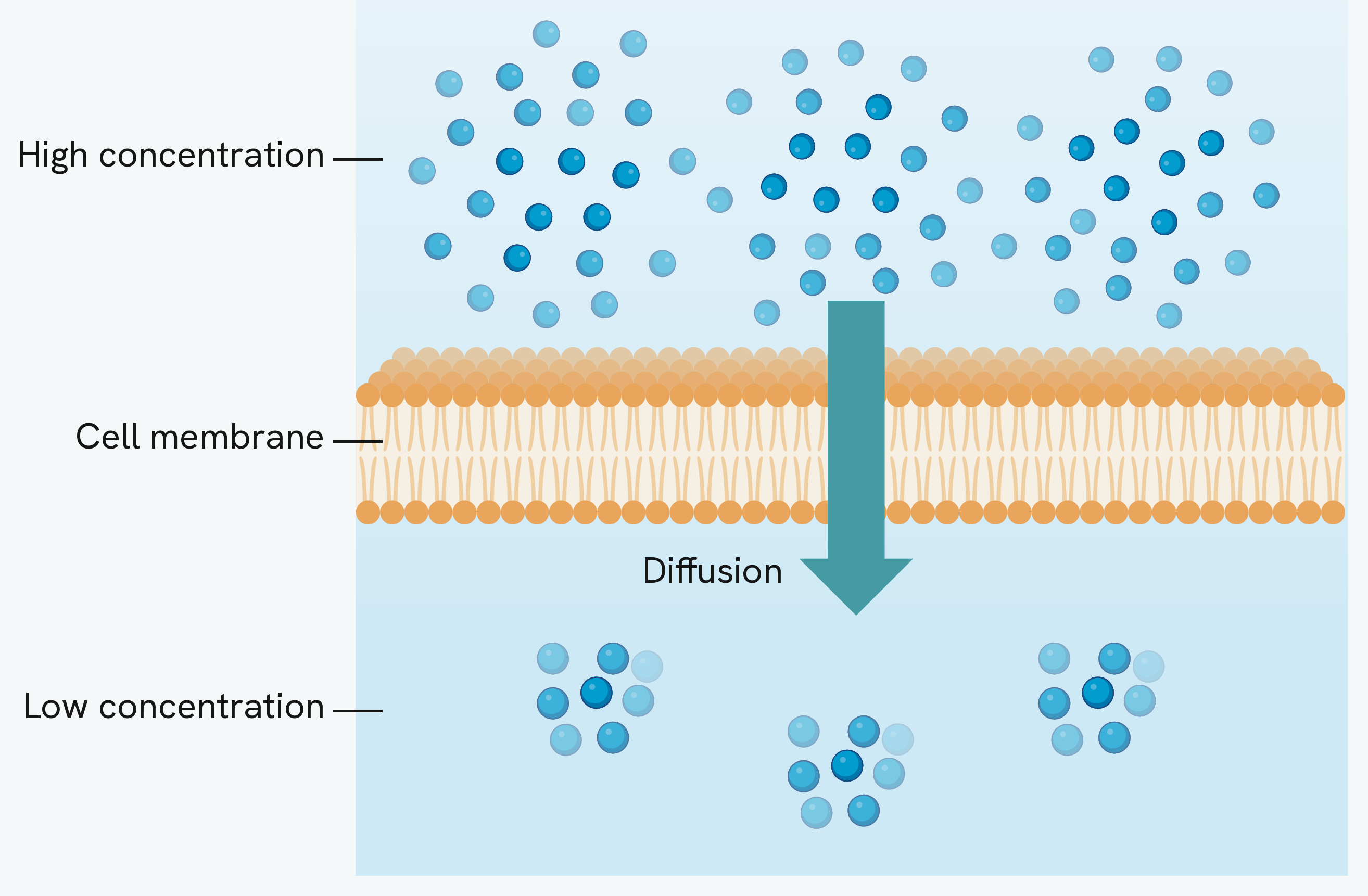
Examples in living things include:
- oxygen diffusing from the alveoli in the lungs into the blood, and carbon dioxide diffusing the other way (gas exchange);
- urea, a waste product, diffusing out of cells into the blood plasma to be carried to the kidneys.
What affects the rate of diffusion
Three factors make diffusion faster.
- A steeper concentration gradient (a bigger difference in concentration between the two areas).
- A higher temperature, because the particles have more kinetic energy and move faster.
- A larger surface area of the membrane across which diffusion happens.
Why large organisms need exchange surfaces
In a single-celled organism, diffusion across the surface is enough to supply the whole cell. In a multicellular organism it is not, because of the surface area to volume ratio.
- A larger organism has a smaller surface area compared with its volume, so its outer surface is not big enough to supply all the cells inside by diffusion alone.
- Many cells are also far from the surface, giving a long diffusion distance.
So the rate of diffusion per unit volume is too slow, and the organism needs specialised exchange surfaces and transport systems, such as the circulatory system, to move substances quickly enough.
How exchange surfaces are adapted
Exchange surfaces share features that make diffusion efficient.
- A large surface area, for example the villi in the small intestine, the alveoli in the lungs, and root hairs on plant roots.
- Thin walls or membranes, often just one cell thick, giving a short diffusion distance.
- In animals, a rich blood supply that carries substances away, keeping the concentration gradient steep.
- In animals, for gas exchange, ventilation (breathing) that refreshes the air and keeps the gradient steep.
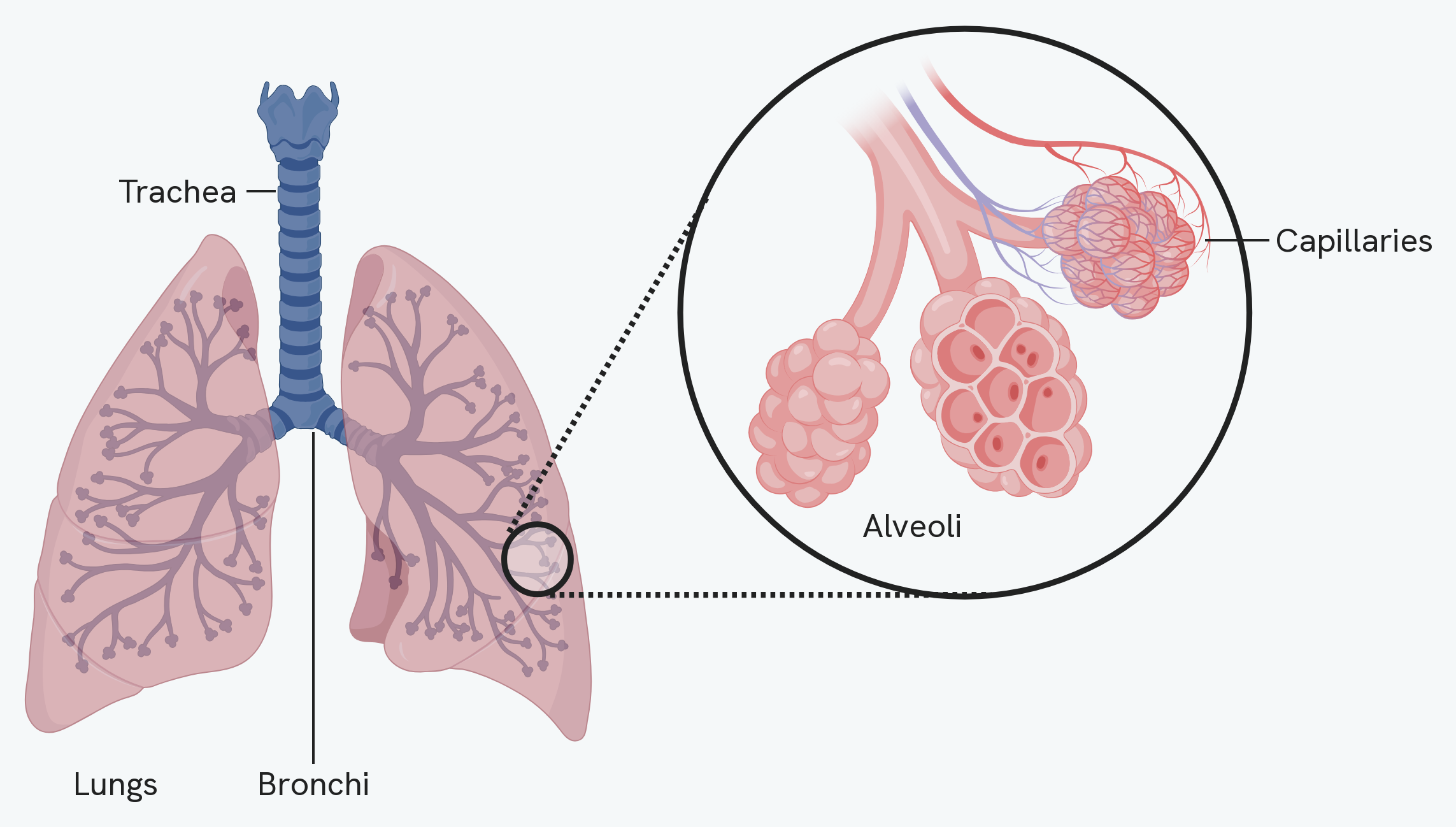
Air reaches the alveoli through the trachea, which divides into the two bronchi, one to each lung. From there the lungs show three of those four features at once. The alveoli are tiny and there are hundreds of millions of them, which is where the large surface area comes from. Their walls are one cell thick, and so are the capillary walls, so oxygen crosses only two cells to reach the blood. The net of capillaries over every cluster is the rich blood supply: blood carries oxygen away as fast as it arrives, so the concentration gradient stays steep. The fourth feature, ventilation, is breathing, which keeps the gradient steep from the other side by replacing the air in the alveoli.
How this fits together
Diffusion moves gases and dissolved substances. The special case of water moving across a membrane, and the way cells move substances against a gradient, are covered in the osmosis and active transport guide.