AQA A-Level Biology: Nerve Impulses
A clear revision guide to nerve impulses for AQA A-Level Biology: the resting potential, the action potential, the refractory period, the all-or-nothing principle, and what affects conduction speed.
A nerve impulse is a brief reversal of the electrical charge across a neurone's membrane that sweeps along the axon. This guide explains how a neurone keeps a resting charge ready, what happens during an action potential, and why one impulse cannot merge into the next. It finishes with the three things that decide how fast an impulse travels. Following the movement of sodium and potassium ions is the key to the whole story.
The resting potential
When a neurone is not transmitting, the inside of the axon is negative relative to the outside, at about −70 mV. The membrane is said to be polarised, and this is the resting potential. It is set up and maintained by two things.
- The sodium-potassium pump actively transports three sodium ions out of the axon for every two potassium ions in.
- The membrane is more permeable to potassium than to sodium, because potassium channels are open while sodium channels are closed, so some potassium ions leak back out.
Together these build up a higher concentration of sodium ions outside and potassium ions inside, and leave the inside of the axon negatively charged.
The action potential
An action potential is a rapid, temporary reversal of this charge, and it happens in stages.
- Reaching threshold. A stimulus makes the membrane more permeable to sodium: some sodium ion channels open and sodium ions diffuse in, making the inside less negative. If this reaches the threshold of about −55 mV, an action potential fires.
- Depolarisation. At threshold, many voltage-gated sodium ion channels open, and sodium ions flood in rapidly. The inside becomes positive, up to about +30 mV.
- Repolarisation. The sodium ion channels close and voltage-gated potassium ion channels open, so potassium ions diffuse out. This returns the inside to a negative charge.
- Hyperpolarisation. The potassium channels are slow to close, so slightly too many potassium ions leave and the potential overshoots, becoming more negative than the resting potential.
- Return to rest. The sodium-potassium pump restores the original distribution of ions and the resting potential is re-established.
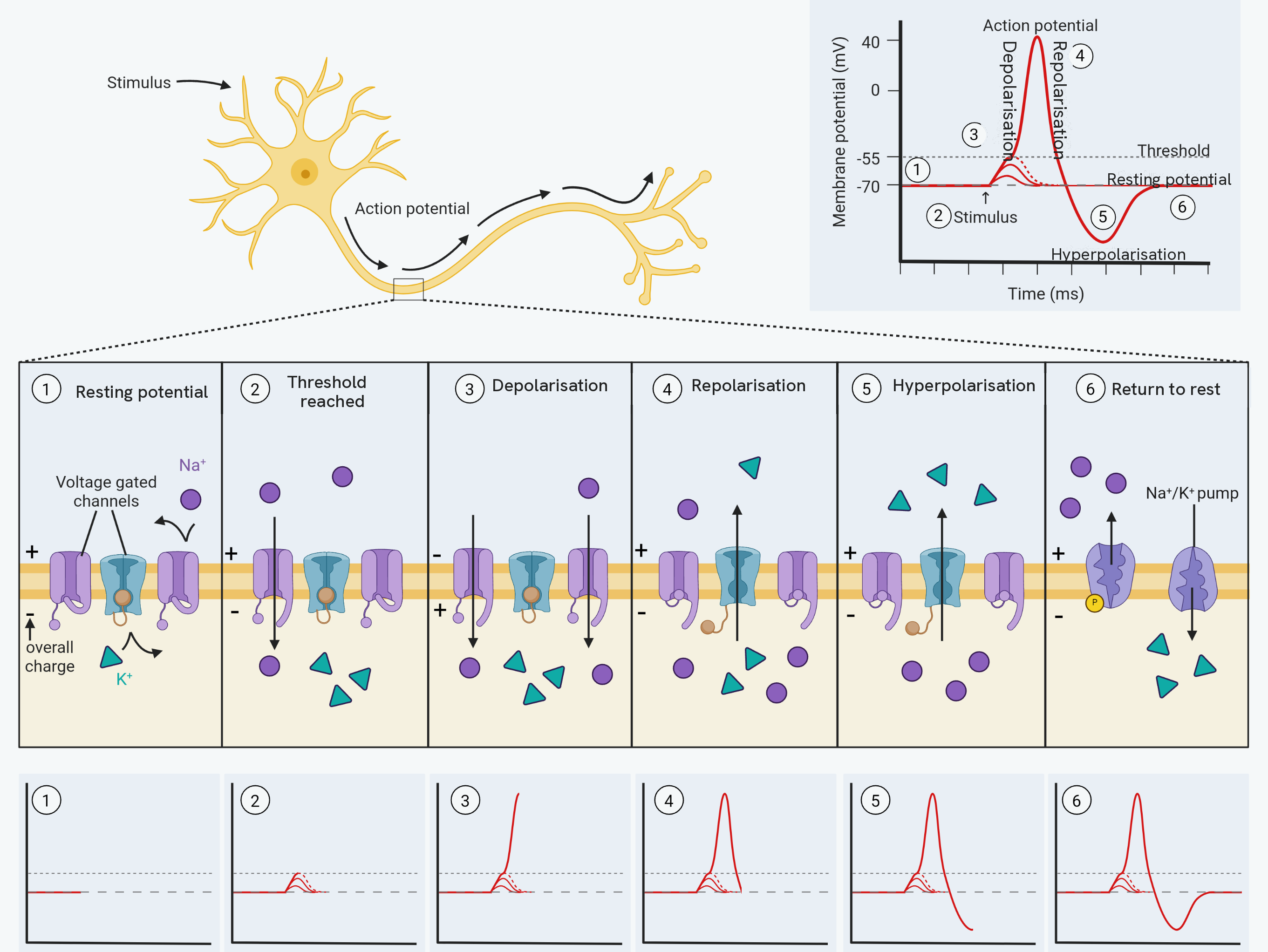
Read the graph and the six panels together, because each panel is what the membrane is doing at that point on the curve.
The thing to get right is which ion is moving, and which way. On the rising limb, sodium ions flood in, so the inside becomes positive: that is depolarisation. On the falling limb, potassium ions move out, so the inside becomes negative again: that is repolarisation. The channels drawn in each panel are the reason the curve has the shape it has.
Notice the dip below the resting potential at the end. That is hyperpolarisation, caused by potassium channels being slow to close, and it is not the same thing as the refractory period, which is the stretch of time during which no new action potential can be fired. One is a voltage, the other is an interval, and questions do ask for them separately.
The refractory period
After an action potential, there is a short time during which the ion channels are recovering and no new action potential can be generated. This is the refractory period, and it is important for three reasons.
- It makes impulses discrete, arriving as separate events that do not overlap or merge.
- It limits the frequency of impulses, so there is an upper limit to how often a neurone can fire.
- It makes impulses one-way (unidirectional), because the region an impulse has just passed through is refractory and cannot be re-excited, so the impulse can only move forwards.
The all-or-nothing principle
An action potential either happens fully or not at all. As long as the stimulus is strong enough to reach threshold, the action potential produced is always the same size, regardless of how strong the stimulus was. A stronger stimulus does not make a bigger impulse; instead it produces action potentials at a higher frequency. This is how the nervous system codes for the intensity of a stimulus.
What affects the speed of conduction
Three factors change how quickly an impulse travels along a neurone.
- Myelination. In a myelinated neurone the myelin sheath insulates most of the axon, so depolarisation can only happen at the gaps between sections of myelin, the nodes of Ranvier. The impulse effectively jumps from node to node, which is called saltatory conduction and is much faster than depolarising the whole length of the membrane, as happens in an unmyelinated neurone.
- Axon diameter. A wider axon conducts faster, because there is less leakage of ions and less resistance to their flow.
- Temperature. A higher temperature speeds conduction, because ions have more kinetic energy and diffuse faster, and because respiration provides ATP more quickly for the sodium-potassium pump. Above a certain temperature, though, the membrane proteins denature and conduction fails.
In an unmyelinated axon the impulse moves as a continuous wave of depolarisation: sodium ions entering at one point raise the permeability of the next region, opening its voltage-gated sodium channels so that it depolarises in turn, and so on along the axon. This is why damage to the myelin sheath, as in some diseases, slows impulses down and makes actions such as muscle contraction slower.
How this fits together
An action potential is the same event repeated over and over along an axon, driven entirely by the controlled movement of sodium and potassium ions. But a neurone does not connect directly to the next cell. Where two neurones meet, the signal has to cross a tiny gap, and how it does that is the subject of the synaptic transmission guide.