AQA A-Level Biology: The Nervous System and Neurones
A clear revision guide to the nervous system for AQA A-Level Biology: the CNS and peripheral nervous system, the autonomic system, the three types of neurone, the myelin sheath, and the reflex arc.
The nervous system carries signals quickly around the body, from the receptors that detect a stimulus to the effectors that respond. This guide sets out how the system is organised, the three types of neurone that make it up, and how they are wired together into a reflex arc, the simplest complete nervous pathway. It gives you the map you need before looking at how the signals themselves are made and passed on.
How the nervous system is organised
The nervous system is divided into two parts.
- The central nervous system (CNS) is the brain and spinal cord. It processes information and coordinates responses.
- The peripheral nervous system (PNS) is made of the neurones that connect the CNS to the rest of the body, carrying signals in and out.
The peripheral nervous system is itself divided by the kind of action it controls.
- The somatic nervous system controls voluntary, conscious actions, such as running.
- The autonomic nervous system controls involuntary, unconscious actions, such as digestion.
The autonomic system has two opposing branches that balance each other:
- The sympathetic system is the fight or flight system, preparing the body for action, for example by speeding up the heart.
- The parasympathetic system is the rest and digest system, calming the body down.
The three types of neurone
A neurone is a single nerve cell, while a nerve is a bundle of the axons of many neurones. There are three types, defined by what they connect.
| Neurone | Carries impulses | Where |
|---|---|---|
| Sensory | From a receptor to the CNS | Peripheral nervous system |
| Relay (intermediate) | Between neurones, coordinating the response | Within the CNS |
| Motor | From the CNS to an effector | Peripheral nervous system |
Many neurones are covered by a myelin sheath, a fatty layer around the axon. It protects the axon, insulates it electrically, stops ions leaking across the membrane, and greatly speeds up the transmission of impulses.
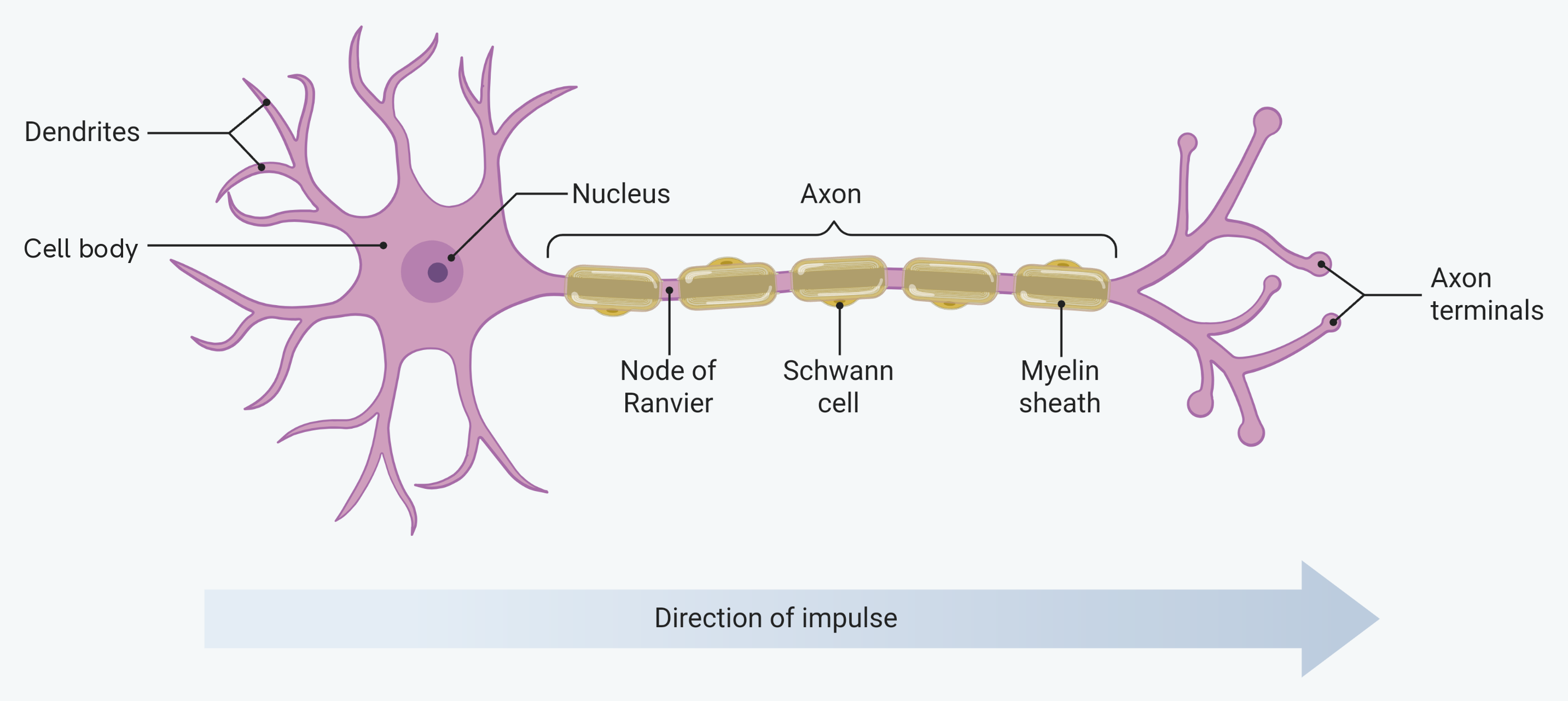
The part to look at is the myelin sheath and the gaps in it. Each section of myelin is a Schwann cell wrapped around the axon, and the small gap between one section and the next is a node of Ranvier. The membrane is only exposed at those gaps, so those are the only places where depolarisation can happen.
Notice the arrow underneath. The impulse travels one way, from the dendrites, through the cell body, along the axon to the axon terminals. That direction is set by the structure itself, and it is why a motor neurone has its cell body at the start and a sensory neurone does not.
The reflex arc
A reflex arc is the pathway a signal follows in a simple reflex. It links the three types of neurone into the shortest possible route from stimulus to response:
stimulus → receptor → sensory neurone → CNS (relay neurone) → motor neurone → effector → response
This arrangement is what makes a reflex so useful.
- It is rapid because the pathway is short, with only about three neurones and few synapses, and synapses are the slow step in transmission.
- It is automatic, not passing through the conscious brain, so the response does not have to be learnt or decided on.
- This protects the body from harm, for example letting an animal escape a predator or pulling away from something that would damage its tissues, before conscious thought could act.
Because there are only a few synapses to cross, and each synapse takes time, keeping their number low is exactly why the reflex is fast.
How this fits together
This is the wiring diagram of the nervous system: a hierarchy of central and peripheral parts, three kinds of neurone, and the reflex arc that connects them. What travels along these neurones is an electrical signal called an action potential, and how that signal is generated and conducted is explained in the nerve impulses guide.