AQA A-Level Biology: Synaptic Transmission
A clear revision guide to synaptic transmission for AQA A-Level Biology: the cholinergic synapse, the neuromuscular junction, summation, inhibitory synapses, and how drugs affect synapses.
Where one neurone meets another, or meets a muscle, there is a tiny gap called a synapse. The electrical impulse cannot cross it, so the signal is carried across by a chemical instead. This guide explains how that chemical transmission works at a cholinergic synapse, why it only goes one way, how synapses add signals together, and how they can also switch a signal off. Understanding the sequence of events at one synapse explains all the rest.
The cholinergic synapse
A cholinergic synapse uses the neurotransmitter acetylcholine. When an action potential arrives at the end of the presynaptic neurone, the following sequence carries the signal across the gap.
- The action potential causes calcium ion channels to open, and calcium ions diffuse into the presynaptic neurone.
- This makes vesicles of acetylcholine move to and fuse with the presynaptic membrane, releasing acetylcholine into the synaptic cleft by exocytosis.
- Acetylcholine diffuses across the cleft and binds to specific receptors on the postsynaptic membrane.
- This opens sodium ion channels, so sodium ions diffuse into the postsynaptic neurone and depolarise it. If enough enters, an action potential is triggered in the postsynaptic neurone. This is an excitatory synapse.
- The acetylcholine is then broken down by the enzyme acetylcholinesterase, so it stops stimulating the postsynaptic membrane and the response does not continue uncontrolled. The products are reabsorbed by the presynaptic neurone and used to make more acetylcholine.
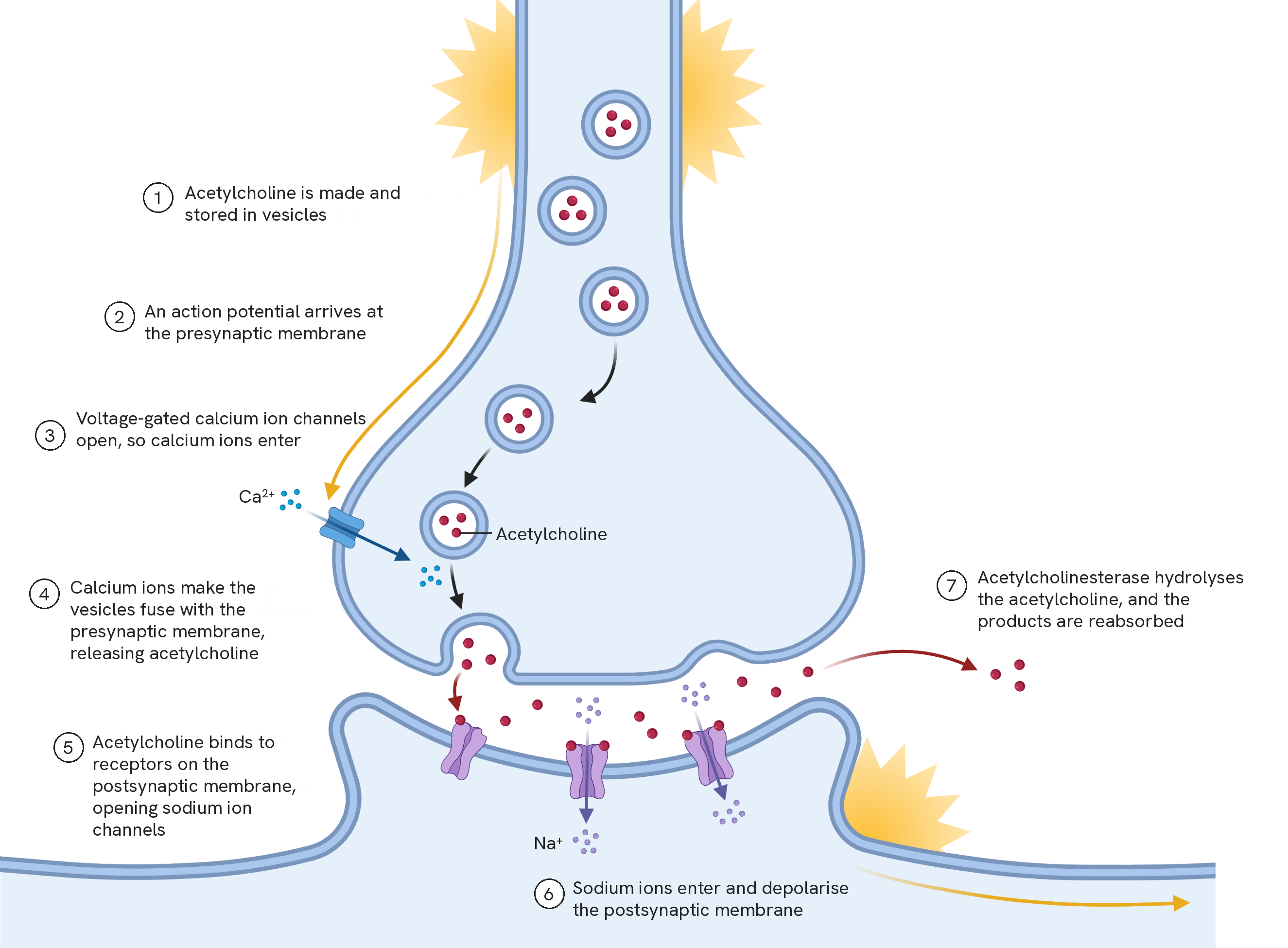
Follow the numbers and you have the sequence a six mark question wants, in order. Two things in it are the ones most often dropped.
Step three is where the calcium ions come in. The action potential does not cross the cleft and does not itself release anything; it opens voltage-gated calcium ion channels, and it is the calcium ions entering that make the vesicles move and fuse. An answer that jumps from the action potential straight to acetylcholine being released has missed the mark in between.
Step seven is not optional. Without acetylcholinesterase hydrolysing the acetylcholine, it would stay bound to the receptors and keep the postsynaptic neurone firing. Say that the products are reabsorbed by the presynaptic neurone and used to make more acetylcholine, and you have the rest of that mark.
Why synapses are one-way
Transmission across a synapse can only go in one direction, and this is because of where the two key molecules are found. Acetylcholine is only made in and released from the presynaptic neurone, and the receptors for it are only on the postsynaptic membrane. So the signal can only ever pass from presynaptic to postsynaptic, which ensures impulses travel in the correct direction through the nervous system.
The neuromuscular junction
A neuromuscular junction is a synapse between a motor neurone and a muscle. It works in the same way as a cholinergic synapse, but with some differences that suit its job of making a muscle contract.
| Feature | Cholinergic synapse | Neuromuscular junction |
|---|---|---|
| Connects | Neurone to neurone | Neurone to muscle |
| Effect | Can be excitatory or inhibitory | Always excitatory |
| Receptors | Fewer | More receptors on the postsynaptic membrane |
| Membrane | Smooth | Folded into clefts that store the breakdown enzyme |
Because acetylcholine at a neuromuscular junction is always excitatory, it always tends to trigger a response in the muscle.
Summation
A single impulse often releases too little neurotransmitter to reach the threshold in the postsynaptic neurone. Summation is the adding together of several signals so that threshold is reached and an action potential fires. There are two kinds.
- Spatial summation: several different presynaptic neurones release neurotransmitter onto the same postsynaptic neurone at the same time, and together they release enough to reach threshold.
- Temporal summation: a single presynaptic neurone releases neurotransmitter repeatedly in quick succession, and the amounts build up until threshold is reached.
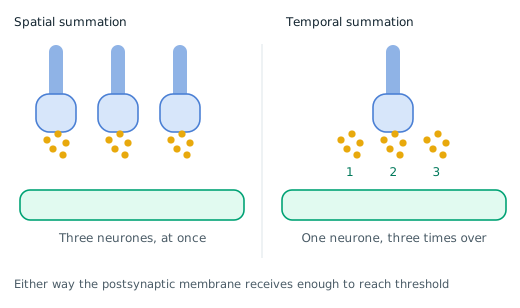
The two sides finish in the same place. The same amount of neurotransmitter reaches the postsynaptic membrane, and in both cases that is enough to reach threshold. What differs is only where it came from.
Count the terminals and you have the answer to which is which. Three terminals, releasing together, is spatial: different neurones, in different places. One terminal, releasing three times over, is temporal: the same neurone, at different times. The names are doing exactly what they say, space against time, and the commonest mistake is simply swapping them.
Summation matters because it lets low-frequency signals, which alone would be too weak, combine to produce a response.
Inhibitory synapses
Not all synapses make the next neurone more likely to fire. Inhibitory neurotransmitters make the postsynaptic membrane less likely to reach threshold, by hyperpolarising it.
They do this by opening potassium channels, so potassium ions diffuse out, and chloride channels, so chloride ions diffuse in. Both make the inside of the postsynaptic neurone more negative, so it is further from threshold. This means a much larger flow of sodium ions would be needed to depolarise it, so an action potential is much less likely to form. Acetylcholine itself acts as an inhibitory neurotransmitter at cholinergic synapses in the heart.
How drugs affect synapses
Because synapses are the control points of the nervous system, drugs that act on them can turn the system up or down.
- Some drugs stimulate the nervous system, causing more action potentials. They might have a similar shape to the neurotransmitter and bind its receptors, trigger more neurotransmitter release, or inhibit the enzyme that breaks the neurotransmitter down so it keeps stimulating the membrane.
- Some drugs inhibit the nervous system, causing fewer action potentials. They might block the release of neurotransmitter, for example by preventing calcium channels opening, or block the receptors so the neurotransmitter cannot bind.
How this fits together
The synapse is where the nervous system does its real processing: signals are passed on, added together, blocked, or redirected, all through the controlled release of a chemical. At the neuromuscular junction, the end result is always the same, the stimulation of a muscle, and how that muscle then contracts is explained in the muscles and contraction guide.