AQA A-Level Biology: Temperature Regulation
A clear revision guide to temperature regulation for AQA A-Level Biology: why core temperature matters, ectotherms and endotherms, the responses to heat and cold, and measuring metabolic rate.
Keeping the body at a steady temperature keeps its enzymes working at their best. This guide explains why a stable core temperature matters, the two broad strategies animals use to manage temperature, and the specific responses the body makes when it gets too hot or too cold. It is another clear example of homeostatic negative feedback, this time coordinated by the hypothalamus.
Why core temperature matters
The body holds its core temperature within narrow limits because its enzymes have an optimum temperature.
- If it is too low, molecules have too little kinetic energy, so there are fewer successful collisions and fewer enzyme-substrate complexes form, slowing reactions down.
- If it is too high, enzymes denature: the hydrogen bonds holding their tertiary structure break, the active site changes shape and is no longer complementary to the substrate, so reactions slow or stop.
The same reasoning applies to blood pH, which is also kept stable so that enzymes stay at their optimum, since extremes of pH break the ionic bonds in an enzyme's tertiary structure and denature it too.
Ectotherms and endotherms
Animals manage their temperature in one of two ways.
- Ectotherms, such as reptiles, have a body temperature that changes with their surroundings. They cannot raise their temperature using their own metabolism, so they rely mainly on behaviour, such as basking in the sun to warm up or moving into shade to cool down.
- Endotherms, such as mammals, maintain a stable body temperature independently of the surroundings, using physiological responses as well as behaviour.
Detecting and correcting temperature change
In endotherms, changes in temperature are detected by the hypothalamus in the brain, which coordinates the response. The skin's arterioles widen or narrow as part of that response. As always with negative feedback, the response opposes the change: if the body is too hot it loses heat, and if it is too cold it conserves or generates heat.
If the body is too hot
- Sweating increases. Sweat spreads over the skin and evaporates, taking heat energy from the body with it. Furred mammals may pant instead.
- Hairs lie flat. The erector muscles relax, so hairs lie flat and no longer trap an insulating layer of warm air.
- Vasodilation. The arterioles leading to the skin capillaries widen, so more warm blood flows near the surface and more heat is radiated away.
- Metabolic rate falls, and there is no shivering, so less heat is generated internally.
- Behaviour: the animal seeks shade or shelter.
If the body is too cold
- Sweating decreases, reducing heat lost by evaporation.
- Hairs stand up. The erector muscles contract, raising the hairs to trap a layer of warm air as insulation.
- Vasoconstriction. The arterioles leading to the skin capillaries narrow, so blood is diverted away from the surface and less heat is radiated away.
- Metabolic rate rises, and the skeletal muscles shiver: their rapid involuntary contractions require respiration, and the heat released as a by-product warms the body.
- Behaviour: the animal shelters, huddles, or basks in the sun.
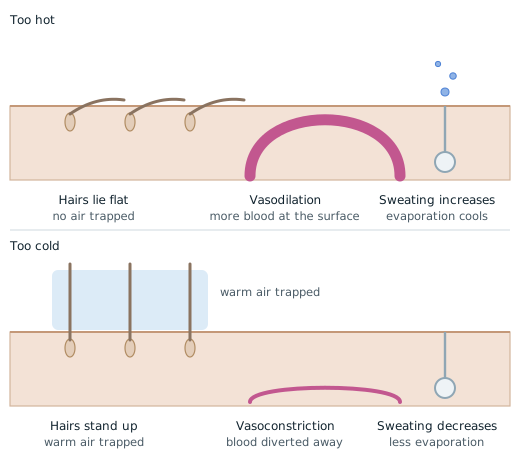
The two panels show the same three structures, and the figure is worth reading structure by structure rather than panel by panel. Nothing new appears when the body gets cold; the hairs, the arteriole and the gland each simply do the opposite thing.
The arteriole is the one most often described wrongly. Compare the two panels and the vessel has changed width, not moved. Capillaries have no muscle in their walls and cannot dilate or constrict; it is the arteriole supplying them that widens or narrows, and saying that the capillaries move closer to the surface loses the mark.
The pale layer in the cold panel is the point of raised hairs. The hairs themselves insulate nothing. What insulates is the still air they hold against the skin, and a layer of trapped air is a poor conductor of heat.
Measuring metabolic rate
Because heat is a by-product of respiration, the body's heat production is linked to its metabolic rate, the rate at which it uses energy. Metabolic rate can be estimated by measuring how fast an organism uses oxygen or releases carbon dioxide, using a respirometer or oxygen and carbon dioxide probes, or by measuring the heat it releases directly using calorimetry.
How this fits together
Temperature regulation completes the picture of homeostasis: the hypothalamus detects a change in core temperature and triggers effectors in the skin, muscles and glands that oppose it, holding conditions steady by negative feedback. This is the same logic that controls heart rate, blood glucose and water balance, and together these systems keep the internal environment stable enough for the body's enzymes, and so its cells, to work.