AQA A-Level Biology: Survival and Response
A clear revision guide to survival and response for AQA A-Level Biology: stimuli and receptors, taxes and kineses, tropisms, the role of IAA in phototropism and gravitropism, and simple reflexes.
Organisms that respond to their surroundings survive better than those that do not. This guide explains the basic pathway from stimulus to response, the simple movements of animals and plants that keep them in favourable conditions, and how a plant hormone called IAA bends shoots towards light and roots towards gravity. The thread running through it all is that every response, however simple, increases an organism's chance of survival.
Stimulus and response
A stimulus is a detectable change in the internal or external environment that leads to a response. Detecting and responding to stimuli helps an organism stay in conditions that suit it, which increases its chance of survival and of passing on its genes.
The response follows a set pathway:
- A receptor detects the stimulus. Each receptor is specific to one type of stimulus.
- A coordinator, such as the nervous system or the hormonal system, works out a suitable response.
- An effector, such as a muscle or a gland, brings the response about.
Taxes and kineses
Simple mobile organisms respond to stimuli with two kinds of movement, and the difference is whether the movement has a direction.
A taxis is a directional response: the organism moves its whole body towards a favourable stimulus (a positive taxis) or away from an unfavourable one (a negative taxis). Woodlice, for example, move away from light. This keeps them concealed under stones during the day, away from predators and in damp conditions that reduce water loss, all of which improve survival.
A kinesis is a non-directional response: the organism changes its speed of movement or how often it changes direction, in response to a stimulus that has no clear direction. Woodlice move faster and turn more often when the air is dry. This makes them more likely to move into an area of higher humidity, where they lose less water. Once they reach favourable, damp conditions they slow down and turn less, so they tend to stay there.
Tropisms in plants
Plants cannot move around, so they respond to directional stimuli by growing. A tropism is a growth response to a directional stimulus, and it is positive if the plant grows towards the stimulus and negative if it grows away.
A taxis and a tropism are alike in that both are directional responses to a stimulus. The difference is that a taxis involves the whole organism moving, while a tropism is a growth response.
The two stimuli you need are light and gravity, and plants respond to them using growth factors, hormone-like substances made in the growing regions such as shoot tips and leaves. These move to other tissues, where they control growth.
The main growth factor is IAA, a type of auxin. It is made in the tips of roots and shoots and moves to other cells by diffusion and active transport over short distances, and through the phloem over long distances. Crucially, IAA has opposite effects in the two organs:
- In shoots, IAA promotes cell elongation.
- In roots, IAA inhibits cell elongation.
How IAA causes phototropism and gravitropism
The same molecule, moving to one side of the tip, bends a shoot towards light and a root towards gravity, because it lengthens cells in a shoot but not in a root.
Phototropism in shoots. Cells in the shoot tip make IAA, which is transported down the shoot, evenly at first. When light comes from one side, IAA moves to the shaded side, so its concentration there rises. Because IAA promotes elongation in shoots, the cells on the shaded side grow longer than those on the lit side, and the shoot bends towards the light. This matters because light is needed for the light-dependent reaction of photosynthesis.
Gravitropism in roots. Cells in the root tip make IAA, which again spreads down the root. Gravity causes IAA to gather on the lower side of the root. Because IAA inhibits elongation in roots, the cells on the lower side grow less than those on top, and the root curves downwards, in the direction of gravity. This anchors the plant firmly in the soil and helps it reach water.
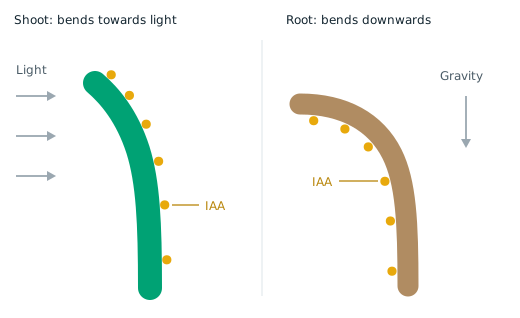
Both drawings show the same thing happening: IAA collecting along one side of the organ. Everything that differs comes afterwards, from what IAA then does to the cells it has collected in.
The quickest way to read the figure is to ask which side of the bend the dots are on.
- In the shoot they are on the outside of the bend. IAA promotes elongation there, those cells grow longer than the ones opposite, and a longer side on the outside of a curve is exactly what bending towards the light looks like.
- In the root they are on the inside of the bend. IAA inhibits elongation there, so those cells grow less than the ones on top, and the shorter side ends up on the inside of the curve, bending the root downwards.
That difference, outside against inside, is the whole of it. The commonest wrong answer says the root bends because IAA makes cells on the lower side grow, which would bend it upwards. In a root IAA does the opposite of what it does in a shoot, and saying so is the mark.
Simple reflexes
A simple reflex is a rapid, automatic response to a stimulus that protects the body without conscious thought. Reflexes are useful precisely because they are fast and do not have to be learnt.
- They are rapid because the pathway is short: it involves only about three neurones and few synapses, and synapses are the slow step in nervous transmission.
- They are automatic, not passing through the conscious parts of the brain, so no decision or learning is needed.
- This speed protects the body from harm, for example by pulling a hand away from a hot surface or letting an animal escape a predator before tissue is damaged.
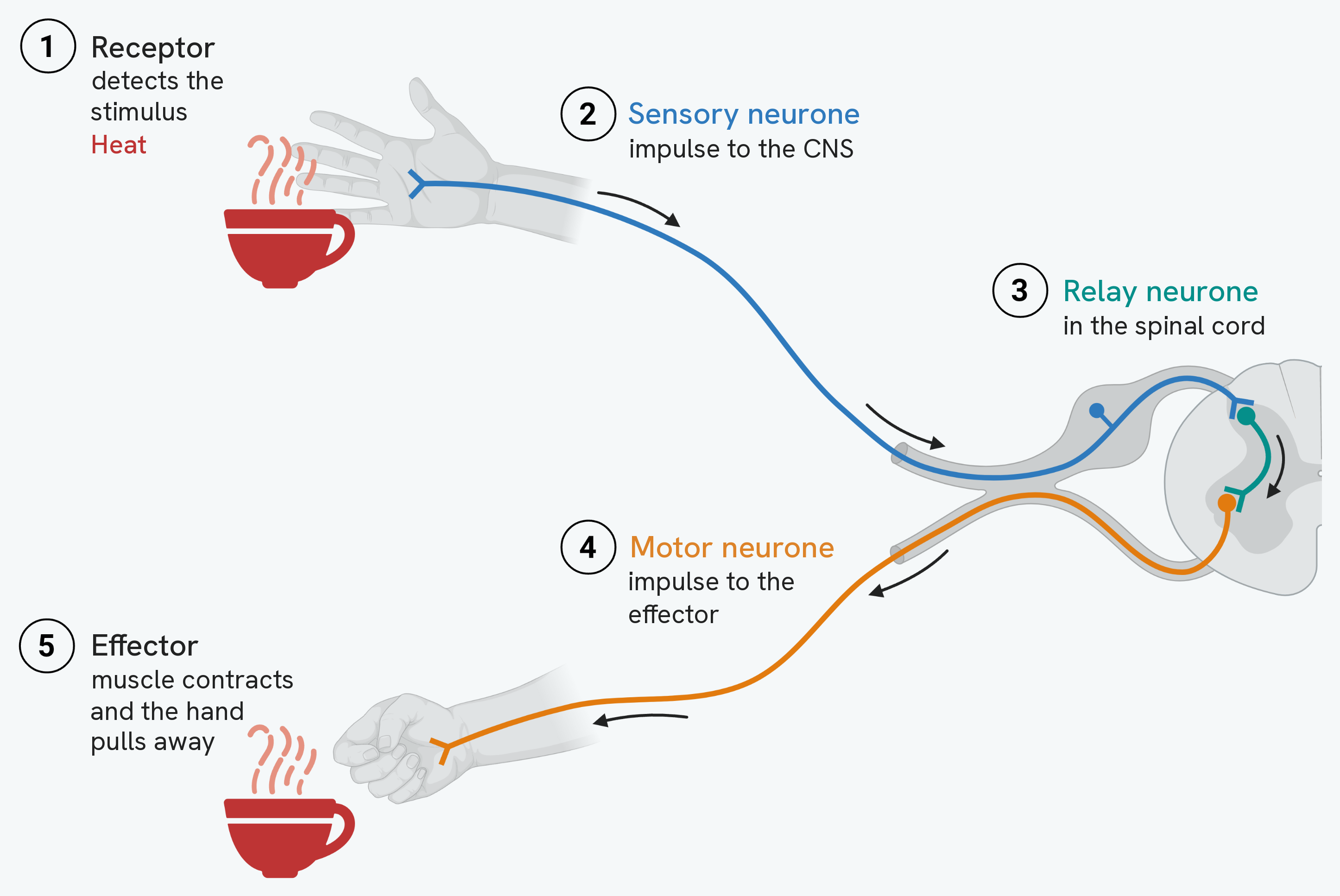
Count the neurones on that figure, because the number is the reason a reflex is fast. There are three, and therefore only two synapses between the stimulus and the response. Synapses are the slow step in nervous transmission, so a pathway with two of them is about as quick as a nervous response can be.
Follow the colours and notice where the pathway does not go. The teal relay neurone sits inside the spinal cord, and nothing on the diagram continues up to the brain. That is what "without conscious thought" means in practice: the decision is made at the level of the cord, and you become aware of the heat after your hand has already moved.
How this fits together
Everything here is about staying in the right place and out of danger. Simple animals move by taxes and kineses, plants grow by tropisms, and both bring the organism into favourable conditions. Detecting the stimulus in the first place is the job of specialised receptors, which is where the receptors guide picks up the story.